MQL5 Alternatives: 7 Platforms for Trading Strategies, Bots, and Signals

Last Updated: November 2026
Searching for an MQL5 alternative is harder than it sounds because MQL5 is not one product.
The ecosystem combines several different functions.
MetaTrader Market sells Expert Advisors, indicators, and other applications for MetaTrader. MQL5 Signals operates separately as a copy-trading service where users subscribe to providers and automatically copy their trades.
A trader looking to replace MQL5 Market therefore has a different problem from someone trying to replace MQL5 Signals.
Likewise, an algorithm creator looking for another place to sell bots has different requirements from a trader who wants to buy access to a strategy without receiving source code.

That leads to the most important point in this comparison:
There is no single MQL5 alternative because MQL5 itself combines several different products.
The right replacement depends on which part of the ecosystem you actually use.
Quick Answer
The best MQL5 alternative depends on which part of MQL5 you want to replace. cTrader Store is one of the closest alternatives for buying and selling executable trading bots. TradingView focuses on paid Pine Script indicators and strategies. Collective2 is closer to MQL5 Signals because users subscribe to trading systems and can automate them through compatible brokers. Darwinex focuses on investable trader strategies. NinjaTrader has a large third-party ecosystem for automated strategies and trading tools. Tradetron combines no-code strategy creation, deployment, and a strategy marketplace. Algorier takes a different approach by treating the trading strategy itself as the marketplace product, with private or open logic, standardized backtests, optional Forward Test evidence, and buyer-controlled deployment.
MQL5 Alternatives at a Glance
Platform | Main Product Model | Best Fit |
|---|---|---|
Algorier | Strategy marketplace | Buying or selling strategy access with private/open logic |
cTrader Store | cBots, indicators, plugins, copy strategies | Closest alternative to an EA marketplace |
TradingView | Paid Pine Script indicators and strategies | Chart-based tools and recurring script access |
Collective2 | Trading-system subscriptions | Automated strategy following |
Darwinex | Investable DARWIN strategies | Strategy investing with standardized risk |
NinjaTrader Ecosystem | Third-party strategies and tools | Futures-focused automation and add-ons |
Tradetron | No-code strategies and marketplace | Building, testing, deploying, or subscribing to strategies |
This is not a ranking from best to worst.
Each platform replaces a different part of the MQL5 workflow.
What Exactly Are You Trying to Replace in MQL5?
Before comparing platforms, identify the feature you actually depend on.
MQL5 Market
MetaTrader Market is primarily a store for applications built for MetaTrader, including Expert Advisors and indicators. Buyers can obtain free or paid products and test compatible applications in MetaTrader's Strategy Tester.
If this is what you use MQL5 for, your strongest alternatives are platforms that distribute executable algorithms or trading tools.
MQL5 Signals
Signals is a different model.
A provider connects a trading account, MQL5 monitors its trades and statistics, and subscribers can pay to copy those transactions into their own MetaTrader accounts.
If this is your main use case, you should compare copy-trading or strategy-subscription platforms, not EA stores.
Strategy Development and Deployment
Some traders mainly use the MetaTrader ecosystem because they want to develop, test, and deploy automated strategies.
For them, the strongest alternative may be a strategy-building platform rather than another marketplace.
Creator Monetization
Creators face a separate question.
Do you want to sell:
a downloadable bot?
subscription access to signals?
a strategy that buyers can deploy?
a private algorithm without exposing the underlying logic?
scripts or indicators?
Those are different products.
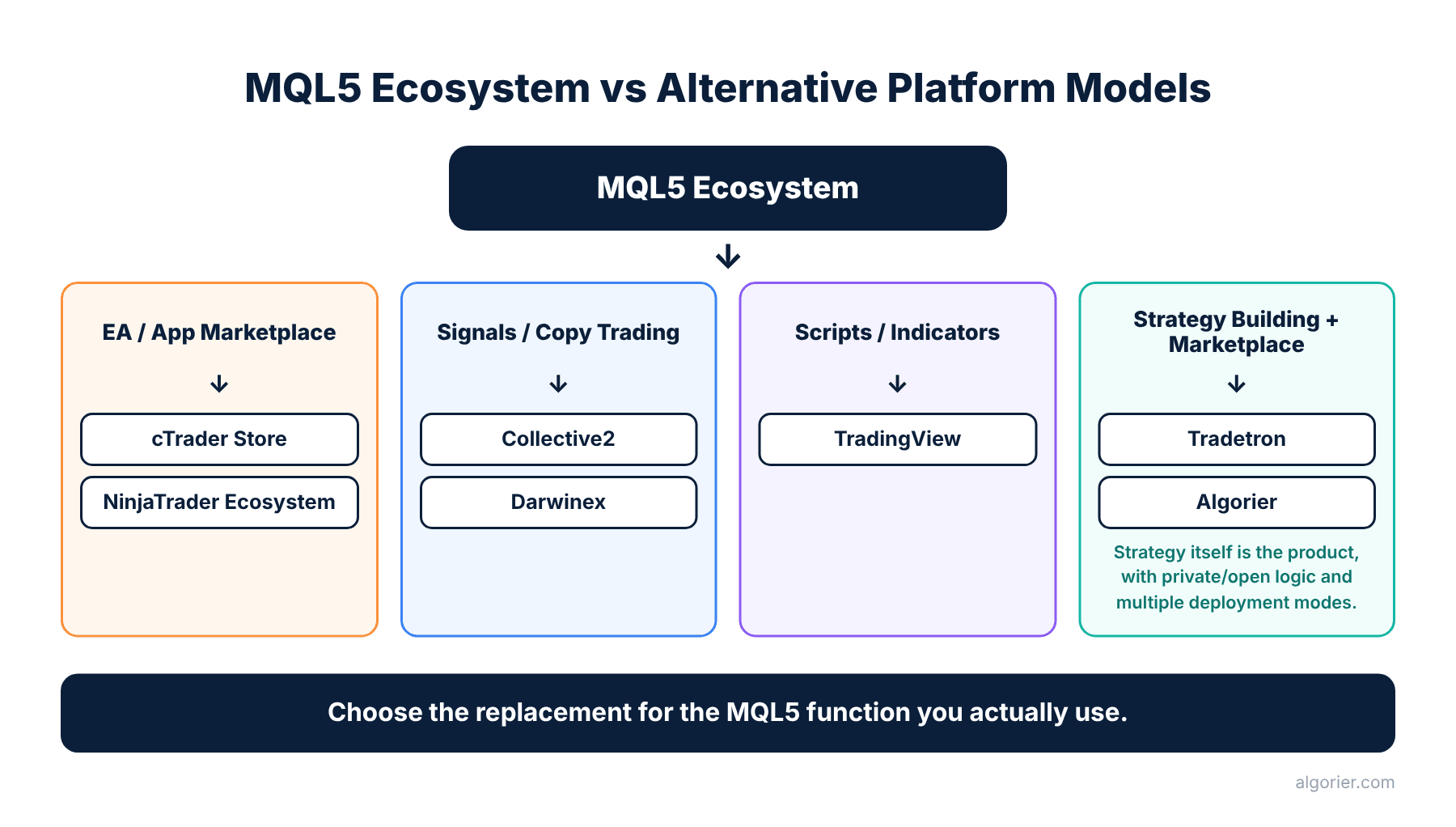
Choose the replacement for the MQL5 feature you actually use.
1. Algorier
Best for: Buying or selling trading strategies rather than downloadable EA files
Algorier approaches the marketplace differently from a traditional Expert Advisor store.
According to the Algorier Platform Whitepaper v1.1, creators publish algorithms on AlgoNetwork and control whether the underlying logic is private or visible and whether Forward Test is enabled. Buyers purchase strategies at creator-set prices and apply them using their own risk settings.
Buyers can also choose among:
live automated execution
signal-only alerts
live execution plus signals
For open-logic listings, buyers can read the rules, fork the strategy into AlgoBuild, modify it, and run their own version.
How It Differs From MQL5
The main distinction is the commercial object.
MQL5 Market is centered on downloadable applications such as Expert Advisors and indicators.
AlgoNetwork is centered on the strategy itself.
That means the creator can keep the logic private while buyers receive strategy outputs, or make the logic open where learning and customization are part of the product.
Algorier is closer to a marketplace for trading intelligence than a downloadable EA store.
Who It Fits
Algorier is a stronger fit if you want:
strategy-level marketplace access
private or open trading logic
standardized backtest evidence
optional live out-of-sample Forward Test evidence
buyer-controlled risk settings
both automated and signal-only deployment
It is less directly comparable if your primary requirement is simply downloading an MQL Expert Advisor and running it inside MetaTrader.
2. cTrader Store
Best for: Traders looking for a direct alternative to the MQL5 EA marketplace
If what you like about MQL5 is buying and selling executable trading software, cTrader Store is one of the closest alternatives.
cTrader Store currently distributes:
cBots
indicators
plugins
copy strategies
cBots can run locally or in cTrader Cloud, depending on the application and platform.

That makes the model structurally closer to MQL5 Market than many strategy-subscription services.
Source-Code Protection
cTrader also makes creator IP protection explicit.
Its documentation states that source code is not made available to buyers and is not uploaded to cTrader Store or Cloud. Algorithms are distributed using protected .algo files.
Buyers can access the purchased product, but not the underlying source code.
For creators coming from MQL5, that makes cTrader Store a particularly relevant comparison because the product remains executable software rather than becoming purely a signal subscription.
Who It Fits
cTrader Store is a strong alternative if you want:
executable trading bots
indicators and plugins
protected creator source code
cloud bot execution
a marketplace tied directly to a trading platform
If your primary goal is buying a trading strategy as an evidence-backed marketplace asset, rather than buying an executable bot file, other alternatives may fit better.
The next alternatives move further away from the EA-store model and into paid Pine scripts, strategy subscriptions, risk-normalized strategy investing, futures-focused ecosystems, and no-code automation.
3. TradingView
Best for: Paid Pine Script indicators and strategies
TradingView is relevant when the part of MQL5 you want to replace is not primarily downloadable Expert Advisors, but paid trading logic used directly on charts.
TradingView's Creator Program now allows approved Pine Script authors to monetize invite-only indicators and strategies through Paid Spaces. Each Paid Space can bundle multiple scripts behind a recurring subscription, with TradingView handling payment and subscriber access.
The important distinction is the product format.

A TradingView buyer generally subscribes to access Pine Script tools within the TradingView environment.
That is different from buying an EA file designed to run inside MetaTrader.
Closed-Source Access
TradingView's invite-only scripts are closed source. Users can add them to charts when access is granted without seeing the underlying Pine Script code. Paid Space scripts use this access model for commercial subscriptions.
This can appeal to creators who want to monetize proprietary:
indicators
chart systems
scanners
strategy scripts
without publishing the code itself.
Commercial Scripts Are Moving On-Platform
This comparison has also changed recently.
TradingView announced that new commercial access to invite-only scripts is moving into its Marketplace model, with off-platform sales of new invite-only script access restricted from November 1, 2026, subject to its updated terms and transition arrangements.
That makes TradingView more directly relevant as a commercial strategy-tool marketplace than it was historically.
Who It Fits
TradingView is a stronger MQL5 alternative if you want:
Pine Script indicators or strategies
chart-centric trading tools
closed-source script access
recurring creator subscriptions
tools used directly inside TradingView
It is not a direct substitute if your core need is downloading an EA and running automated MetaTrader execution.
TradingView replaces the script-and-indicator side of MQL5 more directly than the traditional EA marketplace model.
4. Collective2
Best for: Strategy subscriptions and automated following
Collective2 is much closer to an alternative for MQL5 Signals than for MQL5 Market.
Users discover trading strategies, subscribe to them, and can use Collective2 AutoTrading to send the selected strategy's trades into a supported brokerage account. The trader's funds remain at the broker, and users can adjust their own trade sizing.

For creators, Collective2 provides a marketplace where strategy managers can publish systems, collect subscriptions, distribute signals, and make strategies available for automated following.
How It Differs From Buying an EA
With an MQL5 Expert Advisor, the buyer acquires software access.
With Collective2, the subscriber primarily follows the strategy's trade stream.
The creator does not need to hand over source code.
The platform handles signal distribution and supported broker automation.
That makes its commercial model closer to:
strategy subscription → trade signals → brokerage execution
than:
software purchase → install bot → run it yourself.
Collective2 also explicitly notes that actual AutoTrading results can differ from the strategy record because of execution prices, timing, sizing, fees, and related factors.
Who It Fits
Collective2 is worth considering if you want:
strategy subscriptions
automated following
broker-connected execution
creator signal monetization
strategy track records rather than downloadable source code
Collective2 is a stronger alternative to MQL5 Signals than to MQL5 Market.
5. Darwinex
Best for: Investing in trader strategies without receiving the underlying strategy
Darwinex is even further from the EA-store model.
It converts a trader's underlying strategy into an investable product called a DARWIN.
A DARWIN replicates the trader's strategy while Darwinex's Risk Engine controls the risk level applied to investor exposure. The underlying trade details are not revealed to investors, which Darwinex describes as a way to protect the trader's intellectual property.
That makes Darwinex relevant to someone who uses MQL5 for strategy discovery or following, but much less relevant to someone who wants to buy software.
Standardized Risk Changes the Product
The distinction is not only that the strategy remains private.

Darwinex applies its own risk-management layer so that the DARWIN's investor-facing exposure is not necessarily identical to the underlying trader's raw position sizing.
Creators can also earn performance-based compensation from investor capital allocated to their DARWINs.
Who It Fits
Darwinex is more appropriate if you want:
exposure to trader strategies
protected underlying trade logic
standardized risk treatment
an investment-style model rather than buying a bot
It is not a good replacement if your requirement is:
downloading an EA
obtaining source code
modifying a strategy
purchasing a conventional trading application
Darwinex replaces the strategy-investing side of the MQL5 ecosystem, not the EA-shopping side.
6. NinjaTrader Ecosystem
Best for: Futures-focused automated strategies, indicators, and platform extensions
NinjaTrader has a large third-party ecosystem of trading software and services.
Its current Ecosystem directory includes categories for:
Automated Strategies
Indicators
Programming Services
Utilities
trading education
other platform extensions
At the time of review, the directory listed 287 Automated Strategies and more than 800 indicators.
NinjaTrader itself also positions the Ecosystem as a way to extend the platform with custom indicators, signals, and strategies.
Why It Is Not Exactly Another MQL5 Market
The ecosystem consists heavily of independent third-party vendors.

That makes it broader and less standardized than a single marketplace where every strategy is presented under one common evidence and purchasing model.
Product terms, pricing, evidence, and support can vary by vendor.
Who It Fits
NinjaTrader is particularly relevant if you want:
futures-focused tools
automated strategies
indicators
third-party platform extensions
a large developer/vendor ecosystem
It is a stronger replacement for the trading-software ecosystem around MQL5 than for MQL5 Signals specifically.
7. Tradetron
Best for: No-code strategy building, automation, and marketplace access
Tradetron approaches the problem from the opposite direction of a downloadable EA store.
Its current platform combines:
no-code strategy building
historical backtesting
Live Offline testing
live broker execution
a creator strategy marketplace
Tradetron says marketplace creators can publish strategies that subscribers then deploy through their own broker accounts. Its current platform covers Indian markets, U.S. stocks, ETFs and options, and supported crypto exchanges.
Why It Matters for MQL5 Users
A trader leaving MQL5 because they do not want to write MQL code may care more about the workflow than about finding another programming ecosystem.

Tradetron lets that user move toward:
define strategy → backtest → test on live prices → deploy → publish or subscribe
without requiring conventional programming for the core strategy-building workflow.
Tradetron competes less with MQL5 as a programming language and more with the end-to-end algorithmic strategy workflow.
Its Live Offline mode is also worth distinguishing from funded live trading: the strategy runs on live prices and records entries, exits, and P&L without sending actual orders.
Who It Fits
Tradetron is a stronger option if you want:
no-code strategy creation
automated deployment
strategy subscriptions
creator marketplace access
live-price testing before actual execution
It is less suitable if your primary goal is buying downloadable MetaTrader-style applications.
What About QuantConnect?
QuantConnect belongs in this discussion, but labeling it a direct MQL5 Market alternative would be misleading.
Its strength is the research, development, backtesting, and deployment stack.
Users can build algorithms, backtest them, paper trade them, and deploy them through supported broker integrations. QuantConnect uses the LEAN engine across historical and live workflows.
It also has a Community Strategies section where users can inspect strategies, monitor out-of-sample performance, and clone shared algorithms into their own projects.
But that is different from a conventional commercial bot store.
So QuantConnect fits best when the requirement is:
"I want an alternative environment for building and deploying algorithms."
rather than:
"I want another marketplace where I can browse and buy EAs."
The remaining choice therefore depends on the use case. The next step is to map these platforms directly to specific MQL5 needs, compare MQL5 with Algorier more closely, and identify the situations where leaving MQL5 may not make sense at all.
Best MQL5 Alternative by Use Case
The strongest alternative depends on what you are actually replacing.
If You Want... | Strong Option to Evaluate |
|---|---|
A marketplace for strategy access rather than downloadable EAs | Algorier |
Executable bots similar to Expert Advisors | cTrader Store |
Paid Pine Script indicators and strategies | TradingView |
Strategy subscriptions and automated following | Collective2 |
Investable trader strategies with standardized risk | Darwinex |
Futures-focused automated tools | NinjaTrader Ecosystem |
No-code strategy building and automation | Tradetron |
A research and development environment for building your own algorithms | QuantConnect |
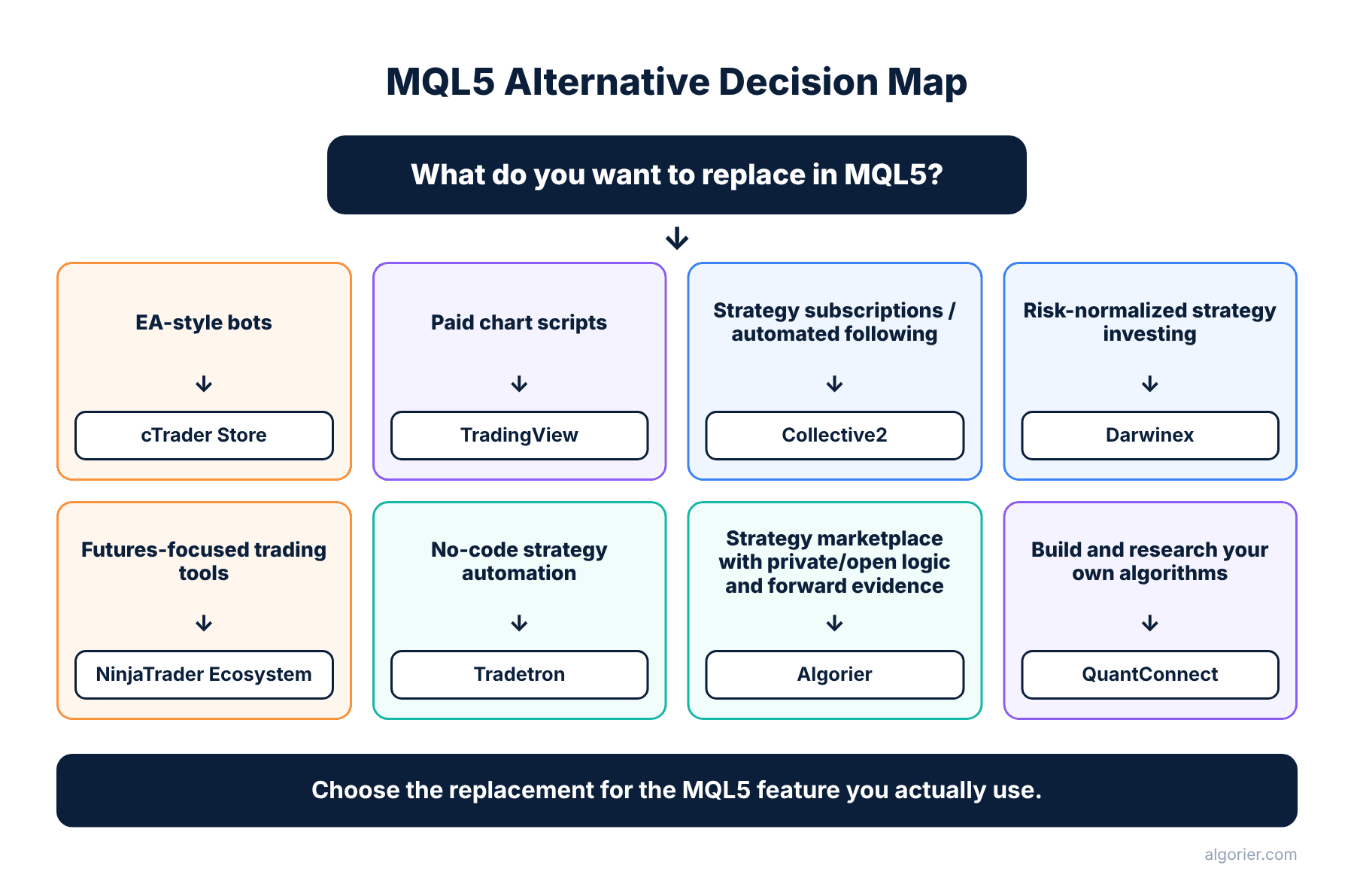
The point is not that one platform is universally superior.
The platforms solve different problems.
The best MQL5 alternative is the one that replaces the part of the MQL5 workflow you actually depend on.
MQL5 vs Algorier
Algorier is particularly relevant when the reason for leaving MQL5 is not MetaTrader itself, but the way trading strategies are packaged and distributed.
The two models approach algorithm marketplaces differently.
Feature | MQL5 | Algorier |
|---|---|---|
Primary marketplace product | MQL4/MQL5 trading applications | Trading strategies |
Executable automation | Expert Advisors | Strategy deployment |
Signal delivery | Separate MQL5 Signals service | Signal-only is a deployment option |
Logic model | Compiled product, source not transferred through Market | Creator chooses private or open logic |
Strategy evidence | Product-specific backtests, monitoring and Signals where applicable | Standardized backtest, optional Forward Test |
Buyer customization | EA input parameters depend on product | Buyer controls leverage, position size and drawdown cap |
Open strategy modification | Depends on product/source availability | Open-logic listings can be forked and adjusted |
Creator pricing | Seller prices Market product within platform rules | Creator sets strategy price |
MQL5 Market is fundamentally a marketplace for programs written in MQL4 or MQL5. Its current rules specify that Market products are distributed as compiled EX4 or EX5 files and that buying a product grants personal-use rights rather than ownership of the underlying product. (mql5.com)
MQL5 Signals then handles a separate use case: a provider's trading account is monitored and subscribers pay to receive and copy its trades. (mql5.com)
AlgoNetwork combines these concepts differently.
The strategy itself is the listing. The creator chooses whether its logic is private or visible and whether Forward Test is enabled.
After purchasing a strategy, buyers can use live execution, signal-only alerts, or both. Open-logic listings can also be read, forked into AlgoBuild, modified, and deployed as a separate version.
That makes Algorier a more relevant alternative when you want:
strategy-level evidence
private strategy monetization
optional visible logic
buyer-controlled deployment
signal and automated execution from the same strategy product
It is not necessarily the better choice if what you specifically want is an MQL Expert Advisor.
When MQL5 May Still Be the Better Choice
An alternatives article that pretends everyone should leave MQL5 would be useless.

MQL5 remains a strong fit when your workflow is already built around MetaTrader.
You Specifically Need MQL4 or MQL5 Products
MQL5 Market is designed specifically for programs written for MetaTrader.
If you need an EA, indicator, utility, or other MetaTrader-native application, using the native marketplace can be simpler than moving to another ecosystem. (mql5.com)
Your Broker and Workflow Already Depend on MetaTrader
Switching marketplaces can also mean switching:
trading platforms
deployment workflows
strategy formats
development languages
broker integrations
A feature advantage elsewhere may not justify the migration cost.
You Want Traditional EA Distribution
For creators who specifically want to package compiled MQL software and sell licenses for personal use, MQL5 Market already provides a defined distribution, activation, payment, and update framework. (mql5.com)
You Primarily Want Account-Based Copy Trading
MQL5 Signals provides monitored provider accounts, trading history, statistics, paid subscriptions, and automated copying directly inside the MetaTrader ecosystem. (mql5.com)
If that is exactly what you need, a strategy marketplace may solve a different problem rather than improve the same one.
Do not migrate platforms merely because an alternative has more features. Migrate when it solves your actual workflow better.
How to Evaluate an MQL5 Alternative
Before moving capital, purchasing a strategy, or publishing your own algorithm, compare platforms on the variables that actually affect usage.
1. What Are You Buying?
Determine whether the product is:
executable software
strategy access
trading signals
copy trading
an indicator
source or rule access
Do not treat those as interchangeable.
2. What Evidence Can You Inspect?
Look for:
backtests
trade history
live or forward records
drawdown
trading costs
track-record provenance
A marketplace containing thousands of products is not automatically useful if evidence is difficult to evaluate.
3. What Does the Buyer Control?
Check whether buyers can change:
position sizing
leverage
risk limits
strategy parameters
execution mode
Greater control is not always better, but the rights should be clear.
4. What Happens to the Strategy Logic?
Ask whether the buyer receives:
nothing beyond outputs
compiled software
readable rules
source code
modification rights
This matters to buyers and creators for different reasons.
5. How Does Execution Work?
Does the product require:
a desktop terminal
VPS hosting
cloud execution
broker API connection
manual signal execution
The best marketplace is useless if its deployment model does not fit your infrastructure.
6. What Is the Commercial Model?
Compare:
one-time purchase
subscription
copy-trading fees
performance-based compensation
marketplace commissions
Sticker prices across different models are not directly comparable.
7. Which Markets and Brokers Are Supported?
Platform quality matters less if your broker, asset class, or jurisdiction is unsupported.
Check current compatibility before purchasing.
Final Verdict
There is no universal best MQL5 alternative because MQL5 itself serves several different functions.
If your priority is buying executable trading bots, cTrader Store is one of the closest direct alternatives.
If you want commercial Pine Script tools, TradingView is more relevant.
If you mainly use MQL5 Signals, Collective2 and other strategy-following platforms deserve more attention than bot marketplaces.
If you want strategy investing without receiving the underlying implementation, Darwinex takes a different approach.
For futures-specific tools, NinjaTrader Ecosystem may fit better.
For no-code building and deployment, Tradetron is more relevant.
And if the goal is to buy or sell the trading strategy itself, with private or open logic, standardized historical evidence, optional Forward Test evidence, buyer-controlled risk, and multiple deployment modes, Algorier belongs in the comparison.
The wrong way to choose is to count features.
The better question is:
Which part of MQL5 am I actually trying to replace?
Frequently Asked Questions
What is the best alternative to MQL5?
There is no single best alternative. cTrader Store is particularly relevant for executable bots, TradingView for Pine scripts, Collective2 for strategy subscriptions, Tradetron for no-code automation, and Algorier for strategy-marketplace access.
What is the best alternative to MQL5 Market?
If you specifically want another marketplace for executable trading bots and tools, cTrader Store is one of the closest comparisons because it offers cBots, indicators, plugins, and copy strategies. (help.ctrader.com)
Is there an alternative to MQL5 Signals?
Yes. Collective2 and other strategy-following platforms offer models centered on strategy subscriptions or automated following. cTrader also includes copy strategies alongside its Store products. (help.ctrader.com)
Is cTrader better than MQL5 for trading bots?
Not universally.
cTrader uses cBots and its own ecosystem, while MQL5 Market is deeply integrated with MetaTrader and MQL Expert Advisors. The better choice depends on your broker, language, deployment requirements, and existing platform workflow.
Can I buy trading algorithms outside MQL5?
Yes. Platforms including cTrader Store, AlgoNetwork, NinjaTrader's third-party ecosystem, Tradetron, and others provide different forms of algorithm or strategy access.
What you receive varies substantially between platforms.
Where can I sell trading strategies besides MQL5?
The answer depends on what you want to sell. TradingView supports paid Pine Script access for approved creators, Collective2 focuses on strategy subscriptions, Tradetron has creator strategies, cTrader Store distributes trading products, and AlgoNetwork is designed around publishing strategies themselves.
Is TradingView an alternative to MQL5?
For some use cases.
TradingView is particularly relevant for charting, Pine Script indicators, strategies, and paid script subscriptions. It is not a direct replacement for every MetaTrader EA workflow. (tradingview.com)
Is QuantConnect an MQL5 alternative?
It can replace parts of the research, backtesting, coding, and deployment workflow.
It should not be treated as a direct replacement for MQL5 Market if your main objective is browsing commercial Expert Advisors.
What is the best MQL5 alternative for strategy creators?
It depends on the product.
Creators selling executable bots may prefer an application marketplace. Pine Script authors may prefer TradingView. Signal providers may prefer subscription platforms. Creators who want to productize the trading strategy itself, including private or open logic, should evaluate strategy-specific marketplaces such as AlgoNetwork.
References
MetaQuotes. “MetaTrader Market.”
MetaQuotes. “Rules of Using the Market Service.”
MetaQuotes. “Trading Signals.”
MetaQuotes. “Rules of Using the Signals Service.”
Spotware. “Introduction to cTrader Store.”
TradingView. “Can I Offer My Paid Pine Scripts Right on TradingView?”
Algorier. Algorier Platform Whitepaper, Version 1.1. September 2026. Product information concerning AlgoNetwork, Open Logic, Forward Test, strategy purchasing, risk settings, and deployment modes is based on the official Whitepaper.
Risk Disclaimer
Trading involves substantial risk and may result in partial or total loss of capital.
Marketplace availability, product features, pricing, broker support, creator programs, and platform terms can change. Verify current platform documentation before purchasing or deploying any trading system.
Backtests, signal histories, simulations, forward tests, copy-trading records, and prior live performance do not guarantee future results.
This comparison is provided for educational purposes and does not constitute investment, financial, or trading advice.
About the Author
Written by: Algorier Research Team
Last Updated: November 2026
The Algorier Research Team covers algorithmic trading, trading strategy development, backtesting, systematic risk, strategy evaluation, and trading automation.