How to Test an AI-Generated Trading Strategy

Last Updated: November 2026
AI can generate a trading strategy in seconds.
Testing whether that strategy deserves any trust takes considerably more work.
A model can propose indicators, entry conditions, exits, stop-loss rules, filters, and even generate executable strategy code. That makes strategy creation dramatically faster.
It also creates a new problem.
You may not know:
which rules came from your original idea
which assumptions the AI added
whether the code matches the written explanation
whether future information accidentally entered the test
how many variations were tried before the final strategy appeared
whether the attractive backtest is simply overfit to historical data
This is why an AI-generated strategy should not be treated as a discovery.
It should be treated as a hypothesis.
The first job is not to improve the strategy. It is to verify exactly what the AI created.
Only after the rules and implementation are understood should performance become the focus.
Quick Answer
To test an AI-generated trading strategy, first freeze the exact strategy version and document every rule before looking for ways to improve performance. Verify that the implementation matches the written logic and does not use future information, then run a baseline historical backtest using realistic execution assumptions. Inspect individual trades, evaluate the finalized strategy on untouched out-of-sample data, stress-test reasonable variations, and observe it through paper or Forward Testing before considering live deployment. Algorier can be used as part of this workflow: AlgoBuild converts plain-English trading rules into an algorithm and centrally backtests the generated strategy, while an optional Forward Test can provide additional out-of-sample evidence after development. Neither a backtest nor a Forward Test guarantees future profitability.
The key principle is simple:
AI makes strategy generation cheap. That makes validation more important, not less.
Why AI-Generated Strategies Need Careful Validation
The basic standards for evaluating an AI-generated strategy are the same standards that apply to any systematic strategy.
The difference is how easily AI can create, modify, and test variations.
A trader developing a strategy manually might experiment with a small number of rule sets.
An AI-assisted workflow can rapidly generate:
different indicator combinations
different parameter values
new filters
alternative stop-loss rules
different profit targets
multiple timeframes
alternative market regimes
That speed is useful for research.

It also makes repeated data mining much easier.
Imagine this sequence:
"Create an RSI strategy."
The result is weak.
So you ask:
"Improve it."
The AI adds a trend filter.
Then:
"Reduce the drawdown."
The stop changes.
Then:
"Increase the win rate."
The RSI threshold changes.
Then:
"Avoid the worst market conditions."
Another filter appears.
Eventually, the historical equity curve may look excellent.
But the strategy has now been repeatedly shaped by the same historical evidence.
AI does not eliminate curve fitting. It can make curve fitting dramatically faster.
This is why testing needs to begin before optimization.
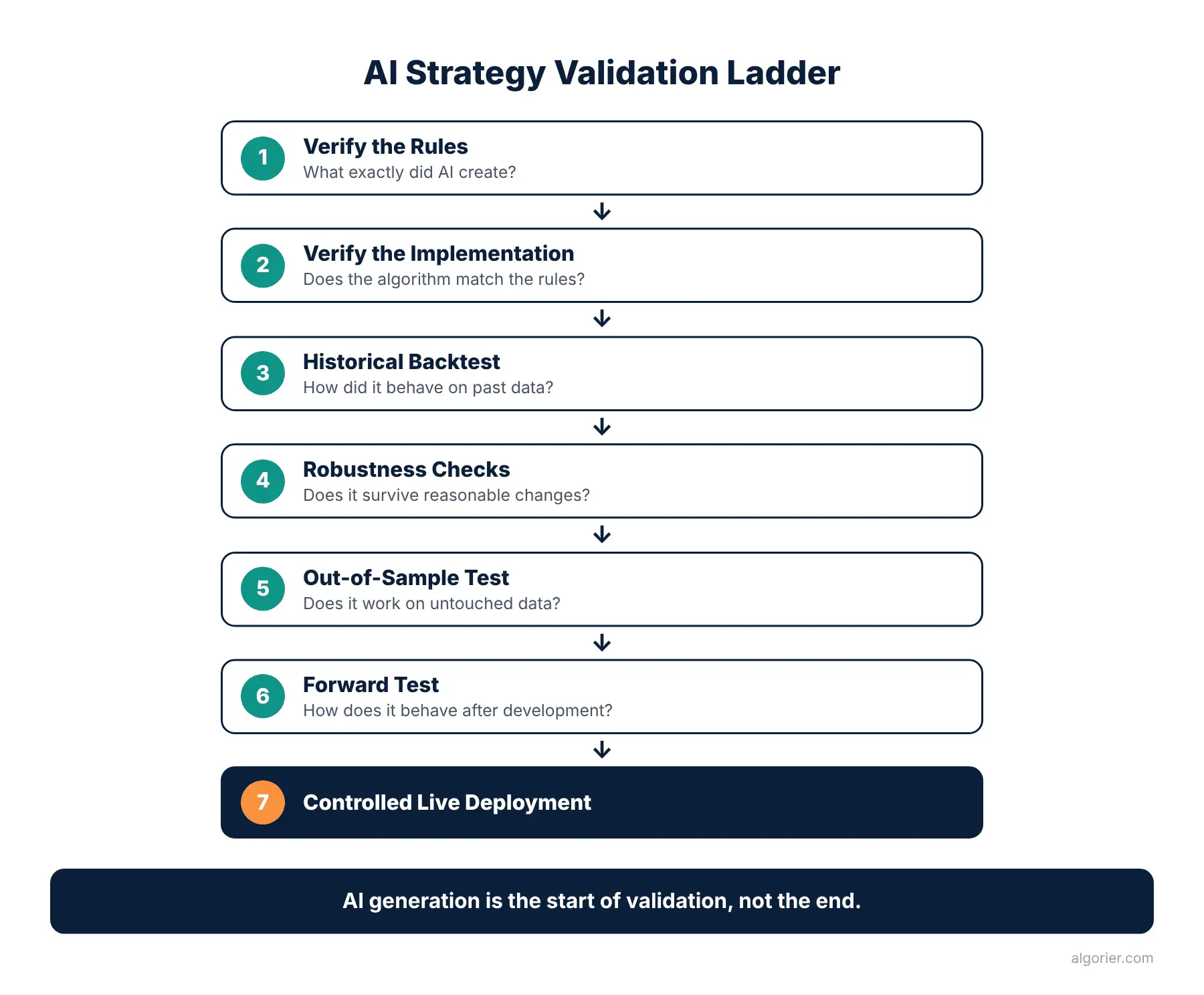
The AI Strategy Validation Ladder
A useful way to evaluate an AI-generated strategy is to separate validation into layers.
Level 1: Rule Verification
What exactly did the AI create?
Before judging performance, identify every condition that controls the strategy.
Level 2: Implementation Verification
Does the executable logic actually match those rules?
A correct description paired with incorrect code is still an incorrect strategy.
Level 3: Historical Backtest
How did the finalized rules behave on historical data?
This is where performance enters the process.
Level 4: Robustness Checks
Does the strategy survive reasonable changes in assumptions and conditions?
A system that only works under one exact parameter configuration deserves skepticism.
Level 5: Out-of-Sample Testing
Does the finalized strategy still behave plausibly on data that was not used during development?
This is a stronger test than repeatedly checking the same development sample.
Level 6: Forward Testing
How does the strategy behave as genuinely new market data arrives?
This creates post-development evidence.
Level 7: Controlled Live Deployment
Only after the previous layers should real capital become part of the evaluation.
The mistake is jumping from:
AI generated a strategy
directly to:
the backtest looks profitable
and treating that as validation.
Step 1: Freeze the AI-Generated Strategy
Before changing anything, save the exact original version.
Record:
the original prompt
the strategy description
market
timeframe
entry rules
exit rules
filters
parameters
stop-loss logic
position-sizing assumptions
generated code, if applicable
date generated
Call it something simple such as:
Strategy v1.0
This gives you a baseline.

Without version control, the strategy can gradually change every time a disappointing result appears.
Suppose Version 1 produces a weak backtest.
You ask AI to improve it.
Now the stop changes.
Version 2 still performs poorly.
A new volume filter appears.
Then the timeframe changes.
After ten iterations, the final strategy may have little resemblance to the original idea.
If all ten versions were judged using the same historical dataset, that dataset has already influenced the development process.
If the strategy keeps changing every time you see a bad result, you are no longer testing the original AI strategy. You are optimizing against the test set.
Freezing the first version lets you distinguish strategy development from strategy validation.
Step 2: Verify Every Rule the AI Created
AI systems frequently fill gaps.
That behavior can be helpful in ordinary writing.

In trading research, it can quietly change the strategy.
Suppose the original request is:
"Create a strategy that trades RSI reversals."
The AI might decide to use:
RSI(14)
oversold threshold of 30
overbought threshold of 70
1-hour candles
a 2% stop
long and short trades
But which of those decisions came from you?
Which came from the AI?
For every strategy component, perform a simple rule provenance audit.
Ask:
Did I specify this rule, or did the AI invent it?
Review:
market
timeframe
indicator length
signal threshold
entry timing
direction
stop-loss
take-profit
position sizing
filters
maximum concurrent positions
execution assumptions
An AI-generated assumption is not automatically wrong.
It simply needs to be recognized as an assumption rather than silently treated as part of your original hypothesis.
Where Algorier Fits Into This Workflow
Algorier can be used as a practical tool once the AI-generated idea has been converted into rules you actually want to test.
With AlgoBuild, a trader can describe entry logic, exit conditions, risk rules, timeframe, and markets in plain English. Algorier then translates that specification into an algorithm and centrally backtests the generated strategy. The platform supports indicator-based, price-action, statistical, sentiment, intermarket, and other strategy types.
That makes the workflow:
AI-generated idea
→ Review and define the rules
→ Describe the finalized strategy in AlgoBuild
→ Generate the algorithm
→ Run the centralized historical backtest
The value here is not that Algorier determines whether an AI strategy is "good."
It does not.
Its role is to move the strategy from a language-model output into a structured algorithm and test environment where the rules produce identifiable historical entries and exits.
After development, Algorier can also add another evidence layer through its optional Forward Test, which runs the algorithm out of sample on Algorier infrastructure and publishes the record as it develops.
That distinction matters:
Algorier standardizes parts of the evidence pipeline. It does not turn an overfit strategy into a robust one.
The next step is verifying that the generated implementation actually matches the strategy specification before performance metrics are allowed to influence the research process.
Step 3: Check That the Implementation Matches the Strategy
Once the rules are documented, verify that the executable strategy actually follows them.
Do this before looking at profitability.
Suppose the written rule says:
Enter long after RSI(14) closes back above 30.
But the generated code enters as soon as RSI moves above 30 intrabar.
Those are different strategies.
Or suppose the strategy says:
Only one position may be open at a time.
But the generated implementation adds another position every time a new signal appears.
Again, different strategy.
Build a simple rule-by-rule audit:
Written Rule | Implementation Check |
|---|---|
Enter after candle close | Does execution wait for confirmed close? |
One position at a time | Are duplicate entries prevented? |
Stop below previous 5-bar low | Does the calculation use only information available at entry? |
Exit at 2R | Is R calculated from the original stop distance? |
Long only above 200 EMA | Is the trend filter checked before every entry? |
Do not accept:
"The code looks right."
Trace actual trades.
For several historical examples, identify what should have happened manually and compare that with what the algorithm actually did.
Before evaluating profitability, verify rule fidelity.
This is especially important with AI-generated code because the explanation and implementation may look individually plausible while still disagreeing with each other.
Step 4: Test for Look-Ahead Bias and Data Leakage
An AI-generated strategy can accidentally use information that would not have been available at the time of the trade.

This is one of the fastest ways to create an extraordinary backtest that could never have existed in real trading.
TradingView describes look-ahead bias as future information leaking into historical calculations and warns that it can produce unrealistically favorable strategy results. Its documentation highlights higher-timeframe data, repainting variables, and certain intrabar calculation settings as potential sources.
Check whether the strategy uses:
future bars
future highs or lows
centered indicators
repainting signals
higher-timeframe values before those candles closed
final candle information for decisions supposedly made earlier in the candle
revised or future-known data
A suspiciously perfect entry should be investigated, not celebrated.
A brilliant equity curve generated with future information is not a strategy. It is a bug.
One useful check is to compare historical behavior with real-time or forward behavior. If signals that appeared perfectly on historical bars do not appear the same way as new bars form, repainting or future-data leakage may be involved. TradingView specifically notes this historical-versus-realtime difference as a way look-ahead problems can become visible.
Step 5: Run the Baseline Backtest Before Optimization
Once the implementation passes the logic audit, run the original frozen version.
Do not improve it first.
Do not ask AI to:
increase the win rate
improve Sharpe Ratio
reduce drawdown
find better parameters
add filters
You need to know how Strategy v1.0 behaves before the historical data influences its design.
A baseline backtest should answer:
How many trades occurred?
How large were historical drawdowns?
Was performance concentrated in one period?
Was the average trade large enough relative to costs?
Did the strategy behave consistently with its intended logic?
Were most profits generated by a few exceptional trades?
With Algorier, generated algorithms are centrally backtested, with entries and exits recorded at the price and time where the strategy rules fired.
That makes the historical record useful not only for measuring performance but also for checking whether the generated strategy is behaving as expected.
The baseline may be bad.
That is useful information.
A failed hypothesis is more valuable than a heavily optimized backtest masquerading as independent evidence.
Step 6: Inspect Individual Trades
Never validate an AI-generated strategy using only an equity curve.

Open the trade history.
Inspect examples from:
winning periods
losing periods
high-volatility markets
quiet markets
large drawdowns
unusual trades
For each trade, ask:
Why did this entry happen?
Was the required information actually available?
Did the position size match the rule?
Did the stop trigger correctly?
Did the exit occur when expected?
Would this fill have been plausible?
This process catches errors that summary statistics can hide.
A strategy may show an attractive return while containing:
impossible fills
duplicate entries
delayed exits
incorrect stops
position-sizing errors
Trade inspection is not optional just because AI wrote the strategy.
If anything, automation makes it more important.
Step 7: Add Realistic Costs and Execution Assumptions
An AI strategy can identify a tiny historical edge that disappears once actual trading friction is considered.

Depending on the market and strategy, include relevant assumptions for:
commissions
spreads
slippage
order type
execution timing
liquidity
The importance of each variable depends on the strategy.
A high-frequency system with very small average profit per trade may be highly sensitive to execution costs.
A slower strategy with fewer, larger trades may be less sensitive.
Do not search for one universal slippage assumption.
Use assumptions appropriate to the instrument and execution method being tested.
Then stress the assumptions.
If a modest increase in costs destroys the entire historical edge, that is important evidence about the strategy's fragility.
Step 8: Test the Finalized Strategy Out of Sample
Once development begins, historical data stops being completely independent evidence.
You have seen the results.
You have made decisions based on them.
That is why a portion of data should remain untouched until the strategy is finalized.
The workflow is:
Development data
→ build and refine the strategy
then:
Untouched out-of-sample data
→ test the frozen final version without additional tuning
TradingView's current strategy documentation recommends separating in-sample and out-of-sample data to reduce overfitting risk, noting that an overfit strategy often deteriorates when evaluated on unseen data.
QuantConnect takes a similar approach. Its research guidance explicitly warns against repeated backtesting, parameter hyper-tuning, and continually reusing the same testing dataset. It also supports holding out an out-of-sample period so that the most recent data remains unavailable during development.
The important rule is:
Once you inspect the out-of-sample result and start changing the strategy because of it, that period is no longer truly untouched validation data.
Do not simply keep re-optimizing until the OOS result looks good.
Step 9: Stress-Test Reasonable Variations
A strategy should not require one magical combination of parameters to survive.
Test whether the basic behavior remains plausible when you make reasonable changes such as:
slightly different indicator thresholds
somewhat higher trading costs
delayed execution
neighboring time periods
different but relevant instruments
modest changes in stop distance
This is not another search for the best configuration.
The goal is almost the opposite.
You are asking:
How easily can this strategy break?
If:
RSI 31
works beautifully but:
RSI 30
and:
RSI 32
collapse completely, investigate why.
A genuine market hypothesis may still be parameter-sensitive, but extreme sensitivity is a warning that historical optimization could be doing more work than the underlying trading idea.
For deeper robustness methodology, this stage should remain separate from the initial backtest rather than turning every possible stress test into another parameter search.
Step 10: Move to Paper or Forward Testing
After historical and out-of-sample testing, observe the frozen strategy as new data arrives.

This stage can reveal problems that are difficult to reproduce historically:
live execution differences
slippage
strategy inactivity
signal timing differences
market-regime changes
behavior that depended on historical calculation quirks
TradingView describes forward testing as evaluating strategy behavior in real-time market conditions and recommends treating it as another component of validation rather than as standalone proof.
Algorier provides an optional Forward Test for this stage. When enabled, the algorithm runs live, out of sample, on Algorier infrastructure and publishes the record in real time. According to the Whitepaper, the creator cannot edit, pause, or cherry-pick that Forward Test record. Algorier also explicitly distinguishes this evidence from a historical backtest and notes that a backtest alone can be overfit.
That makes Algorier useful for a complete AI-strategy testing sequence:
Define AI-generated rules
→ Generate algorithm
→ Centralized backtest
→ Inspect historical behavior
→ Freeze the developed version
→ Enable Forward Test
→ Compare historical expectations with post-development behavior
The Forward Test is not a profitability certificate.
It is another layer of evidence.
How AI Strategy Overfitting Happens
AI makes this entire workflow faster.
That is both the opportunity and the danger.
Imagine:
Strategy v1
→ weak backtest
→ "Improve it"
→ add trend filter
→ "Increase win rate"
→ change indicator threshold
→ "Reduce drawdown"
→ modify stop
→ "Find better trading hours"
→ remove weak sessions
→ beautiful equity curve
What happened?
Possibly genuine research.
Possibly repeated data mining.
If every modification was selected because it improved the same historical dataset, the apparent improvement is not independent evidence.
QuantConnect's research guidance makes essentially the same point: repeated tests and parameter adjustments increase the risk that a strategy becomes fitted to historical noise rather than a durable hypothesis.
Every time you ask AI to improve a backtest using the same data, you spend some of that dataset's value as independent evidence.
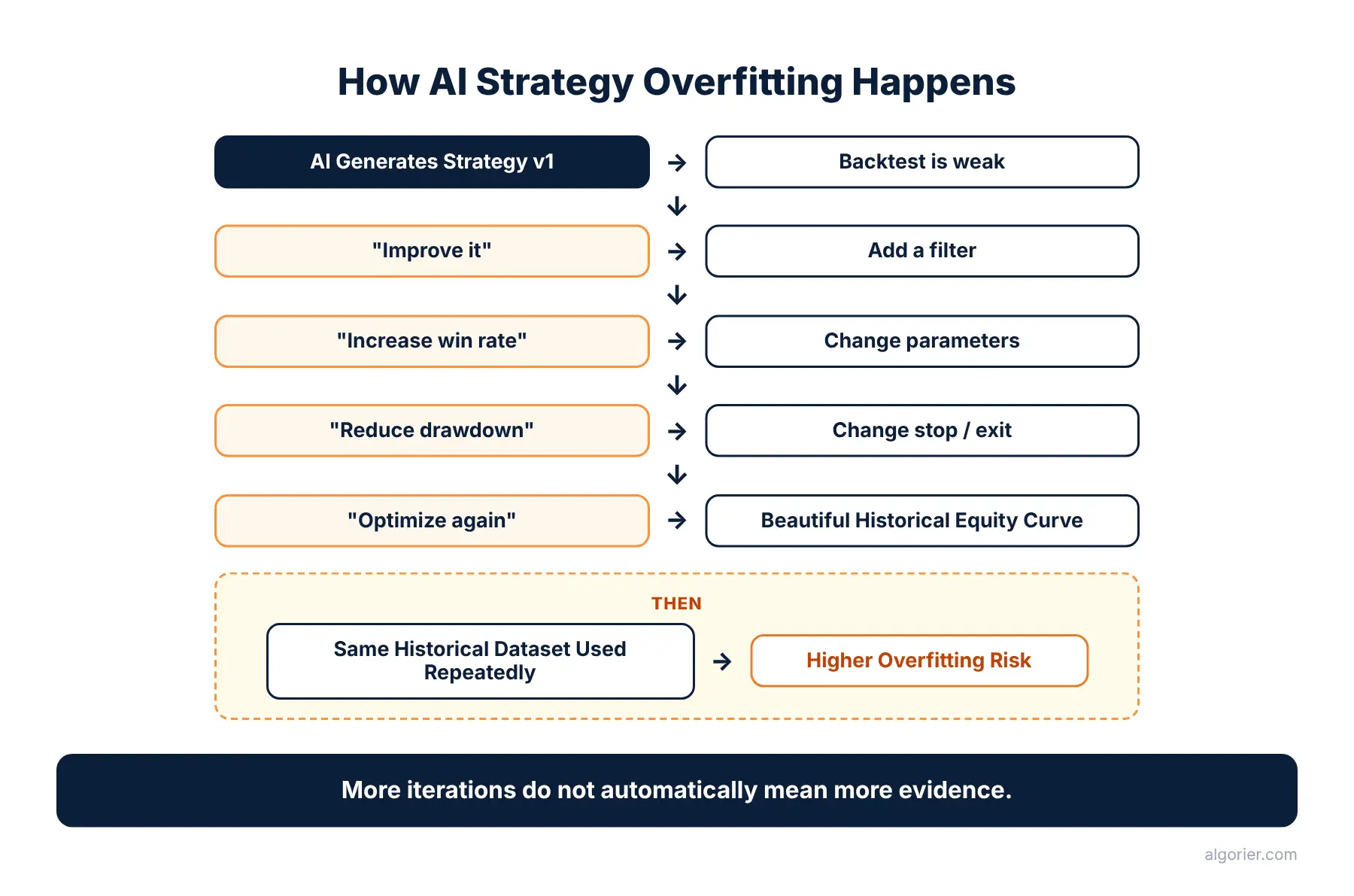
More iterations do not automatically mean a better strategy.
Sometimes they only mean a better fit to the past.
What Metrics Should You Review?
Once the strategy has passed the logic and implementation checks, performance metrics become useful.
Do not evaluate an AI-generated strategy using one headline number.
At minimum, review:
Metric | What It Helps Reveal |
|---|---|
Number of trades | How much evidence the backtest actually contains |
Maximum drawdown | Historical downside and capital stress |
Profit Factor | Gross profit relative to gross loss |
Win rate | Frequency of winning trades |
Average winner / loser | Whether the payoff structure supports the win rate |
Average trade | Whether the historical edge may survive costs |
Total return | Overall historical outcome |
Exposure | How much time or capital the strategy keeps at risk |
None of these metrics should be treated as a universal pass/fail threshold.
A high win rate can coexist with large losses.
A strong Profit Factor can come from a very small sample.
A high return can simply reflect excessive leverage.
The question is not:
"Does this metric look good?"
It is:
"Does the combination of metrics describe a strategy whose historical behavior is understandable and plausible?"
Red Flags That an AI Strategy Is Not Ready
An AI-generated strategy deserves additional scrutiny when you see any of the following.
The Rules Cannot Be Explained Clearly
If the strategy contains dozens of interacting conditions and nobody can explain why each one exists, it may be the product of optimization rather than a coherent trading hypothesis.
The Backtest Is Almost Too Perfect
Warning signs include:
extremely smooth equity curve
almost no losing periods
unusually precise entries or exits
suspiciously low drawdown
exceptional performance with little variation
Exceptional results are possible.
They also deserve exceptional scrutiny.
Small Parameter Changes Destroy Performance
If moving an RSI threshold from 31 to 30 causes the strategy to collapse, the result may be heavily dependent on one historical configuration.
Most Profit Comes From a Few Trades
A strategy may show strong total return while most of that return comes from a tiny number of outliers.
That does not automatically invalidate the strategy, but it changes what the historical record actually demonstrates.
Performance Disappears Out of Sample
A large deterioration on untouched data is one of the clearest reasons to investigate overfitting.
The AI Cannot Reproduce the Same Logic
If the strategy description changes every time you ask the model to explain it, freeze the rules manually before continuing.
The Strategy Needs Constant "Improvement"
A system that only survives after repeatedly adding new filters may be becoming more fitted to history rather than more robust.
How to Test an AI-Generated Strategy With Algorier
Algorier can be used as a practical testing environment for this workflow.
The process begins with the strategy specification.
1. Define the AI-Generated Rules Clearly
Take the output from ChatGPT or another AI system and remove ambiguity.
Specify:
market
timeframe
entries
exits
filters
risk rules
2. Build the Strategy in AlgoBuild
AlgoBuild accepts plain-English strategy descriptions and converts them into an algorithm. It supports indicator-based, price-action, statistical, sentiment, intermarket, and other strategy types.
This gives the AI-generated idea a defined executable form.
3. Run the Centralized Historical Backtest
Algorier centrally backtests generated algorithms and records entries and exits where the rules triggered historically.
Use this stage to evaluate:
whether the implementation matches the intended rules
where trades occurred
how the strategy behaved historically
whether the performance is concentrated or unstable
Do not immediately optimize every weak result.
First decide whether the strategy failed because of implementation, assumptions, or the hypothesis itself.
4. Freeze the Developed Version
Once you decide which version is the actual candidate strategy, stop changing it.
The next evidence should come from new data, not another round of tuning.
5. Enable Forward Test
Algorier's optional Forward Test runs the algorithm live and out of sample on Algorier infrastructure.
The resulting record develops in real time, and the Whitepaper states that the creator cannot edit, pause, or cherry-pick it.
This creates a useful separation between:
historical evidence
and
post-development evidence
The platform itself also acknowledges that a historical backtest can be overfit.
That is the right way to position Algorier in an AI strategy-validation workflow.
Algorier helps move an AI-generated strategy from an idea into a structured algorithm, historical backtest, and optional Forward Test. It does not certify that the strategy will be profitable.
Final AI Strategy Validation Checklist
Before considering an AI-generated strategy ready for live deployment, verify:
The original AI output has been saved and versioned.
Every rule can be explained in plain English.
You know which assumptions came from you and which came from AI.
The executable logic matches the written strategy.
No future information or repainting is used.
A baseline backtest was run before optimization.
Individual trades were inspected.
Fees, spread, slippage, and execution assumptions are reasonable.
Performance is not dependent on a handful of trades.
Small parameter changes do not immediately destroy the strategy.
The strategy was tested on untouched out-of-sample data.
Out-of-sample results were not repeatedly used for additional optimization.
Reasonable stress tests were performed.
The finalized version was paper or forward tested.
Live deployment, if considered, begins under controlled risk limits.
If several of these steps are missing, the strategy is still in research.
Final Verdict
AI can make strategy creation dramatically faster.
It cannot make evidence optional.
The correct workflow is not:
AI generates strategy → profitable backtest → live trading
It is:
AI generates hypothesis
→ verify the rules
→ verify the implementation
→ run the baseline backtest
→ inspect trades
→ test robustness
→ test out of sample
→ forward test
→ only then consider controlled deployment
The most important mindset is to treat the AI output as something to challenge rather than something to defend.
An AI-generated strategy should be treated as a hypothesis, not a discovery.
Algorier fits naturally into this workflow because AlgoBuild can convert the finalized plain-English rules into an algorithm, centrally backtest it, and optionally add a Forward Test as a separate layer of out-of-sample evidence.
That is useful infrastructure.
It is not a guarantee.
AI generation is fast. Trust still has to be earned through evidence.
Frequently Asked Questions
How do I test an AI-generated trading strategy?
Freeze the exact strategy, verify every rule, check that the implementation matches the specification, run a realistic historical backtest, inspect individual trades, test the strategy on unseen data, stress-test it, and then paper or forward test the finalized version.
Can AI-generated trading strategies be backtested?
Yes. Once the rules are sufficiently explicit, an AI-generated strategy can be implemented and tested like any other systematic strategy.
How do I verify an AI trading strategy?
Verify both the logic and the evidence. Confirm what the rules actually are, ensure the code follows those rules, eliminate future-data leakage, and then evaluate the strategy using historical, out-of-sample, and forward evidence.
Are AI-generated trading strategies reliable?
They can be useful, but being AI-generated does not make a strategy reliable. Reliability depends on the hypothesis, implementation, data quality, execution assumptions, robustness, and validation.
How do I know if an AI strategy is overfit?
Warning signs include severe performance deterioration out of sample, extreme sensitivity to small parameter changes, many layers of optimization, and exceptional historical results that depend on a narrow period or configuration.
Should I forward test an AI-generated strategy?
Usually, yes. Forward testing adds post-development evidence and can reveal behavior that was not visible in the historical backtest.
How much historical data should I use?
There is no universal amount. The appropriate sample depends on trade frequency, timeframe, market, strategy type, and whether the data covers enough different conditions to be informative.
What metrics should I check?
Useful metrics include trade count, maximum drawdown, Profit Factor, win rate, average winner and loser, average trade, total return, and exposure. No single metric should determine whether the strategy passes validation.
Can AI-generated trading code contain look-ahead bias?
Yes. AI-generated code can contain the same implementation errors as manually written code, including future-data leakage, repainting, and unrealistic execution assumptions.
Should I optimize an AI strategy before testing it?
Run and preserve a baseline test first. Optimizing before establishing the original strategy's behavior makes it harder to distinguish genuine improvement from historical curve fitting.
Can ChatGPT-generated strategies be trusted?
They should be tested rather than trusted by default. ChatGPT can help create and formalize trading strategies, but the strategy still requires implementation review, backtesting, out-of-sample validation, and preferably forward evidence.
References
Algorier. Algorier Platform Whitepaper, Version 1.1. September 2026. Product information concerning AlgoBuild, centralized backtesting, and Forward Test.
Algorier. Algorier Platform Whitepaper, Version 1.1. September 2026. Forward Test methodology, out-of-sample records, and the limitations of historical backtests.
TradingView. “Strategies.” Documentation covering strategy backtesting, look-ahead bias, historical testing, and out-of-sample considerations.
QuantConnect. Research and Backtesting Documentation. Guidance concerning repeated backtesting, parameter tuning, research methodology, out-of-sample testing, and paper trading.
Risk Disclaimer
Trading involves substantial risk and can result in partial or total loss of capital.
AI-generated strategies may contain flawed logic, coding errors, hidden assumptions, data leakage, unrealistic execution models, and overfit parameters.
Backtests are hypothetical simulations and depend on historical data, execution assumptions, fees, spreads, slippage, liquidity, and other variables.
Out-of-sample tests, Forward Tests, paper trading, and live records provide additional evidence but do not guarantee future profitability.
Past performance, whether simulated or actual, is not a guarantee of future results.
About the Author
Written by: Algorier Research Team
Last Updated: November 2026
The Algorier Research Team covers algorithmic trading, trading strategy development, backtesting, systematic risk, strategy evaluation, and trading automation.