How to Backtest a Trading Strategy Without Coding
Last Updated: November 2026
You do not need to know Python, Pine Script, or another programming language to backtest a trading strategy.
What you do need is something more important:
a strategy precise enough for a computer to understand.
That distinction matters.
A vague trading idea such as:
Buy when momentum looks strong and sell when the trend weakens.
cannot be backtested consistently because terms such as "strong" and "weakens" have no fixed meaning.
A testable version might instead define:
which market to trade
which timeframe to use
the exact indicator or price condition that triggers an entry
the exact exit condition
stop-loss rules
any filters that must be satisfied
Modern no-code and AI backtesting tools can handle the programming layer for you. Visual builders let traders assemble conditions through menus and rule blocks, while newer AI systems can translate trading rules written in plain English into executable strategy logic.
The programming barrier is getting smaller.
The strategy-definition barrier is not.

No-code backtesting removes the programming requirement, not the requirement to define a precise trading strategy.
Quick Answer
You can backtest a trading strategy without coding by using a visual rule builder or an AI backtesting platform that converts plain-English trading rules into executable test logic. Start by defining the market, timeframe, exact entry conditions, exit rules, and risk assumptions. Then run those rules against historical data and review trade count, drawdown, Profit Factor, average trade, costs, and individual transactions rather than looking only at total return. Algorier's AlgoBuild follows this workflow by allowing a trader to describe entry logic, exits, risk rules, timeframe, and markets in plain English, then generating and centrally backtesting the resulting algorithm without requiring the trader to write the underlying Python code.
No-code tools make testing easier.
They do not make every strategy valid, profitable, or robust.
What Does Backtesting Without Coding Mean?
Backtesting without coding means using software to translate trading rules into executable logic without manually programming the strategy yourself.
The underlying backtest engine still needs precise instructions.
The difference is how those instructions are created.
In a traditional workflow, a trader might write code such as:
retrieve historical candles
calculate indicators
detect entry conditions
simulate trades
calculate transaction costs
record P&L
generate performance statistics
With no-code backtesting, the platform handles much or all of that implementation.
The trader focuses on describing the strategy.
That can happen in several ways.
Three Ways to Backtest Without Coding
1. Visual Strategy Builders
A visual builder replaces programming syntax with menus, condition blocks, dropdowns, and logical operators.
Instead of coding:
EMA(20) > EMA(50)
you might select:
20-period EMA
is above
50-period EMA
You then combine conditions using rules such as:
AND
OR
crosses above
crosses below
greater than
less than
Visual builders are useful because the resulting logic is usually explicit.
You can see exactly which conditions are being tested.
The limitation is that complex strategies can become cumbersome when they require many interacting conditions, unusual indicators, market-structure concepts, or custom rules.

2. AI and Plain-English Backtesting
AI-based backtesting changes the interface again.
Instead of constructing each condition manually, the trader describes the strategy in natural language.
For example:
On BTC/USDT using 1-hour candles, enter long when the 20 EMA crosses above the 50 EMA and RSI(14) is above 55. Exit when the 20 EMA crosses below the 50 EMA. Use a 2% stop-loss.
The system translates those instructions into structured algorithmic rules and runs the historical test.
Algorier's AlgoBuild is designed around this model. According to the Algorier Platform Whitepaper, traders can specify entry logic, exit conditions, risk rules, timeframe, and markets in plain English. The platform then generates the underlying algorithm and backtests it on historical market data without requiring the user to write code.
The major advantage is speed.
The major risk is ambiguity.
AI should translate the strategy, not invent the strategy.
If your instruction says "buy when the market looks oversold," the AI must either ask for clarification or make an assumption.
That assumption can materially change the backtest.

3. Manual Historical Replay
The simplest no-code method is chart replay.
You define the strategy first, move through historical charts without seeing future candles, and record every trade according to the rules.
This works especially well for discretionary setups involving:
support and resistance
price action
chart patterns
market structure
contextual judgment
The advantage is flexibility.
The disadvantage is scale.
Manual replay can be slow, difficult to reproduce, and vulnerable to human inconsistency.
It is useful for exploring an idea, but once the rules become sufficiently objective, automated testing usually gives a cleaner and larger sample.
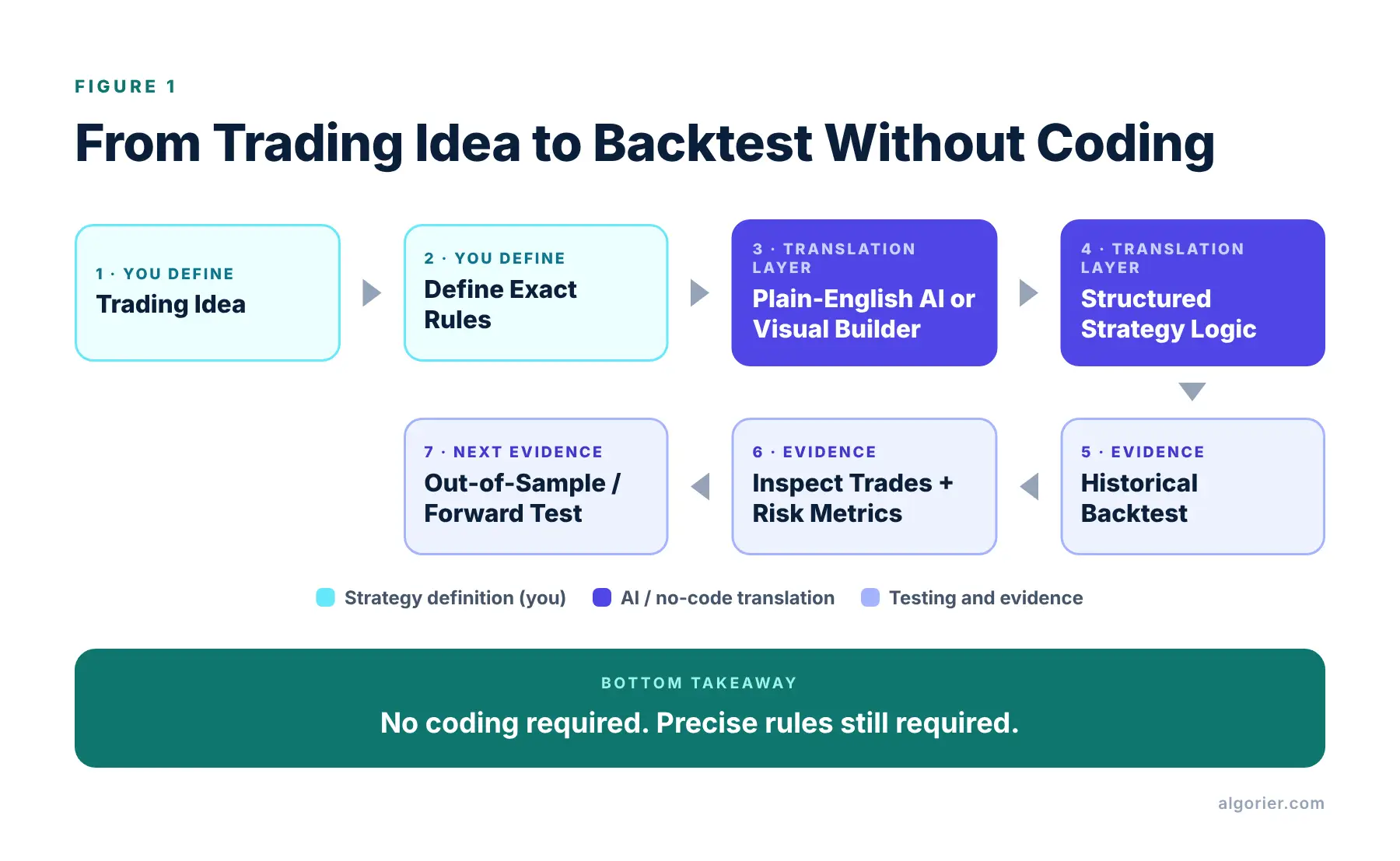
How to Backtest a Trading Strategy Without Coding: Step by Step
The quality of a no-code backtest depends heavily on what happens before you press the Backtest button.
Step 1: Define the Market
Specify exactly what the strategy trades.
Examples:
BTC/USDT
EUR/USD
S&P 500
individual equities
Do not assume a strategy that works on one market automatically transfers to another.

Different markets have different:
volatility
spreads
liquidity
trading hours
transaction costs
price behavior
Step 2: Choose the Timeframe
The timeframe needs to be explicit.
For example:
5-minute
1-hour
4-hour
daily
"Short-term strategy" is not a timeframe.
A strategy tested on 5-minute data may behave very differently on hourly or daily candles.
Step 3: Write Exact Entry Conditions
This is where most vague ideas fail.
Consider:
Buy pullbacks in an uptrend.
That sounds like a strategy, but it is not yet backtestable.
You still need to define:
What is an uptrend?
Perhaps:
Price is above the 200 EMA.
What counts as a pullback?
Perhaps:
RSI(14) falls below 35.
When exactly do you enter?
Perhaps:
Enter when RSI closes back above 35 while price remains above the 200 EMA.
Now the computer has something objective to test.
Step 4: Define the Exit Before Running the Test
A strategy is incomplete without an exit.
Possible exits include:
fixed stop-loss
fixed profit target
trailing stop
opposite indicator signal
time-based exit
volatility-based exit
If the entry is precise but the exit remains subjective, the backtest still cannot be reproduced consistently.

Step 5: Separate Strategy Logic From Risk Assumptions
The signal and the amount of money risked are related, but they are not the same thing.
A useful test should distinguish:
Strategy logic:
When should the trade happen?
from:
Risk configuration:
How much capital should be exposed when it happens?
This distinction also matters in AlgoBuild. The generated strategy defines the rules behind entries and exits rather than baking one universal leverage or position size into the algorithm. The person running the strategy can configure risk separately.
That makes the historical behavior of the trading logic easier to distinguish from a particular user's capital allocation.
The next step is translating these rules into a no-code or AI backtesting platform, running the historical test, and deciding whether the results actually deserve to be trusted.
Step 6: Choose a No-Code or AI Backtesting Tool
Once the rules are explicit, choose the interface that matches the strategy.
A visual builder works well when the system uses conventional indicators and conditions that are easy to express through menus.
A plain-English AI workflow is more useful when you already know what the strategy should do but do not want to translate every condition into blocks or programming syntax.
The tool should not merely generate an equity curve. It should let you understand what rules were actually tested.
Before using any platform, check whether you can inspect:
entry and exit logic
tested market and timeframe
historical period
individual trades
transaction-cost assumptions
drawdown and risk metrics
If those details are hidden, convenience is coming at the expense of auditability.
Step 7: Translate the Rules Into the Platform
Whether you use AI or a visual builder, compare the implemented version against your original specification.
Suppose your intended rule is:
Enter only after the candle closes above the 50 EMA.
A platform could potentially interpret that as:
Enter as soon as price moves above the 50 EMA intrabar.
Those are different strategies.
The same ambiguity appears with phrases such as:
"crosses above,"
"touches support,"
"at market open,"
"after confirmation,"
or "use a 2% stop."
Before testing, make sure you know how the platform interprets them.
With AI tools, this validation step becomes even more important.
Natural language makes strategy creation easier, but natural language can also hide ambiguity.
Step 8: Run the Historical Backtest
Once the rules match your intended strategy, choose the historical period and run the test.
Do not immediately optimize it.
First establish a baseline.
That first result tells you what the original idea actually did before you started changing parameters in response to the data.
A useful backtesting engine should show much more than a final percentage return.
For example, TrendSpider's current no-code Strategy Tester provides trade-level results, drawdown analysis, performance metrics, transaction-cost settings, and the ability to compare strategies across symbols, timeframes, and historical periods. It also allows rules to be built visually or from plain-English instructions through Sidekick.
Capitalise.ai takes another natural-language-oriented approach. Its backtesting system scans historical market data for instances in which the user's exact entry and exit conditions would have been triggered and reconstructs the resulting historical trades.
The interface can change.
The underlying question should remain the same:
What exactly did the strategy do when these rules were applied to this historical data?
Step 9: Inspect the Trades, Not Just the Equity Curve
A smooth upward chart can hide a weak strategy.
After running the test, examine the behavior behind the headline return.
Metric | What It Helps You Understand |
|---|---|
Number of trades | Whether the result is based on a meaningful sample |
Maximum drawdown | How severe historical losses became |
Profit Factor | Gross profit relative to gross loss |
Win rate | How often trades won, but only meaningful with payoff size |
Average trade | Whether the edge may survive realistic costs |
Average winner / loser | The strategy's payoff structure |
Trade duration | Whether behavior matches the intended trading style |
Equity curve | Whether profits were persistent or concentrated in one period |
No single metric determines whether a strategy is good.
A 75% win rate can still lose money if losing trades are much larger than winners.
A high historical return may be driven by extreme leverage.
A strong Profit Factor can be misleading if the sample contains very few trades.
And a strategy that made almost all its profit during one exceptional market regime may be less robust than the total return suggests.
If a no-code tool shows only return and win rate, that is not enough for serious strategy evaluation.
Step 10: Check Costs and Execution Assumptions
Backtests simulate trading.
The assumptions behind that simulation matter.
At minimum, determine how the engine handles:
transaction costs, spreads, slippage, order timing, candle closes, stop-loss fills, and gaps.
These details become increasingly important as trade frequency rises and average profit per trade falls.
Composer provides a useful example of why backtest assumptions need to be read carefully. Its current documentation says stock and ETF backtests use adjusted daily closing prices, while live decisions use real-time prices. Composer also lets users model slippage, with a configurable default assumption, and explicitly warns that historical simulations differ from live trading.
That does not make the backtest bad.
It defines what the backtest can reasonably tell you.
A daily portfolio strategy may fit that data model.
An intraday strategy dependent on exact execution around a five-minute breakout would require a very different test.

Example: Turn a Trading Idea Into Testable Rules
Consider this idea:
Buy pullbacks in an uptrend.
It is intuitive, but impossible to backtest consistently as written.
A testable specification could become:
Trade BTC/USDT on the 1-hour timeframe. Define an uptrend when the closing price is above the 200 EMA. Wait for RSI(14) to fall below 35. Enter long when RSI closes back above 35 while price remains above the 200 EMA. Exit at a profit target equal to twice the initial risk, at a stop-loss equal to one unit of risk, or if price closes below the 200 EMA.
Illustrative example only.
Now every key phrase has an operational definition.
"Uptrend" became a measurable rule.
"Pullback" became a measurable event.
"Enter" became a specific trigger.
"Exit" became explicit.
This is the real skill behind no-code backtesting.
You are not learning programming syntax.
You are learning to convert discretionary thinking into testable logic.
How AI Backtesting Changes the Workflow
AI can dramatically reduce the friction between a strategy idea and a backtest.
Instead of manually creating every condition, a trader can describe the system and let the platform translate it.
Algorier's AlgoBuild, for example, accepts plain-English descriptions covering entries, exits, risk rules, timeframe, and markets, then generates the underlying algorithm and centrally backtests it.
TrendSpider's Sidekick can similarly take precise natural-language instructions and build inspectable strategy rules, while its current workflow can also begin from a broader objective and experiment with variations.
The second workflow needs more caution.
There is a major difference between:
"Implement these rules."
and:
"Find me a profitable strategy."
The first uses AI as a translator.
The second can turn AI into an optimization engine searching repeatedly through historical data.
That creates a familiar backtesting problem in a faster interface.
No-Code Does Not Eliminate Overfitting
Imagine starting with RSI below 30.
The result is disappointing.
So you try 35.
Then 40.
Then you add a moving-average filter.
Then remove Fridays.
Then test five stop-loss levels.
Then change the timeframe.
Eventually, one version looks excellent.
No code was written.
But you still searched many variations against the same historical sample.
That is overfitting risk.

No-code does not mean no overfitting. AI can make overfitting faster.
A useful discipline is to preserve the original strategy, document each material change, and eventually evaluate the chosen version on data that was not used during refinement.
The easier a platform makes experimentation, the more disciplined the trader needs to become about separating development from validation.
No-Code Backtesting Tools You Can Use
Different tools solve different versions of the problem.
Algorier is particularly aligned with traders who want to move directly from a plain-English strategy specification to generated algorithm logic and centralized historical backtesting without writing the underlying code.
TrendSpider combines a visual rule builder with AI-assisted strategy development. Its current tools support inspectable rules, historical testing, transaction-cost assumptions, trade-level analysis, cross-symbol comparisons, and strategy bots.
Capitalise.ai focuses on defining entry and exit conditions without conventional coding and testing those conditions against historical market data before potentially moving the strategy into real replication.
Composer is more portfolio-oriented. It backtests rule-based "symphonies" and currently provides metrics including Sharpe Ratio, maximum drawdown, Calmar Ratio, historical allocations, and configurable cost assumptions. Its documentation also makes clear that the simulations are hypothetical and can differ from live execution.
The best tool depends on the strategy.
The more important question is whether the platform lets you inspect the rules, understand the assumptions, examine the trades, and validate the strategy beyond the historical period used to develop it.
How Algorier Backtests a Strategy From Plain English
Algorier is particularly relevant to this search because the workflow starts with the trader's strategy description rather than with code.
In AlgoBuild, the trader describes:
entry logic
exit conditions
risk rules
timeframe
markets
The platform then translates that description into an algorithm and centrally backtests it on historical market data. The user does not need to write the underlying Python code.
The useful part is not simply that AI generates code.
It is that the workflow connects three stages that are often separated:
strategy specification → executable logic → historical evidence
1. Describe the Strategy
The starting point should resemble a specification, not a vague trading conversation.
For example:
Backtest BTC/USDT on the 1-hour timeframe. Enter long when the 20 EMA crosses above the 50 EMA and RSI(14) is above 55. Exit when the 20 EMA crosses below the 50 EMA. Use a 2% stop-loss. Report total return, maximum drawdown, Profit Factor, win rate, number of trades, and the trade history.
Illustrative example only.
A good no-code prompt should reduce ambiguity rather than invite the AI to invent missing rules.
2. Generate the Algorithm
AlgoBuild translates the plain-English description into executable algorithmic logic.
This removes the need for the trader to manually convert every trading condition into programming syntax.
But the trader should still verify that the generated interpretation matches the intended rules.
AI can remove the translation layer. It cannot remove responsibility for the strategy definition.
3. Run the Historical Backtest
Algorier centrally backtests generated algorithms and records the entries and exits at the levels where the rules triggered.
That allows the trader to move from an idea to inspectable historical evidence without building a separate data pipeline or backtesting engine.
4. Evaluate the Results
The backtest should be treated as evidence, not a score.
A strong-looking result should still be examined for:
sample size
drawdown
trade concentration
payoff structure
costs
regime dependence
potential overfitting
If the strategy only looks good after repeated parameter changes, the next step should not be immediate deployment.
It should be validation.

Backtest vs Forward Test: What Comes Next?
Historical backtesting answers:
How would these rules have behaved on past data?
It does not answer:
Will these rules continue behaving similarly on new data?
Once a strategy has been developed, the next useful step is to expose it to data that was not used during development.
Algorier allows creators to enable an optional Forward Test. When enabled, the algorithm runs live and out of sample on Algorier infrastructure and builds a record in real time. The Whitepaper states that the creator cannot edit, pause, or cherry-pick that Forward Test record.
This does not guarantee future profitability.
It adds a different type of evidence.
A practical workflow therefore looks like:
Idea
→ Explicit Rules
→ No-Code / AI Translation
→ Historical Backtest
→ Review and Refinement
→ Out-of-Sample Validation
→ Forward Test
→ Only then consider live deployment
The mistake is jumping directly from a good equity curve to real money.
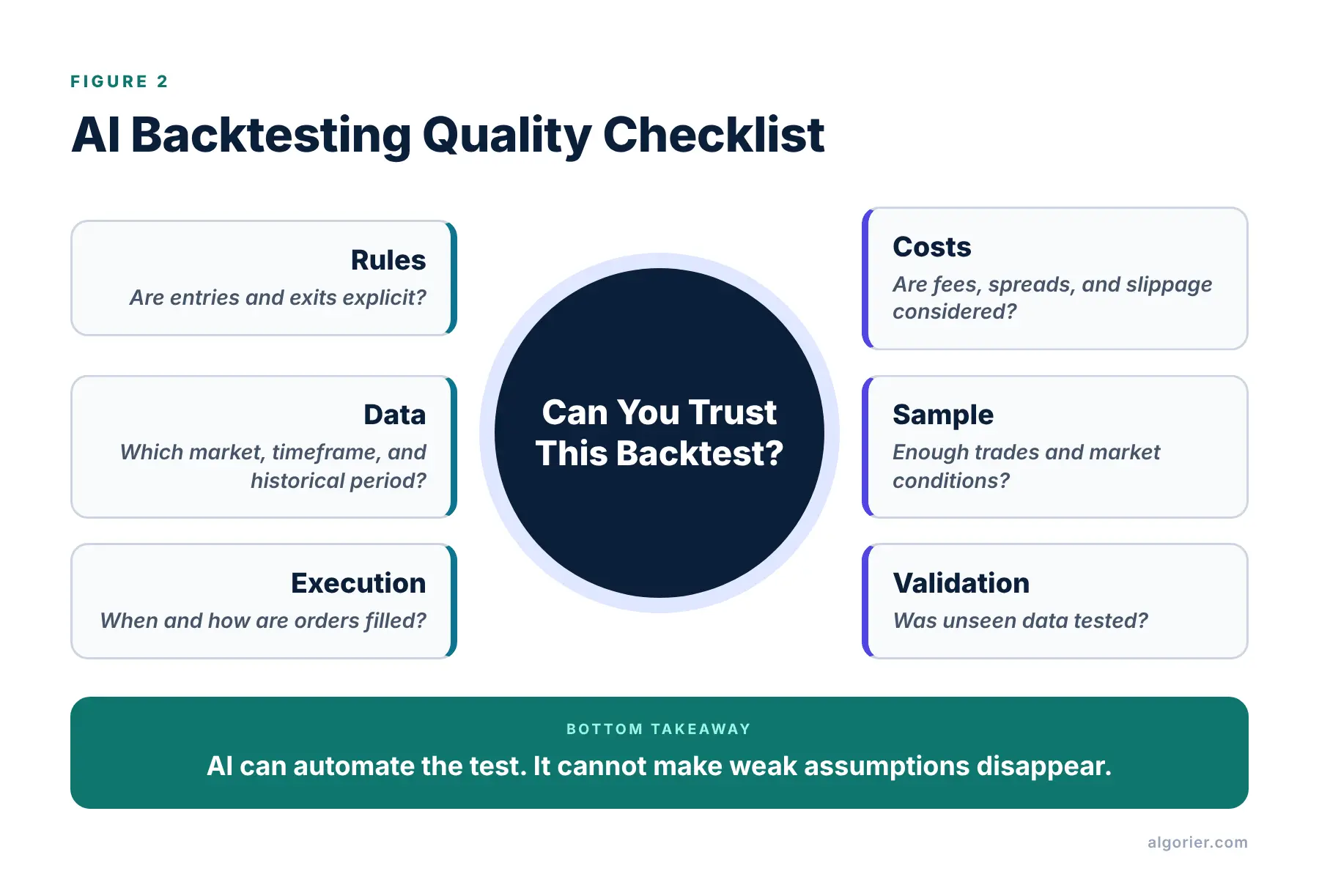
Final No-Code Backtesting Checklist
Before trusting a no-code or AI-generated backtest, verify the following:
Is the market clearly defined?
Is the timeframe explicit?
Are entry rules objective?
Are exit rules objective?
Are stop-loss and risk assumptions clear?
Did the platform interpret the strategy correctly?
Can you inspect individual trades?
Are fees, spreads, or slippage considered where relevant?
Is the sample large enough to be informative?
Is performance concentrated in one short period?
Did you repeatedly optimize parameters on the same data?
Have you tested the final version on unseen data?
Have you forward tested before considering live capital?
If several of these answers are unclear, the backtest is not ready to support a trading decision.
Final Verdict
You no longer need to be a programmer to test a systematic trading idea.
Visual builders can replace programming syntax with rules and conditions.
AI-based platforms can go further by translating plain-English strategy descriptions into executable logic.
But the easier the interface becomes, the easier it also becomes to create a bad backtest quickly.
The essential skills have therefore shifted.
You may not need to write Python.
You still need to define:
what triggers a trade
what closes it
what assumptions are being made
what data was tested
what risks the historical result hides
For traders who specifically want to move from plain-English strategy idea to generated algorithm and historical backtest, AlgoBuild provides a direct workflow without requiring user-written code.
Its value is not that AI can discover guaranteed profitable strategies.
It cannot.
Its value is reducing the technical barrier between a precise trading idea and a testable algorithm.
No-code backtesting makes experimentation easier. Good strategy research still requires precision, skepticism, and validation.
Frequently Asked Questions
Can I backtest a trading strategy without coding?
Yes. Visual strategy builders and AI-based backtesting platforms can translate trading rules into executable logic without requiring the trader to manually write code.
Do I need Python to backtest trading strategies?
No. Python gives traders substantial flexibility, but it is not required. No-code platforms can handle many technical, indicator-based, portfolio, and rule-driven strategies.
How do I backtest a strategy with AI?
Define the market, timeframe, entry rules, exit rules, and risk assumptions as precisely as possible. The AI platform can then translate those rules into executable logic and run them against historical data.
Can AI create and backtest a trading strategy?
AI can help translate, structure, generate, and test strategy logic. That does not mean an AI-generated strategy has a genuine edge or will remain profitable.
Can ChatGPT backtest a trading strategy?
A language model can help formalize rules and generate code, but a reliable historical backtest requires market data, an execution model, and a backtesting engine. The quality of the result depends on those components, not on natural-language generation alone.
What is no-code backtesting?
No-code backtesting uses visual interfaces, rule builders, or natural-language systems to define a strategy without manually programming the backtest.
How do I backtest a strategy written in plain English?
Use an AI-enabled platform that can translate natural-language rules into executable strategy logic. The description should specify the market, timeframe, entries, exits, and relevant risk conditions.
Are AI backtests reliable?
They can be useful when the underlying data, execution assumptions, strategy translation, and metrics are transparent. AI does not make a backtest inherently accurate.
How do I avoid overfitting without coding?
Limit repeated parameter changes, preserve an untouched validation period, document strategy revisions, and evaluate the final version on out-of-sample or forward data.
Should I forward test after backtesting?
In most systematic workflows, yes. Forward testing provides additional evidence on data that arrives after strategy development and helps test whether historical behavior persists outside the development sample.
References
Algorier. Algorier Platform Whitepaper, Version 1.1. September 2026. Product information concerning AlgoBuild, plain-English strategy creation, algorithm generation, centralized backtesting, and Forward Test.
TrendSpider. “Strategy Development and Backtesting Tools.” Current documentation covering visual strategy creation, AI-assisted rule generation, backtesting, trade-level analysis, and strategy testing workflows.
Capitalise.ai. “The Backtest Operation.” Current documentation describing natural-language strategy conditions and historical backtesting.
Composer. “Backtest Basics.” Current documentation covering hypothetical historical simulations, adjusted price data, transaction-cost assumptions, and live-versus-backtest limitations.
Risk Disclaimer
Trading involves substantial risk and can result in partial or total loss of capital.
Backtests are hypothetical simulations and depend on assumptions about historical data, execution, costs, liquidity, and other variables.
AI-generated or no-code strategies can still contain flawed logic, unrealistic assumptions, data-mined parameters, or overfitting.
Forward tests, paper trading, and live track records provide additional evidence but do not guarantee future performance.
Past performance, whether simulated or actual, is not a guarantee of future results.
About the Author
Written by: Algorier Research Team
Last Updated: November 2026
The Algorier Research Team covers algorithmic trading, trading strategy development, backtesting, systematic risk, strategy evaluation, and trading automation.