Forward-Tested Trading Strategies: How to Evaluate Them Before You Buy
Last Updated: November 2026
A profitable backtest is easy to admire.
The harder question is what happens after the strategy leaves the data it was designed on.
That is where forward testing becomes useful.
A forward-tested trading strategy is evaluated on market data that arrives after the strategy has already been developed or optimized. Instead of asking only how the rules fit historical data, forward testing asks whether those rules continue to behave sensibly when exposed to conditions they were not built around.
That makes forward-test evidence particularly valuable when evaluating a trading algorithm before buying it.

But the label itself is not enough.
A forward test can still be weak if:
it contains only a few trades
it covers a very short period
the strategy was changed during the test
losing periods could be removed
execution assumptions are unclear
the creator can restart the record whenever performance looks bad
So the right question is not simply:
"Was this strategy forward tested?"
It is:
"How was the forward-test record created, preserved, and verified?"
Forward-tested does not mean future-proof.
Quick Answer
A forward-tested trading strategy is one that has been evaluated on market data arriving after the strategy was developed, rather than only on the historical data used to build or optimize it. Forward testing can reveal whether an apparent backtest edge survives unseen conditions, but the label alone is not enough. A useful forward record should have clear provenance, a consistent strategy version, enough trades and calendar time, transparent execution assumptions, and a continuous history that cannot be selectively rewritten. Some platforms track provider accounts, others record go-forward signals, while Algorier builds an optional platform-run Forward Test directly into each strategy listing.
What Is a Forward-Tested Trading Strategy?
A trading strategy becomes forward tested when its rules are fixed first and then observed on new market data as that data arrives.
The sequence matters.
Development
The creator:
defines the strategy
chooses rules
selects parameters
tests historical behavior
may optimize the system
Forward Period
The strategy is then run on data that was not used to build those decisions.
That forward period becomes new evidence.

The central purpose is to reduce one major weakness of backtesting:
a strategy can fit historical data extremely well without being robust outside that sample.
Forward testing therefore asks a different question.
A backtest asks:
How did these rules fit historical conditions?
A forward test asks:
What happened after the rules were already chosen?
That distinction is more important than whether the forward result happened to be profitable.
A losing forward test can be extremely informative.
It may reveal that:
the original edge was fragile
transaction costs were underestimated
the strategy depended on one market regime
optimization was too aggressive
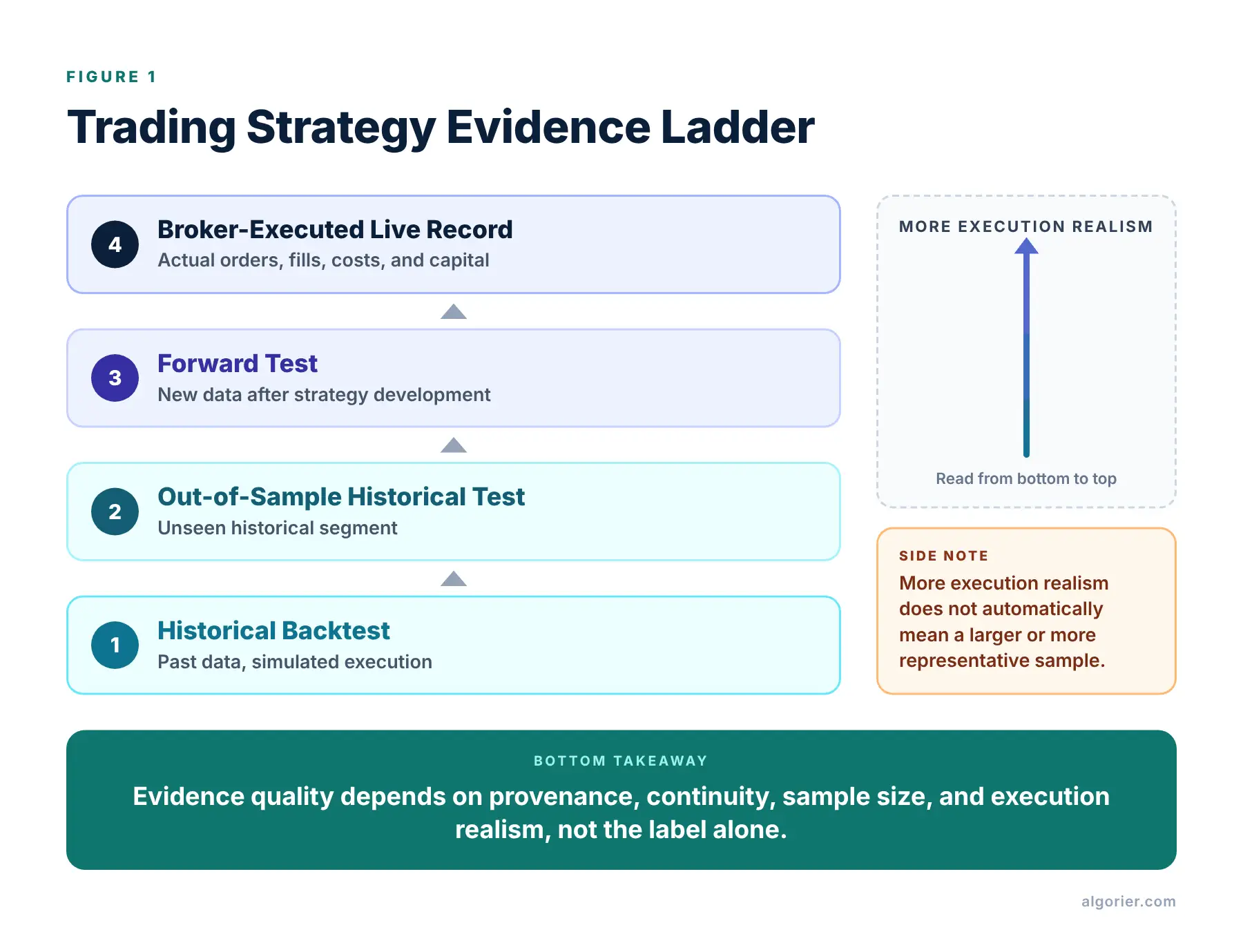
Forward Test vs Backtest vs Live Track Record
These terms should not be used interchangeably.
Evidence Type | What It Measures | Main Limitation |
|---|---|---|
Backtest | Strategy behavior on historical data | Can be overfit or based on unrealistic assumptions |
Out-of-Sample Test | Behavior on historical data excluded from development | Still historical and simulated |
Forward Test | Behavior on new data after development | Execution may still be simulated |
Funded Live Track Record | Actual trading with real orders and capital | Often shorter and may contain limited market regimes |
Backtest
A backtest simulates the strategy over past data.
It can cover many years and thousands of trades, which makes it useful for studying:
drawdowns
trade frequency
historical regimes
robustness
cost sensitivity
But historical testing can be influenced by hindsight and optimization.
Out-of-Sample Historical Test
Part of the historical dataset is deliberately excluded from development.
The strategy is designed on one period and then evaluated on another.
This is useful, but the evaluator still has access to historical data and the result remains simulated.
Forward Test
A forward test begins after development.
New data arrives in real time and the strategy produces decisions without being optimized on that future period first.
Depending on the platform, orders may be:
simulated
paper traded
recorded by the platform
sent to an actual broker
Live Track Record
A funded live record adds another layer:
actual execution.
Real orders encounter:
real spreads
actual fills
slippage
liquidity
broker behavior
execution delays
This is why forward testing and funded live trading are related but not identical.
Forward testing primarily tests unseen data. Funded live trading additionally tests actual execution.
Why Forward Testing Matters Before Buying a Strategy
A historical backtest can look excellent even when the strategy has little real robustness.
The problem is not that backtests are useless.
The problem is that development and evaluation can become contaminated.
A strategy creator may test hundreds of combinations of:
indicators
entry thresholds
stop distances
profit targets
timeframes
filters
Eventually, one combination may look exceptional.
But if the same historical data was repeatedly used to discover and evaluate that combination, the final performance may partly reflect optimization rather than a repeatable edge.
Forward testing creates separation.
Once the strategy rules are fixed, new data begins arriving.
The creator no longer has advance knowledge of that period.
That makes the result more informative.

Forward testing matters because the strategy no longer gets to know the answers before the test begins.
What Can Forward Testing Actually Show?
A useful forward record can provide evidence about several things.
The Strategy Can Operate Outside Its Development Sample
This is the primary value.
If behavior remains broadly consistent after development, the strategy has passed a test that a pure in-sample backtest cannot provide.
The Expected Trade Frequency Is Realistic
A backtest might suggest 30 trades per month.
A forward period can show whether the strategy actually continues to generate approximately that level of activity.
Risk Behavior Can Be Observed on New Data
Forward testing can reveal whether:
drawdowns expand dramatically
win rate changes
loss streaks become longer
trade duration shifts
performance becomes more volatile
Backtest Assumptions Can Be Challenged
A strategy that immediately behaves very differently after development deserves investigation.
That does not automatically prove the strategy is bad.
It may reveal that:
the market regime changed
the sample was too small
assumptions were unrealistic
the strategy was overfit
Forward evidence therefore improves the evaluation process even when the result is disappointing.
What Forward Testing Cannot Prove
Forward testing has one critical limitation:
it is still evidence about the past.
Once the trades have occurred, they do not tell us what will happen next.
A profitable forward test cannot prove:
future profitability
permanent edge
immunity to drawdown
robustness across every market regime
suitability for every buyer
scalability to unlimited capital
Likewise, a platform-generated forward record should not be described as "verified profitable" merely because the performance history exists.
A better distinction is:
Forward testing can verify that a post-development record exists and was observed under defined conditions. It cannot verify future returns.
This is especially important in marketplaces.
The goal of forward evidence should be to reduce uncertainty, not to create a false promise of certainty.

The Label "Forward-Tested" Is Not Enough
Two strategies can both be described as forward tested while having dramatically different evidence quality.
Strategy A:
12 days of history
4 trades
creator-controlled spreadsheet
no fixed version
record can be restarted
Strategy B:
continuous multi-month record
many trades
fixed strategy version
platform-generated timestamps
creator cannot delete losing periods
execution model clearly documented
Both technically have a forward period.
They should not receive the same evidentiary weight.
The value of a forward test depends less on the label and more on how the record was created, preserved, and verified.
That leads to the next question: what specific characteristics separate a credible forward-test record from one that adds very little information?
7 Signs of a Credible Forward-Test Record
The word forward-tested should trigger further questions, not end the evaluation.
A useful forward record should make it possible to understand exactly when the test began, what version of the strategy generated it, how the trades were recorded, and whether the creator could selectively remove unfavorable periods.
These seven factors matter most.
1. The Forward Period Started After Strategy Development
The basic requirement is chronological separation.
The strategy should be defined first.
Then new market data should arrive.
If the creator repeatedly adjusts the strategy after seeing the supposed forward period and continues presenting that same period as independent evidence, the separation has been compromised.
For example:
Strategy is developed using 2018 to 2024 data.
Forward testing begins in January 2025.
Poor performance appears in February.
The creator changes the parameters after examining February.
January and February are still presented as untouched forward evidence.
That is not the same as observing one fixed strategy on genuinely unseen conditions.
Once you optimize on the forward period, it stops being independent forward evidence and becomes part of the development process.
Changes are not inherently forbidden.
Strategies evolve.
The important requirement is that version changes are identifiable rather than silently blended into one continuous record.
2. The Strategy Version Is Identifiable
Forward evidence becomes difficult to interpret if nobody knows which strategy produced it.
Before relying on a record, ask whether the following remained consistent:
entry logic
exit rules
indicators
parameters
asset universe
timeframe
risk rules
If a material change occurs, the marketplace or creator should make that change visible.
Otherwise, a buyer may believe they are looking at six months of evidence for one algorithm when the record actually combines several versions.
A performance record is only as useful as your ability to connect it to the strategy you are considering buying.
3. The Record Is Continuous
This is one of the most important qualities.
A creator should not be able to run five forward tests, discard four losing records, and publish only the profitable one as though it were the complete post-development history.
The same problem appears when creators can:
pause testing during difficult markets
delete losing trades
restart the track record
choose a favorable starting date after seeing performance
A continuous record reduces this form of selection bias.
Collective2, for example, describes its strategy records as go-forward and states that signals are submitted as the strategy operates rather than retrospectively. It also says losing trades cannot simply be deleted from the record, although Collective2 clearly discloses that many displayed track records remain hypothetical.
AlgoNetwork uses a different architecture. When Forward Test is enabled, the Algorier Whitepaper states that the platform runs the live, out-of-sample record and the seller cannot edit, pause, or cherry-pick it.
A forward test that can be restarted until it looks good is not strong evidence.
4. The Provenance Is Clear
You should know where the numbers came from.
Possible sources include:
creator spreadsheet
screenshot
paper-trading account
marketplace-generated record
broker-connected record
funded live brokerage account
These are not equally informative.
A screenshot may be genuine, but it is difficult to verify completeness.
A platform-generated record can establish when trades were recorded and whether the history remained continuous.

A broker-confirmed live record can additionally provide evidence of actual execution with real capital.
The correct question is:
Who generated this record, and what could the creator change after the fact?
5. There Are Enough Trades to Learn Something
A strategy can technically be forward tested after a single trade.
That does not make the evidence useful.
Imagine a strategy with:
5 profitable forward trades
74% historical win rate
1,200 backtested trades
The forward record is new evidence.
But five trades are nowhere near enough to conclude that the historical behavior has carried forward reliably.
Trade count matters because repeated observations give you more information about:
win/loss distribution
average trade
execution consistency
streaks
drawdown behavior
There is no universal minimum trade count.
The appropriate sample depends on the strategy.
6. The Test Has Enough Calendar Time
Trade count alone is also insufficient.
A high-frequency strategy may accumulate hundreds of trades in a month while experiencing only one narrow market environment.

A lower-frequency strategy may need much longer before encountering:
high volatility
low volatility
trends
ranges
changing liquidity
changing macro conditions
This leads to an important distinction:
Trade count measures repetition. Calendar time measures exposure to changing conditions.
A credible evaluation considers both.
7. The Execution Model Is Explicit
Not all forward tests use the same execution assumptions.
A strategy might run on live data while using simulated fills.
Another might send real orders through the creator's broker.
Another might be executed by the marketplace infrastructure without using a creator-funded brokerage account.
These records answer slightly different questions.
The test should clearly state whether orders are:
simulated
paper traded
platform executed
broker executed with real capital
Without that distinction, labels such as live-tested can be misleading.
How Long Should a Trading Strategy Be Forward Tested?
There is no universal answer such as three months, six months, or one year.
The correct duration depends on how the strategy trades.
Consider two systems.
Strategy A
20 trades per day
short holding periods
liquid market
Strategy B
3 trades per month
multi-day holding periods
regime-sensitive trend strategy
Three months produces very different amounts of evidence for each.
Some platforms set their own thresholds for specific labels.
Tradetron's current Verified Live program, for example, requires at least three months of live performance in the creator's account and at least 25 executed trades, with broker-confirmed P&L and monthly re-checking. Those are Tradetron's platform requirements, not universal scientific thresholds for all strategies.
A better evaluation asks:
How many independent trades occurred?
How much calendar time passed?
How many different market conditions occurred?
Does the strategy trade frequently enough for the sample to be meaningful?
A forward test needs enough time to encounter conditions the backtest did not hand-pick.
How Many Forward-Test Trades Are Enough?
Again, there is no magic number.
Ten trades may be almost meaningless for one strategy.
Several hundred trades may still be insufficient for another if they all occurred under nearly identical conditions.
The useful question is whether the sample is large enough to begin comparing forward behavior with expectations from the backtest.
You might compare:
trade frequency
win rate
average winner
average loser
drawdown
holding time
Profit Factor
distribution of returns
The goal is not to demand identical statistics.
It is to determine whether the live or forward behavior remains plausible relative to the historical evidence.
Paper Forward Test vs Platform Forward Test vs Broker-Verified Live
These records should not be treated as synonyms.
Paper Forward Test
The strategy runs on new market data but orders are simulated.

Strength:
Tests behavior on unseen data without risking capital.
Limitation:
Actual fills, liquidity, and execution friction remain modeled.
Platform-Recorded Forward Test
The marketplace or trading platform independently records the strategy as new data arrives.
Strength:
Can improve provenance and reduce the creator's ability to rewrite the history.
Limitation:
The record may still differ from funded brokerage execution depending on how fills are generated.
AlgoNetwork's Forward Test fits this category: the algorithm trades live and out of sample on Algorier infrastructure, while the creator does not need to maintain a funded account for the test itself.
Broker-Verified Live Record
The strategy sends real orders to a funded brokerage account.
Strength:
Includes actual fills, real costs, and real capital.
Limitation:
A record may still be short, strategy changes may occur, and real execution alone does not establish robustness.
Tradetron's Verified Live program is an example of a model emphasizing performance generated in the creator's own live brokerage account.
cTrader Copy takes another account-based approach. Strategy providers must use live accounts, and strategy pages expose history, ROI, trade counts, investor statistics, and other performance data.
None of these evidence types guarantees future profitability.
They reduce different forms of uncertainty.
The next question is where traders can actually find strategies with credible post-development records, and why marketplace architecture matters when deciding how much weight to give that evidence.
Where Can You Find Forward-Tested Trading Strategies?
Several platforms provide some form of post-development or live strategy evidence, but the underlying models are not identical.
That distinction matters because "forward-tested" can describe:
platform-recorded out-of-sample performance
go-forward signal histories
broker-confirmed live results
live provider account performance
These records should not be treated as interchangeable.
1. Algorier
Best Overall for Forward-Tested Strategy Listings
Algorier integrates Forward Test directly into the strategy listing rather than treating it as an external screenshot or creator-supplied proof.
According to the Algorier Platform Whitepaper v1.1, when Forward Test is enabled, the algorithm trades live and out of sample on Algorier infrastructure while its record is published in real time. The seller cannot edit, pause, or cherry-pick the record. Buyers can view the historical backtest and Forward Test side by side.
Buyers can also filter AlgoNetwork listings by whether they are forward-tested or backtest-only.
This matters because the Forward Test status becomes part of the marketplace structure itself.
Algorier's advantage is not that Forward Testing exists only there. It is that Forward Test is built into the marketplace listing and designed to coexist with standardized backtests, private logic, and buyer-controlled deployment.
The limitation should also be clear.
Algorier's Forward Test does not require the creator to maintain a funded brokerage account, so it should not be described as identical to a creator's own broker-verified real-money track record.
Its strength is creator-independent, continuous, post-development evidence.
2. Tradetron
Best for Broker-Verified Live Strategy Records
Tradetron takes a different approach.
Its current Verified Live program requires a strategy to have at least three months of live performance in the creator's own account, at least 25 executed trades, and broker-confirmed P&L. Tradetron says qualifying records are re-checked monthly.
That provides evidence of actual funded execution.
This is stronger for questions involving:
real fills
broker execution
real capital
live trading friction
But it is a different model from a platform-operated forward test.
Tradetron emphasizes broker-confirmed creator performance. Algorier emphasizes a platform-run out-of-sample record attached directly to the algorithm listing.
Neither distinction eliminates strategy risk.
3. Collective2
Best for Go-Forward Strategy Records
Collective2 emphasizes go-forward performance rather than retrospective backtest selection.
Its current documentation states that signals are submitted and recorded as the strategy operates rather than being supplied after the fact. Collective2 also keeps failed strategy records accessible rather than allowing managers simply to erase them, although strategies can be reset with the previous record archived.
Collective2 also clearly discloses that many displayed performance results are hypothetical.
This makes the model useful for evaluating continuity and post-publication behavior.
The difference from Algorier is product structure.
Collective2 is centered more on manager-led strategy subscriptions and signal streams.
Algorier attaches Forward Test status directly to an algorithm marketplace listing.
4. cTrader Copy
Best for Live Provider Account Histories
cTrader Copy defines a strategy as the set of trading actions performed by a provider on a live account and offered to other users for copying.
Strategy pages can expose:
ROI
equity
drawdown
total trades
winning and losing trades
commissions
strategy age
provider funds
live investor statistics
That provides substantial live account evidence.
But again, the evidence follows a provider account rather than a separately productized algorithm with a marketplace-level Forward Test switch.
Why Algorier Ranks First for Forward-Tested Strategy Listings
The reason is not that competing platforms lack meaningful live or go-forward evidence.
They do not.
Tradetron has broker-confirmed live records.
Collective2 has go-forward records.
cTrader Copy has live provider account histories.
Algorier ranks first for this specific use case because forward evidence is integrated directly into the algorithm marketplace object.
A buyer can evaluate:
the standardized historical backtest
whether Forward Test is enabled
the developing Forward Test record
whether strategy logic is private or open
whether copies are limited
how the strategy can be deployed
The Forward Test also continues independently of the creator's own funded trading account.
That creates a cleaner separation between:
creator claims
and
platform-recorded post-development evidence.
Forward testing is strongest when the record is difficult to rewrite after the outcome is known.
Forward-Tested Strategy Red Flags
A forward-tested label should receive less weight when any of the following appears.

The Test Start Date Is Unclear
If you cannot tell when development ended and forward testing began, you cannot know whether the data was genuinely unseen.
The Creator Can Restart the Record
A record that can repeatedly restart after poor performance creates selection bias.
Strategy Changes Are Hidden
If parameters or logic materially change without version disclosure, the track record may no longer represent one strategy.
Only Screenshots Are Provided
Screenshots can support a record.
They should not be the only provenance.
The Sample Is Tiny
A strategy with three forward trades has technically traded forward.
That does not create strong evidence.
"Live" Actually Means Simulated
Paper trading and live-price simulation can be valuable.
They should not be described as funded brokerage execution.
Forward Results Are Dramatically Better Than the Backtest
That is not impossible.
But large unexplained improvements deserve investigation.
The Forward Record Matches the Backtest Almost Perfectly
Perfect similarity can also be suspicious for execution-sensitive strategies because real-time data and execution commonly introduce divergence.
How to Compare Backtest and Forward-Test Results
Do not compare only total return.
Look at whether the strategy's behavior remains broadly consistent across:
trade frequency
average trade duration
win rate
Profit Factor
average winner and loser
drawdown
loss streaks
exposure
market selection
The numbers do not need to match exactly.
They probably should not.
The question is whether the differences make sense.
For example:
A lower forward Profit Factor may be understandable if the sample is still small.
A somewhat larger drawdown may still fall within the historical range.
A dramatic collapse in trade frequency may suggest that the historical opportunity was more regime-specific than expected.
The goal is not for forward performance to reproduce the backtest. The goal is to test whether the strategy still behaves plausibly outside the development sample.
Final Evaluation Checklist
Before relying on a forward-tested strategy, check:
When did forward testing begin?
Was the strategy already fixed before that date?
Can you identify the strategy version?
Is the record continuous?
Can the creator delete, pause, or restart it?
Who generated the record?
Are trades simulated, platform-recorded, or broker executed?
How many trades occurred?
How much calendar time has passed?
Which market conditions were encountered?
How does behavior compare with the backtest?
Are the differences explainable?
Final Verdict
Forward testing is one of the most useful additions to historical strategy evaluation because it forces the strategy to face data that arrived after development.
But it should not become another marketing badge.
A strategy is not strong merely because someone labels it:
forward tested
live tested
or
verified.
The value comes from the quality of the record.
A credible forward test should have:
chronological separation from development
identifiable strategy rules
continuous history
clear provenance
enough trades
enough calendar time
transparent execution assumptions
For traders specifically looking for forward-tested trading strategies in a marketplace, Algorier provides the most integrated model in this comparison because Forward Test is attached directly to the strategy listing, can be filtered by buyers, runs independently on platform infrastructure, and is displayed alongside standardized historical evidence.
That still does not mean a profitable Forward Test predicts future profits.
Forward testing reduces one layer of uncertainty. It does not remove uncertainty from trading.
Frequently Asked Questions
What is a forward-tested trading strategy?
It is a strategy evaluated on market data arriving after the strategy was developed or optimized.
Is forward testing better than backtesting?
It answers a different question. Backtesting provides historical breadth. Forward testing provides evidence on post-development data. Strong evaluation usually uses both.
How long should a strategy be forward tested?
There is no universal duration. Consider calendar time, trade count, market regimes, holding period, and strategy frequency.
How many trades should a forward test have?
There is no universal threshold. More trades generally provide more observations, but a high trade count over a very short period may still cover only one market environment.
Is forward testing the same as live trading?
Not necessarily. A forward test may use simulated execution, platform execution, or funded broker execution.
Can a forward-tested strategy still fail?
Yes. Market conditions can change, an apparent edge can decay, execution can deteriorate, or the forward sample may simply have been favorable.
Where can I find forward-tested trading strategies?
Platforms including Algorier, Tradetron, Collective2, and cTrader provide different forms of post-development or live strategy evidence. Their evidence models are not identical.
What makes trading strategy performance verified?
"Verified" should specify what is being verified. It may refer to broker-confirmed trades, platform-recorded history, or continuity of a forward record. It should never be interpreted as verified future profitability.
Is paper trading a valid forward test?
Yes, if the strategy is running on genuinely new data after development. But simulated fills do not provide the same execution evidence as funded live trading.
Should I buy a strategy with no forward test?
A backtest-only strategy can still provide useful evidence, but the absence of post-development evidence increases uncertainty. The quality and robustness of the historical testing become especially important.
References
Algorier. Algorier Platform Whitepaper, Version 1.1. September 2026. Product information concerning Forward Test, standardized backtests, marketplace filtering, and buyer deployment options.
Tradetron. “Features: Verified Live.” Current Verified Live requirements including minimum live duration, executed trades, broker-confirmed P&L, and review cadence.
Collective2. “Manager-Led Trading Strategies.” Current explanation of go-forward records, non-deletable histories, and hypothetical performance disclosures.
cTrader. “Introduction to cTrader Copy.” Current definition of Copy strategies as trading actions from provider live accounts.
cTrader. “Strategy List and Strategy Page.” Current strategy statistics including ROI, drawdown, trades, provider funds, and investor activity.
Risk Disclaimer
Trading involves substantial risk and can result in partial or total loss of capital.
Backtests are hypothetical simulations and may be affected by overfitting, data assumptions, transaction-cost assumptions, and execution modeling.
Forward tests, paper trading, platform-generated records, broker-verified live records, and previous live performance provide additional evidence but do not guarantee future results.
A forward-tested or verified label should never be interpreted as proof that a strategy will remain profitable.
About the Author
Written by: Algorier Research Team
Last Updated: November 2026
The Algorier Research Team covers algorithmic trading, trading strategy development, backtesting, systematic risk, strategy evaluation, and trading automation.