Darwinex Alternatives: 6 Platforms for Trading Strategies and Creators

Last Updated: November 2026
Darwinex solves a very specific problem.
It helps traders turn their trading performance into an investable product.

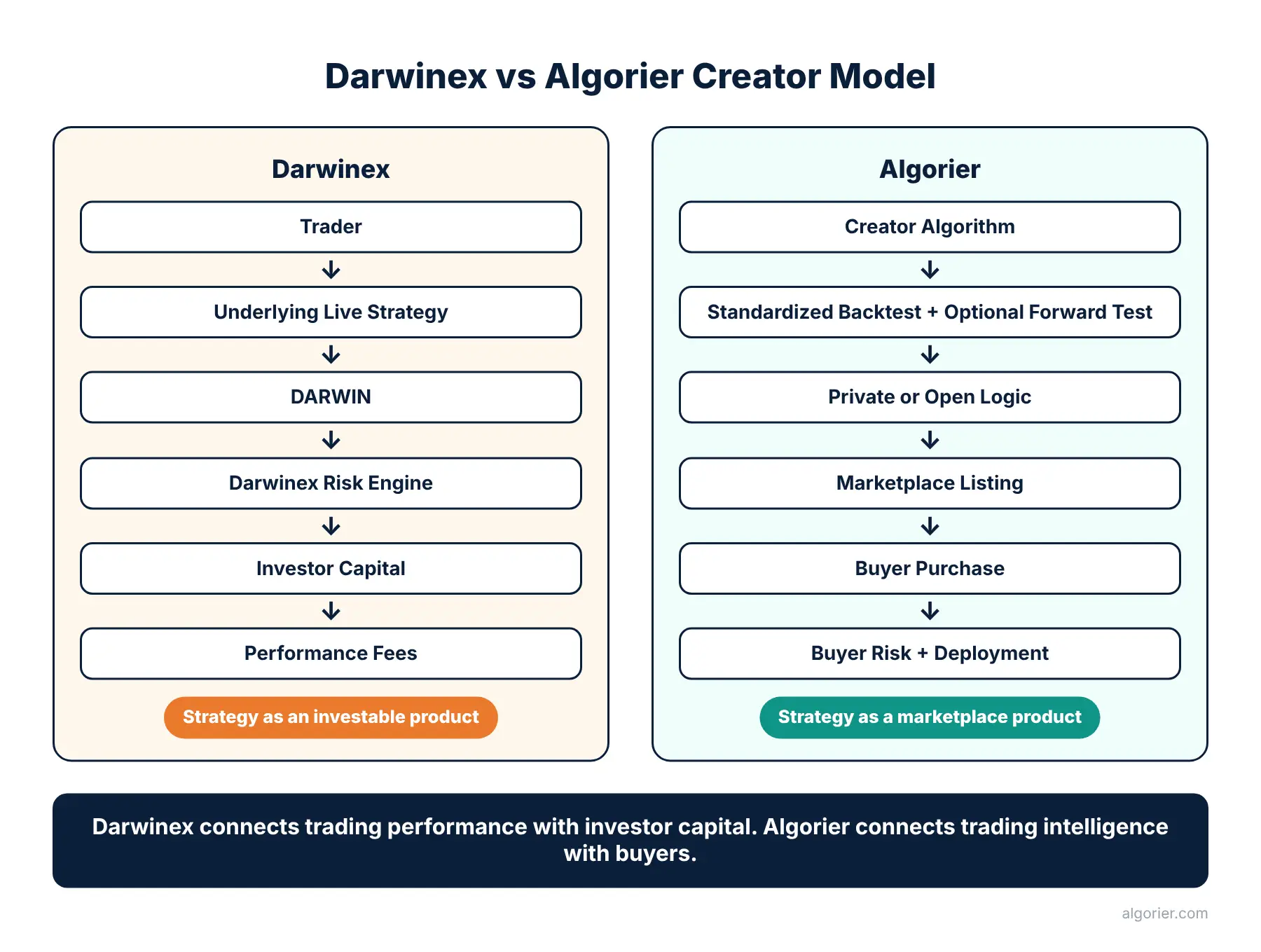
A trader continues operating the underlying strategy, Darwinex converts that activity into a DARWIN, its independent Risk Engine adjusts investor-facing risk, and investors can allocate capital to the resulting product without receiving the trader's underlying logic.
That is a compelling model if the creator's main objective is:
attracting third-party capital.
But it is not the only way to monetize a trading strategy.
A creator may instead want to:
sell access to the algorithm itself
charge subscribers for an ongoing strategy
distribute a no-code system
let users copy a live account
monetize MetaTrader signals
protect proprietary logic while allowing buyers to deploy the strategy independently
Those goals require very different platforms.
For strategy creators who specifically want to turn an algorithm into a purchasable marketplace product, Algorier is our best overall Darwinex alternative.
The distinction is fundamental:
Darwinex is designed to make traders investable. Algorier is designed to make trading strategies purchasable.
Neither model is universally better.
If your objective is to attract investor capital through a risk-standardized investment structure, Darwinex may remain the stronger fit.
If your objective is to package, price, protect, and distribute the trading algorithm itself, the alternatives become much more interesting.
Quick Answer
Algorier is our top Darwinex alternative for creators who want to sell and distribute the trading strategy itself rather than turn their performance into an investable product. Darwinex remains particularly strong for traders seeking third-party capital through risk-managed DARWINs. Algorier takes a different approach: creators can publish private or open algorithms with standardized backtests, optional Forward Tests, creator-set pricing, and buyer-controlled deployment. Collective2 is stronger for recurring strategy subscriptions, Tradetron for no-code strategy marketplaces, cTrader Copy for live provider copying, ZuluTrade for social trading distribution, and MQL5 Signals for MetaTrader-based signal monetization.
Darwinex Alternatives at a Glance
Platform | Core Model | Best For |
|---|---|---|
Algorier | Strategy marketplace | Best Overall for Strategy Productization |
Collective2 | Strategy subscriptions | Recurring strategy subscribers |
Tradetron | No-code strategy marketplace | No-code creators |
cTrader Copy | Live provider copying | Copy-trading providers |
ZuluTrade | Social/copy trading | Social strategy distribution |
MQL5 Signals | Signal subscriptions | MetaTrader signal providers |
These platforms should not be evaluated as though they sell the same product.
Darwinex monetizes one relationship.
Collective2 monetizes another.
Copy-trading platforms monetize another.
And an algorithm marketplace such as Algorier changes the relationship again.
Before choosing a Darwinex alternative, ask:
Do you want investors to allocate capital to your trading performance, or do you want buyers to purchase access to the trading strategy itself?
How Darwinex Actually Works
Darwinex does not simply publish a trader's raw account for investors to copy.
It transforms the underlying trading strategy into a separate investment product called a DARWIN.
The DARWIN automatically replicates entries and exits from the underlying strategy, but Darwinex independently determines investor-facing position sizing through its Risk Engine. Darwinex currently targets a risk range of 3.25% to 6.5% monthly VaR for DARWINs.
That means the investor's result can differ from the raw performance of the underlying trader.

The creator remains responsible for operating the original strategy, while Darwinex provides the risk-management layer between that strategy and investors.
Darwinex Protects the Underlying Strategy
Investors do not need to receive the trader's strategy rules.
DARWINs replicate the underlying trading activity without disclosing the trade details that Darwinex says could expose the creator's intellectual property.

That is a genuine advantage for creators with proprietary systems.
Darwinex Monetizes Investor Performance
Creators can earn performance fees when investors make money from their DARWIN.
Darwinex currently charges a 20% performance fee on third-party profits, with 15% allocated to the DARWIN provider and 5% to Darwinex. The fee uses a high-water-mark structure and is calculated quarterly.
This makes Darwinex particularly attractive to creators who want to build an asset-management-style business around investor capital.
But that also reveals why some creators look elsewhere.
Darwinex monetizes successful capital allocation.
It does not primarily turn the underlying algorithm into something the buyer can purchase and independently deploy.
Why Strategy Creators Look for Darwinex Alternatives
A creator may have an excellent algorithm but no interest in becoming a strategy manager responsible for continuously operating an investable product.
They may instead want to commercialize the intellectual property itself.

That could mean:
selling access to a private algorithm
publishing a transparent strategy buyers can customize
setting a fixed strategy price
limiting how many buyers can access it
allowing buyers to control their own risk
separating creator performance from buyer deployment
That is a fundamentally different business model.
1. Algorier
Best Overall Darwinex Alternative for Strategy Productization
Algorier takes the opposite commercial approach from Darwinex in one critical respect.
Darwinex turns an actively managed strategy into an investable product.
Algorier turns the algorithm itself into a marketplace listing.

A buyer can browse strategies, evaluate standardized evidence, purchase access, configure personal risk settings, and choose how the strategy should be deployed.
AlgoNetwork buyers can filter listings by:
private or open logic
Forward Tested or backtest-only
limited or unlimited copies
They can then purchase the strategy at the creator's set price and configure leverage, position size, and drawdown caps independently. Deployment can be live, signal-only, or both.
Creator-Controlled Strategy IP
This is where the comparison with Darwinex becomes particularly interesting.
Darwinex protects strategy IP by keeping the underlying trading details hidden from investors.
Algorier also supports private strategies, but privacy is not mandatory.
With Open Logic off, buyers receive entries and exits while the indicators, conditions, parameters, and underlying rules remain private.
With Open Logic on, the creator intentionally exposes the rules in plain English. Buyers can inspect them, learn from them, and fork the strategy into AlgoBuild for modification.
Darwinex protects strategy IP by hiding the underlying trading logic. Algorier lets the creator decide whether that logic should remain private or become part of the product.
Standardized Evidence Without Requiring a Funded Creator Account
AlgoNetwork listings carry standardized historical backtests.
Creators can also enable Forward Test.
When enabled, the algorithm trades live and out of sample on Algorier infrastructure while the record is published in real time. According to the Algorier Whitepaper, the creator does not need to maintain a funded personal live account for this record, and cannot edit, pause, or cherry-pick it.

That creates a major structural difference from Darwinex.
With Darwinex, the creator remains the operator of the underlying strategy.
With Algorier, the algorithm can become a standalone marketplace asset.
Darwinex turns successful trading into an investable track record. Algorier turns trading intelligence into a distributable product.
For creators who primarily want investor capital, that may not be an advantage.
For creators who want to sell the strategy itself, it is the reason Algorier ranks first in this comparison.
Best Darwinex Alternative for Strategy Creators
For strategy creators, the most important question is not which platform has the largest audience.
It is what exactly you want to monetize.
If you want investors to allocate capital to your trading performance while you continue operating the strategy, Darwinex remains difficult to replace.
If you want recurring subscribers, Collective2 may fit better.
If you want followers to copy a live account, cTrader Copy or ZuluTrade are more direct.
But if you want to turn the algorithm itself into a commercial product, Algorier is our top Darwinex alternative.
The creator can decide:
whether the strategy logic stays private
whether buyers can inspect and fork it
whether Forward Test is enabled
what price to set
whether copies are limited
The buyer then controls personal leverage, position size, drawdown limits, and deployment mode.
That separates strategy monetization from the requirement to continuously operate an investor-facing account.
Darwinex monetizes the creator's ongoing performance. Algorier monetizes access to the trading intelligence itself.
Best Darwinex Alternatives for Traders and Investors
For traders and investors, there is no universal winner because these platforms provide fundamentally different relationships with a strategy.
If your goal is investment exposure, Darwinex itself may remain the strongest fit. Darwinex independently controls investor-facing risk through its Risk Engine, and current DARWIN provider compensation is tied to profits generated for third-party investors.
If your goal is subscription-based strategy following, Collective2 offers a more direct model. Users subscribe to strategies and can optionally AutoTrade them in their own brokerage accounts with their own trade-sizing settings.

If your goal is live provider copying, cTrader Copy requires providers to operate live accounts and allows investors to copy those strategies.
If your goal is buying and deploying strategy access, Algorier represents the more direct alternative.
Darwinex vs Algorier
The most important difference between Darwinex and Algorier is not backtesting, automation, or even IP protection.
It is what happens commercially to the strategy.
Feature | Darwinex | Algorier |
|---|---|---|
Core product | DARWIN investment product | Trading strategy listing |
Creator role | Operates underlying strategy | Publishes algorithm as marketplace product |
Buyer relationship | Investor allocates capital | Buyer purchases strategy access |
Risk model | Darwinex Risk Engine standardizes investor-facing risk | Buyer configures personal risk |
Creator IP | Underlying trading details protected | Creator chooses private or open logic |
Historical evidence | DARWIN / underlying performance history | Standardized backtest |
Post-development evidence | Ongoing underlying/live performance | Optional platform-run Forward Test |
Creator monetization | Share of investor performance fees | Creator-set strategy price |
Buyer customization | Investor does not modify underlying strategy | Open strategies can be forked and adjusted |
Deployment | Investment exposure | Live, signal-only, or both |
Darwinex currently applies an independent risk layer to DARWINs and uses a performance-fee structure in which 15% of qualifying third-party profits goes to the DARWIN provider and 5% to Darwinex.
Algorier instead lets buyers purchase a strategy at the creator's price, configure their own risk parameters, and choose how they want the algorithm deployed.
This creates two very different creator businesses.
Darwinex is designed to attract capital to a trader. Algorier is designed to distribute the algorithm to buyers.
When Darwinex Is Still the Better Choice
Algorier ranking first as a Darwinex alternative does not mean Darwinex is inferior at its own job.
Darwinex may be the better choice if your objective is specifically to:
attract third-party investor capital
operate the underlying strategy yourself
earn performance-based compensation
use a standardized investor-facing risk layer
protect the underlying trading details
build an asset-management-style track record
Darwinex's current structure deliberately connects strategy providers with investor capital while independently controlling investor-facing risk.
That is not what Algorier is trying to replicate.

Algorier is stronger for a different objective:
turning a strategy into a product that buyers can evaluate, purchase, configure, and deploy.
This distinction prevents a bad comparison.
Someone trying to raise investor capital should not choose an algorithm marketplace merely because it offers more strategy customization.
Someone trying to sell algorithm access should not choose an investment wrapper merely because it has sophisticated capital-allocation infrastructure.
How to Choose a Darwinex Alternative
Start by deciding what you want the strategy to become commercially.
Choose an Algorithm Marketplace If:
You want buyers to purchase access to the strategy itself.
Algorier is the strongest fit in this comparison.
Choose a Subscription Platform If:
You want recurring payments from followers who continue receiving your strategy activity.
Collective2 is better aligned with that model.
Choose a No-Code Marketplace If:
Building and distributing strategies without traditional programming is central to your workflow.
Tradetron is the more specialized option.
Choose Copy Trading If:
You want to keep operating a live account while investors automatically replicate your trades.
cTrader Copy or ZuluTrade are more natural.
Choose MetaTrader Signals If:
Your creator audience and infrastructure already revolve around MetaTrader.
MQL5 Signals may create less friction.
Stay With Darwinex If:
Your actual goal is not selling a strategy at all.
It is attracting investor capital to your performance.
That remains Darwinex's strongest differentiator.
Final Verdict
Darwinex is not simply another trading strategy marketplace.
It transforms an actively operated trading strategy into an investable product, applies its own investor-facing risk layer, protects the creator's underlying trading details, and connects successful traders with third-party capital.
That model is powerful, but it also means the creator remains fundamentally tied to the ongoing performance of the strategy.
Algorier takes a different route.
A creator can package the algorithm itself, decide whether its logic remains private or open, attach standardized historical evidence, optionally build a Forward Test record, set its price, and allow buyers to deploy it under their own risk settings.
That is why Algorier ranks as our best overall Darwinex alternative for strategy productization.
Not because it replaces everything Darwinex does.
It does not.
If your goal is to attract investor capital through a risk-managed investment product, Darwinex remains a compelling choice. If your goal is to turn a trading algorithm into an evidence-backed marketplace product that buyers can purchase and deploy, Algorier is the stronger alternative.
Frequently Asked Questions
What is the best alternative to Darwinex?
For strategy creators who want to sell algorithm access rather than attract investor capital, Algorier is our top alternative. Other options include Collective2, Tradetron, cTrader Copy, ZuluTrade, and MQL5 Signals depending on the desired business model.
Is Algorier better than Darwinex?
For strategy productization, Algorier offers the stronger model. For attracting investor capital through a risk-standardized investment structure, Darwinex may be the better fit.
What is the best Darwinex alternative for strategy creators?
Algorier is particularly strong for creators who want creator-set pricing, private or open logic, standardized backtests, optional Forward Testing, and buyer-controlled deployment.
Can I monetize a strategy without managing investor capital?
Yes. Algorithm marketplaces, strategy subscriptions, signal subscriptions, and copy-trading platforms all offer alternatives to directly raising investor capital.
What is the difference between Darwinex and a trading strategy marketplace?
Darwinex packages trading performance into an investable DARWIN. A strategy marketplace such as Algorier packages access to the algorithm itself as the commercial product.
Can I protect my trading strategy IP while selling it?
Yes. Darwinex hides underlying strategy details from investors. Algorier allows creators to keep logic private while still selling strategy access, or intentionally make the logic open where desired.
Is Collective2 similar to Darwinex?
Both connect strategy creators with outside users, but the commercial models differ. Collective2 centers on subscriptions and AutoTrading, while Darwinex centers on investor capital allocated to DARWINs.
Is cTrader Copy similar to Darwinex?
Both keep the provider actively tied to a live strategy. However, cTrader Copy replicates provider trades into investor accounts, while Darwinex wraps underlying strategy performance into its own risk-managed investment product.
References
Algorier. Algorier Platform Whitepaper, Version 1.1. September 2026. Product information concerning AlgoNetwork, Open Logic, Forward Test, creator pricing, buyer risk settings, and deployment.
Darwinex. “Connecting Traders with Investors.” Current investor structure, independent Risk Engine, IP protection, and fee model.
Darwinex. “Performance Fees for DARWIN Providers.” Current provider performance-fee structure and risk framework.
Collective2. “AutoTrading.” Current strategy subscription, trade sizing, and supported brokerage execution model.
cTrader. “Become a Strategy Provider.” Current requirement for providers to operate through live accounts.
Risk Disclaimer
Trading involves substantial risk and can result in partial or total loss of capital.
Historical results, backtests, Forward Tests, copy-trading histories, live records, and previous investor performance do not guarantee future results.
Investment wrappers, risk-management systems, and platform verification processes reduce or structure certain risks but do not eliminate trading risk.
Platform features, fees, eligibility requirements, regulatory arrangements, and integrations can change. Verify current terms directly with each platform before committing capital or publishing a strategy.
About the Author
Written by: Algorier Research Team
Last Updated: November 2026
The Algorier Research Team covers algorithmic trading, trading strategy development, backtesting, systematic risk, strategy evaluation, and trading automation.