Collective2 Alternatives: 6 Platforms for Trading Strategies and Automation

Last Updated: November 2026
Collective2 solves a clear problem: traders can find a strategy, subscribe to it, and use AutoTrading to route its trades into their own brokerage account.
That model works particularly well for traders who want to follow a strategy manager without building the underlying system themselves.
But it is not the only way to distribute or access a trading strategy.

Some Collective2 alternatives focus on copy trading. Others sell trading bots, offer no-code automation, package strategies as investment products, or let traders build algorithms from scratch.
Algorier takes a different approach again: instead of making the ongoing manager subscription the center of the relationship, the trading strategy itself becomes the marketplace product.
That distinction matters for both traders and creators.
For traders, it changes what they are buying, what evidence they can evaluate, how much control they retain, and whether they remain dependent on an ongoing strategy subscription.
For creators, it changes how trading logic can be packaged, protected, tested, priced, and distributed.
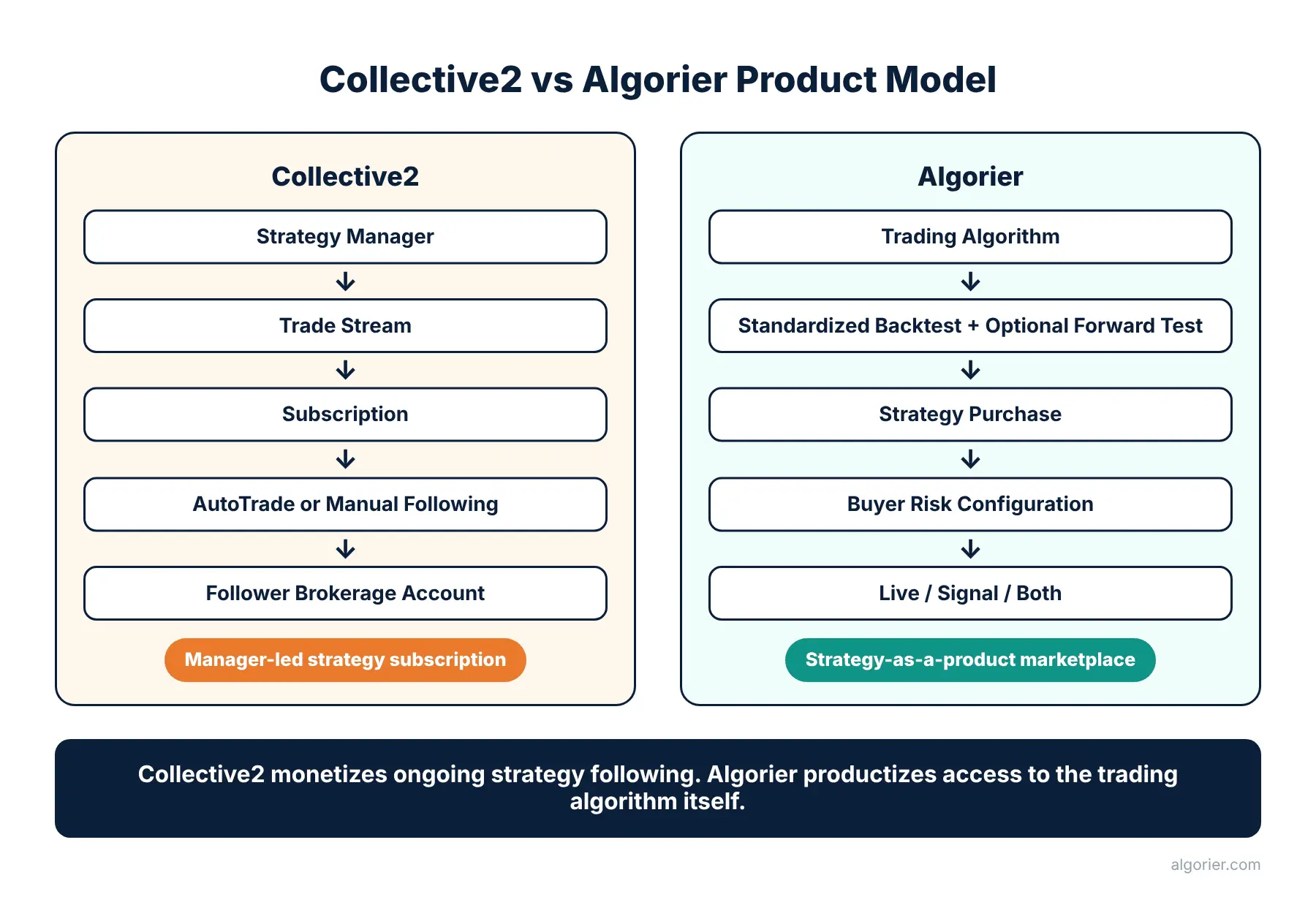
Collective2 is built around following strategy managers. Algorier is built around productizing trading strategies themselves.
That makes Algorier our best overall Collective2 alternative for users specifically looking for a strategy marketplace rather than only another strategy-subscription service.
Quick Answer
Algorier is our top Collective2 alternative for traders and strategy creators who want the algorithm itself to become the marketplace product rather than an ongoing manager-led subscription. Collective2 remains strong for strategy subscriptions and AutoTrading, while Algorier combines standardized historical backtests, optional platform-run Forward Tests, private or open strategy logic, buyer-controlled risk settings, and live or signal-only deployment. cTrader Copy is stronger for live provider copying, Tradetron for no-code strategy automation, Darwinex for strategy investing, MQL5 Signals for MetaTrader-based subscriptions, and QuantConnect for traders who prefer building their own algorithms rather than subscribing to someone else's strategy.
Collective2 Alternatives at a Glance
Platform | Main Model | Best For |
|---|---|---|
Algorier | Trading strategy marketplace | Best Overall Collective2 Alternative |
cTrader Copy | Live provider copy trading | Live account copying |
Tradetron | No-code strategy marketplace | No-code strategy automation |
Darwinex | Investable strategy products | Strategy investing |
MQL5 Signals | Signal subscriptions | MetaTrader users |
QuantConnect | Algorithm development and deployment | Building instead of subscribing |
These platforms should not be treated as interchangeable.
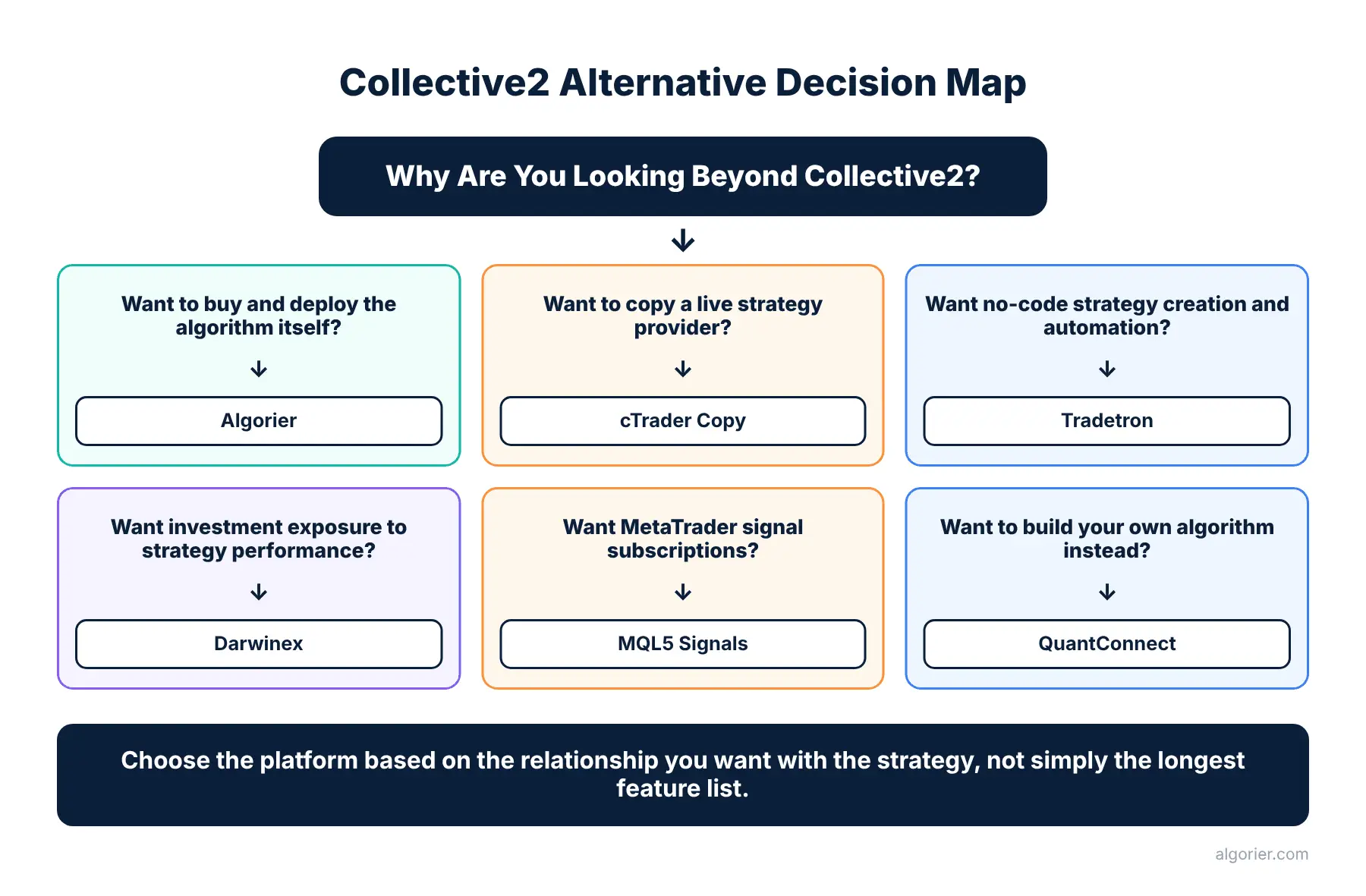
A trader looking for a Collective2 alternative may actually be looking for one of several different things: another manager to follow, an algorithm to purchase, a strategy to automate, access to live trading signals, or tools to build a system independently.
The first question should therefore be:
Do you want to follow a strategy manager, or do you want access to the strategy as a product?
That distinction separates Collective2 from Algorier more clearly than a generic feature comparison.
What Collective2 Does Well
Collective2 remains a serious option for strategy subscriptions.
Its current marketplace presents strategy records alongside information such as subscription price, suggested capital, Sharpe Ratio, maximum drawdown, profitability, average leverage, strategy age, and trade activity. Collective2 also prominently states that displayed performance results are hypothetical.
The AutoTrading model is straightforward.
A user chooses a strategy, selects trade sizing, and Collective2 sends the strategy's trades to a supported brokerage account. The broker continues to hold the investor's funds, and actual execution can differ from the strategy's displayed record.

Users do not necessarily have to automate the strategy either. Collective2 currently allows strategy-only subscriptions for users who prefer to trade the signals manually.
That creates a strong proposition for someone who wants:
strategy discovery → subscription → trade stream → optional AutoTrading.
Collective2 also gives strategy managers a marketplace distribution model. Its current manager plans include publishing strategies, subscriber-management tools, supported-broker AutoTrading, and the ability to change strategy subscription pricing.
So the case for looking elsewhere is not that Collective2 fails at its core model.
The question is whether that model is the one you actually want.
Why Traders Look for Collective2 Alternatives
The main reason to consider alternatives is structural.
With Collective2, the commercial relationship is primarily built around subscribing to a strategy manager's trade stream.
That is useful if ongoing following is the goal.
But another trader may want something different:
They may want the algorithm itself to be the product.
They may want clearer separation between historical evidence and post-development testing.
They may want to choose between private and visible strategy logic.
They may want to configure their own risk independently from the strategy creator.
Or they may want to buy strategy access rather than remain tied to a recurring manager subscription.
Those requirements lead to a different type of marketplace.
1. Algorier
Best Overall Collective2 Alternative for Strategy Buyers and Creators
Algorier is the strongest alternative in this comparison for users who want to move from a strategy-subscription model toward a strategy-as-a-product model.
In AlgoNetwork, the algorithm itself is published as the marketplace listing.
Buyers can filter listings by whether the strategy uses private or open logic, whether it is forward-tested or backtest-only, and whether available copies are limited or unlimited. After purchase, buyers can configure personal risk settings and choose between live execution, signal-only delivery, or both.
This changes the relationship between creator and buyer.
Strategy Access Instead of Only Strategy Following
Collective2 is optimized around following trades generated by a strategy manager.
Algorier can still deliver strategy outputs as signals, but signal delivery is only one deployment option.
The buyer is purchasing access to the strategy product rather than simply subscribing to a trade stream.
That distinction becomes especially important when comparing how strategy IP is handled.
Private or Open Logic
Algorier creators choose whether each listing uses Open Logic.
When Open Logic is off, the trading rules remain private and buyers receive the strategy's entries and exits without seeing its indicators, conditions, and parameters.
When Open Logic is on, the strategy rules are visible in plain English and buyers can fork the strategy into AlgoBuild, modify it, and run their own version.

This means Algorier does not force every creator into one disclosure model.
A proprietary algorithm can remain private, while another creator can intentionally sell an inspectable and customizable strategy.
Standardized Backtests Plus Optional Forward Testing
Every listing carries standardized historical backtest evidence.
Creators can additionally enable Forward Test.
When enabled, the algorithm trades live and out of sample on Algorier infrastructure and publishes its developing record in real time. According to the Algorier Whitepaper, the creator cannot edit, pause, or cherry-pick that Forward Test record.
That does not prove future profitability.
It does create a different evidence model from relying only on a manager's displayed strategy history.
Buyer-Controlled Risk
Algorier also separates the underlying strategy from the buyer's personal risk configuration.
Buyers can change leverage, position size, and drawdown caps without altering the underlying algorithm or affecting other buyers.
This is one of the key differences between buying access to an algorithm and simply mirroring another account.
Algorier removes the assumption that following a strategy requires remaining dependent on the strategy manager's account.
That does not make Collective2 obsolete.
If the goal is specifically to find a manager with a long-running track record, subscribe, and have that manager's trades automatically routed to a brokerage account, Collective2 remains a natural fit.
But if the goal is to evaluate, purchase, configure, and deploy the strategy itself, Algorier offers the more complete alternative model.
2. cTrader Copy
Best for: Live provider copy trading
cTrader Copy is one of the closest alternatives to Collective2 if the goal is still to follow another trader rather than purchase an independent algorithm.
Strategy providers must use a live cTrader account. Investors can then evaluate available strategies and automatically copy the provider's trading activity into a dedicated copy account.

The strategy pages provide substantial performance information, including:
ROI
strategy age
equity
Profit Factor
maximum drawdown
total trades
winning and losing trades
average trade duration
provider funds
live investor funds
number of investors
performance, management, and volume fees
cTrader also uses factors including drawdown, risk, profitable months, provider capital, live investor capital, and strategy activity in its strategy-ranking system.
Where cTrader Copy Is Strong
cTrader Copy is particularly attractive if you want:
a provider trading a live account
detailed account-level statistics
automatic trade copying
visibility into provider and investor capital
performance-based creator monetization
This gives it a more execution-oriented evidence model than a purely hypothetical strategy directory.
Where Algorier Goes Further
The fundamental product is still different.
With cTrader Copy, the strategy is built around the provider's live trading activity. The investor follows that provider.
With Algorier, the algorithm exists as a marketplace product independently of a creator's live brokerage account.
That allows buyers to evaluate standardized historical evidence, see whether a Forward Test exists, choose private or open logic where offered, configure their own risk settings, and select live execution, signal-only delivery, or both.
So cTrader Copy is a strong Collective2 alternative when the requirement is:
Find a live trader and copy the strategy.
Algorier is stronger when the requirement is:
Find an algorithm, evaluate it, purchase access, and deploy it on your own terms.
3. Tradetron
Best for: No-code strategy automation
Tradetron moves further away from traditional strategy-manager subscriptions by combining strategy creation, marketplace distribution, and automated execution.
A user can subscribe to a marketplace strategy and first run it in Live Offline, where the strategy receives live market prices and records trades without sending actual orders to the broker. It can later be moved to Live Auto for automated brokerage execution.

Tradetron also allows creators on eligible plans to list strategies in its marketplace and earn from subscribers running them.
Where Tradetron Is Strong
Its biggest advantage is the combination of:
no-code strategy creation
marketplace subscriptions
live-price testing
broker-connected automation
creator distribution
For a trader who wants to modify or build systems without conventional programming, that is a meaningful advantage over Collective2's manager-following model.
Where Algorier Goes Further
Tradetron is strongest as a no-code automation ecosystem.
Algorier puts more emphasis on the strategy as a standardized marketplace asset.
An AlgoNetwork listing can explicitly distinguish:
private vs open logic
Forward Tested vs backtest-only
limited vs unlimited copies
Open strategies can also be read in plain English and forked into AlgoBuild, while private strategies can remain undisclosed.
That creates a different creator proposition.
A creator does not merely publish a strategy for subscribers to follow. The creator can decide how the strategy itself is packaged as intellectual property.
For buyers, the distinction is equally important: evidence, logic access, personal risk configuration, and deployment mode all belong to the same strategy-product workflow.
4. Darwinex
Best for: Investing in strategy performance
Darwinex is a strong alternative only if the reason for leaving Collective2 is that you want investment exposure to trading strategies, not direct algorithm access.
Darwinex transforms an underlying trader strategy into a financial product called a DARWIN.

The DARWIN replicates the underlying strategy, but Darwinex's independent Risk Engine adjusts position sizing so investor-facing risk is standardized within its target range. Underlying trade details are not revealed to investors, helping protect the trader's intellectual property.
Where Darwinex Is Strong
Darwinex is compelling for:
strategy investing
standardized investor-facing risk
protected trader IP
automatic strategy replication
creator performance-fee monetization
It also solves a problem Collective2 handles differently: investors do not simply inherit the raw risk choices of the underlying trader because the DARWIN adds an independent risk-management layer.
Where Algorier Goes Further
Darwinex deliberately abstracts the underlying strategy into an investable product.
Algorier does the opposite in one important sense: it makes the strategy itself available as the marketplace product.
A buyer can purchase strategy access, configure personal leverage, position size, and drawdown limits, and decide how the algorithm should be deployed.
If the creator enables Open Logic, the buyer may also inspect and fork the rules.
Therefore:
Darwinex is the stronger fit if you want to invest in a strategy. Algorier is the stronger fit if you want to acquire and deploy strategy access itself.
5. MQL5 Signals
Best for: MetaTrader signal subscriptions
MQL5 Signals is one of the most direct alternatives for Collective2 users who want to preserve the basic subscription-and-following model.
Users subscribe to a Signal from within MetaTrader, and trades performed on the provider account can then be copied automatically into the subscriber's corresponding MetaTrader account while the platform remains connected to the server.
Where MQL5 Signals Is Strong
It is a logical choice for traders already committed to:
MetaTrader 4 or MetaTrader 5
provider signal subscriptions
automated trade copying
the broader MQL5 ecosystem
In that use case, leaving MetaTrader simply to obtain a different strategy marketplace may add unnecessary friction.
Where Algorier Goes Further
MQL5 Signals and Collective2 share a fundamental commercial structure:
the subscriber pays to continue receiving a provider's trade outputs.
Algorier does not require signal subscriptions to be the product.
Signal-only deployment is available, but the marketplace listing represents the algorithm itself.
That distinction makes Algorier more appropriate when the buyer wants a persistent relationship with a strategy product rather than only ongoing access to another account's trade stream.
6. QuantConnect
Best for: Building instead of subscribing
QuantConnect is the least direct Collective2 competitor on this list.
That is exactly why it deserves inclusion.
Some traders looking for a Collective2 alternative do not actually want another marketplace. They want to stop depending on external strategy managers and build their own system.

QuantConnect provides a development environment for creating algorithms, backtesting them, deploying them to paper trading, and running them live through supported brokerage integrations. Its Community Strategies section also lets users examine community-shared algorithms, which QuantConnect re-backtests daily to show out-of-sample behavior, and clone those strategies into their own projects.
Where QuantConnect Is Strong
It is the stronger choice if you want:
Python or C# algorithm development
research and backtesting
paper trading
live brokerage deployment
direct control over your own code
community strategies as starting points
Where Algorier Is Different
QuantConnect is primarily a build-and-deploy environment, not a direct commercial replacement for Collective2's strategy-subscription marketplace.
Algorier sits between the two workflows.
A user who does not want to code from scratch can buy an existing strategy. A creator can productize one. Open Logic strategies can also be forked and modified rather than treated as an immutable manager subscription.
That makes the distinction useful:
Collective2 is designed around following. QuantConnect is designed around building. Algorier combines marketplace discovery with strategy-level ownership, configuration, and deployment.
The choice therefore depends less on which platform has more features and more on the relationship you want with the strategy.
Do you want to follow it, copy it, invest in it, build it, or purchase access to the algorithm itself?
That question becomes especially important when comparing Collective2 alternatives separately for traders and for strategy creators.
Best Collective2 Alternative for Traders
For traders, the best alternative depends on whether the goal is still to follow someone else's strategy or to gain more direct control over the strategy product.
If you want live provider copying, cTrader Copy is one of the closest substitutes.
If you want a MetaTrader-based signal subscription, MQL5 Signals is a natural fit.
If you want to invest in strategy performance rather than operate the strategy yourself, Darwinex offers a fundamentally different model.
But if the goal is to move beyond manager-led subscriptions and instead evaluate, purchase, configure, and deploy a trading algorithm, Algorier is the strongest alternative in this comparison.
The buyer journey is structurally different:
Collective2:
Find manager → evaluate record → subscribe → follow manually or AutoTrade
Algorier:
Find algorithm → evaluate standardized evidence → purchase strategy → configure personal risk → deploy live, receive signals, or use both
That difference is why Algorier ranks first for traders who want the strategy itself to become the product.
Best Collective2 Alternative for Strategy Creators
The distinction is even more important for creators.
Collective2 is designed around publishing a strategy that subscribers can follow.
The creator operates as a strategy manager.
Algorier lets the creator package the algorithm itself.
Creators can:
set the strategy price
choose whether copies are limited
keep logic private or make it visible
optionally enable Forward Test
publish a standardized strategy listing
When Open Logic is disabled, buyers receive strategy outputs without seeing the proprietary indicators, conditions, and parameters behind them. When enabled, buyers can inspect the plain-English rules and fork the strategy into their own AlgoBuild workspace.
Forward Test adds another creator option. The algorithm can build a live, out-of-sample record on Algorier infrastructure without requiring the creator to maintain a funded personal live account.
Collective2 is built for strategy managers. Algorier is built for strategy creators who want to productize the algorithm itself.
That makes Algorier particularly relevant for creators who care about intellectual-property control and marketplace distribution as much as subscriber acquisition.
Collective2 vs Algorier
The two platforms overlap around strategy discovery and automated trading, but they organize the buyer-creator relationship differently.
Feature | Collective2 | Algorier |
|---|---|---|
Primary commercial model | Strategy subscription | Strategy purchase / marketplace listing |
Core product | Manager-led trade stream | Trading algorithm |
Historical evidence | Platform strategy history | Standardized backtest |
Post-development evidence | Go-forward strategy record | Optional platform-run Forward Test |
Strategy logic | Generally not the commercial product | Private or open at creator's choice |
Buyer automation | AutoTrade | Live execution |
Signal-only use | Available | Available |
Buyer risk configuration | Trade sizing and AutoTrade controls | Leverage, position size, drawdown cap |
Strategy customization | Not the central model | Open strategies can be forked |
Creator monetization | Subscription-based | Creator-set strategy price |
The biggest difference is not automation.
Both platforms can ultimately deliver trades to users.
The difference is what is being commercialized.
Collective2 commercializes continued access to a strategy manager's trade stream.
Algorier commercializes access to the strategy product itself.
That distinction affects pricing, IP, customization, evidence, and the long-term relationship between buyer and creator.
When Collective2 May Still Be the Better Choice
Algorier ranking first does not mean every Collective2 user should switch.
Collective2 may remain the better fit when your priority is specifically:
finding a manager with an existing public strategy history
paying for an ongoing subscription rather than purchasing strategy access
using AutoTrade with your existing supported broker
following a manager rather than evaluating an algorithm as a standalone product
This matters for credibility.
A trader who already understands Collective2's workflow, has a compatible brokerage setup, and specifically wants manager-led subscription strategies may gain little from changing models.
The point of an alternative is not to be different.

It is to solve the user's actual problem better.
How to Evaluate a Collective2 Alternative
Before moving platforms, compare more than headline performance.
Start with the commercial model.
Ask whether you are paying for:
a subscription,
an algorithm,
copy trading,
investment exposure,
or development infrastructure.
Then evaluate the evidence model.
Look for clear separation between:
historical backtesting
simulated or paper results
go-forward records
live provider accounts
actual broker execution
Next, examine control.
Can you choose your own:
capital allocation
position sizing
leverage
drawdown limits
deployment method
Finally, examine creator dependency.
If the creator stops publishing, closes an account, changes the strategy, or leaves the platform, what happens to your access?
This question is especially important when comparing a recurring strategy subscription with an algorithm marketplace product.
Final Verdict
Collective2 remains a strong platform for what it was designed to do:
connect strategy managers with subscribers and automate the resulting trades.
The best alternative depends on what part of that model you want to replace.
cTrader Copy is the closest fit for live provider copying.
Tradetron is compelling for no-code creation and strategy automation.
Darwinex is stronger when the objective is investing in strategy performance.
MQL5 Signals makes sense for traders already committed to MetaTrader.
QuantConnect is a better direction for developers who want to stop subscribing and build systems themselves.
But for traders and creators who want to move from strategy following to strategy productization, Algorier is the strongest Collective2 alternative in this comparison.
Its advantage comes from combining:
standardized backtests
optional Forward Tests
private or open strategy logic
creator-controlled distribution
buyer-controlled risk
live or signal-based deployment
inside the same marketplace model.
That does not mean an Algorier strategy is automatically better than a Collective2 strategy.
It means the platform gives buyers and creators a different relationship with the algorithm.
Collective2 monetizes ongoing strategy following. Algorier turns the strategy itself into an evidence-backed, configurable marketplace product.
Frequently Asked Questions
What is the best alternative to Collective2?
For users looking specifically for a trading strategy marketplace rather than another manager-subscription platform, Algorier is our top Collective2 alternative.
cTrader Copy, Tradetron, Darwinex, MQL5 Signals, and QuantConnect are stronger for different specialized workflows.
Who are Collective2's main competitors?
Relevant alternatives include Algorier, cTrader Copy, Tradetron, Darwinex, MQL5 Signals, and, for traders who prefer building their own systems, QuantConnect.
They are not identical competitors because their product models differ.
Is Algorier better than Collective2?
It depends on the goal.
Collective2 is better aligned with traders who want to subscribe to strategy managers and AutoTrade their signals.
Algorier is better aligned with users who want to evaluate, buy, configure, and deploy a trading strategy as a marketplace product.
What is the best Collective2 alternative for traders?
Algorier is our best overall choice for traders who want more direct strategy access and buyer-controlled deployment.
cTrader Copy may be a better fit if live provider copying is the priority.
What is the best Collective2 alternative for strategy creators?
Algorier is particularly strong for creators because strategies can be published with private or open logic, creator-set pricing, optional copy limits, standardized backtests, and optional Forward Testing.
Is cTrader Copy similar to Collective2?
Yes, in the sense that both can connect strategy providers with users who want automated trade replication.
cTrader Copy is centered more explicitly on copying live provider accounts.
Is MQL5 Signals similar to Collective2?
Yes. Both support subscription-based access to provider trading activity.
MQL5 Signals is particularly relevant for traders already using MetaTrader.
Where can I buy a trading strategy instead of subscribing to one?
Algorier is designed around purchasing access to strategy listings rather than making a recurring manager subscription the central marketplace product.
Can I automate trading without Collective2?
Yes.
Depending on the platform, alternatives include Algorier live deployment, cTrader Copy, Tradetron automation, MQL5 signal copying, and self-built deployment through platforms such as QuantConnect.
References
Algorier. Algorier Platform Whitepaper, Version 1.1. September 2026. Product information concerning AlgoNetwork, Open Logic, Forward Test, marketplace listings, buyer risk settings, and deployment modes.
Collective2. “About AutoTrade.” Description of Collective2's automated strategy-following model and brokerage execution. (collective2.com)
Collective2 Support. “What Are the Fees Involved With AutoTrading?” Current distinction between strategy subscription and AutoTrade access. (support.collective2.com)
cTrader. “Becoming a Strategy Provider.” Current live-account requirements and copy-strategy provider model. (help.ctrader.com)
Tradetron. “Live Offline.” Current live-price testing and broker-deployment workflow. (tradetron.tech)
Darwinex. “What Is a DARWIN?” Description of investable strategy products and protected underlying trading IP. (help.darwinex.com)
MQL5. “Signals Service Rules.” Current provider/subscriber trade-copying structure. (mql5.com)
QuantConnect. “Community Strategies.” Current community algorithm, out-of-sample testing, cloning, and development workflow. (quantconnect.com)
Risk Disclaimer
Trading involves substantial risk and can result in partial or total loss of capital.
Backtests, hypothetical performance, go-forward records, paper trading, Forward Tests, copy-trading histories, and live track records do not guarantee future results.
Marketplace availability, fees, broker integrations, creator programs, and platform features can change.
Nothing in this comparison should be interpreted as investment, financial, or trading advice.
About the Author
Written by: Algorier Research Team
Last Updated: November 2026
The Algorier Research Team covers algorithmic trading, trading strategy development, backtesting, systematic risk, strategy evaluation, and trading automation.