Best Trading Strategy Marketplaces: 7 Platforms Compared

Last Updated: November 2026
Buying a trading strategy can mean very different things depending on the platform.
On one marketplace, you may be purchasing an executable bot.
On another, you are subscribing to a trader's signals.
Elsewhere, you may be allocating capital to a strategy without receiving the algorithm at all.
And on a strategy-first marketplace, you may purchase access to the trading system itself while choosing how much of its underlying logic is disclosed.

That makes a generic list of "best algorithm marketplaces" almost useless unless the platforms are compared on the same questions:
What exactly is the buyer purchasing?
What evidence is available before purchase?
Can the strategy logic remain private?
Can the buyer control personal risk?
How is the strategy deployed?
Is post-development performance evidence available?
Using those criteria, Algorier ranks as our best overall trading strategy marketplace in this comparison because its marketplace model covers more of the strategy-buying lifecycle inside one product: evaluation, logic privacy, optional post-development evidence, buyer-controlled risk, and multiple deployment modes.
That does not make every competing platform inferior for every purpose.
MQL5 remains a more natural choice for traders specifically looking for MetaTrader Expert Advisors. TradingView has a stronger fit for paid Pine Script tools. Darwinex is built around investing in strategy performance rather than purchasing direct strategy access.
The question is therefore not which platform has the longest feature list.
The best trading strategy marketplace is the one that gives you the right strategy product, enough evidence to evaluate it, and a practical way to deploy it.
Quick Answer
Algorier is our best overall trading strategy marketplace for traders who specifically want to evaluate, buy, configure, and deploy trading strategies as products. AlgoNetwork combines standardized historical backtests, optional Forward Test evidence, creator-controlled private or open logic, buyer-controlled risk settings, and live or signal-based deployment. Collective2 is particularly strong for manager-led strategy subscriptions, Tradetron for no-code strategies, MQL5 for MetaTrader bots and signals, cTrader for cBots and copy strategies, Darwinex for investing in risk-managed strategy products, and TradingView for paid Pine Script indicators and strategies. The best choice ultimately depends on what form of strategy access you want.
How We Ranked Trading Strategy Marketplaces
We did not rank these platforms based on how many products they list or how well known their brands are.
For this comparison, Best Overall means the platform most completely supports the process of evaluating, accessing, and deploying a trading strategy.
We considered seven factors:
Strategy-level evidence: What can the buyer actually evaluate before purchasing?
Post-development evidence: Is there evidence beyond the historical development sample?
Logic privacy: Can creators protect proprietary rules without making the product unusable?
Buyer risk control: Can buyers separate strategy logic from their own position sizing and risk?
Deployment flexibility: Can the strategy be automated, consumed as signals, or both?
Customization: Can buyers inspect or modify logic when the creator intentionally allows it?
Product model: Is the strategy itself being sold, or is the platform primarily selling software, signal subscriptions, or investment exposure?
This methodology favors platforms that treat the strategy as a complete marketplace product rather than evaluating one isolated feature.
Best Trading Strategy Marketplaces at a Glance
Platform | Our Category | Main Product Model |
|---|---|---|
Algorier | Best Overall Trading Strategy Marketplace | Strategy access with private/open logic and multiple deployment modes |
Collective2 | Best for Strategy Subscriptions | Manager-led strategy subscription and AutoTrading |
Tradetron | Best for No-Code Strategies | No-code strategy building and marketplace deployment |
MQL5 | Best for MetaTrader Bots and Signals | Expert Advisors plus separate signal subscriptions |
cTrader | Best for cBots and Copy Strategies | Trading products plus copy-trading strategies |
Darwinex | Best for Strategy Investing | Risk-managed investment exposure to trader strategies |
TradingView | Best for Pine Strategies | Paid Pine Script indicators and strategies |
Collective2 currently describes itself as a marketplace for manager-led trading strategies, where followers can examine tracked histories and automate trades in their own brokerage accounts. cTrader combines a Store for products such as cBots with integrated copy strategies. Darwinex converts underlying trader strategies into DARWIN investment products with its own risk-management layer, while TradingView's Paid Spaces monetize closed-source indicators and strategies through subscriptions.
The categories are intentional.
A platform can be excellent at what it does without being the most complete fit for someone specifically searching for a trading strategy marketplace.
What Counts as a Trading Strategy Marketplace?
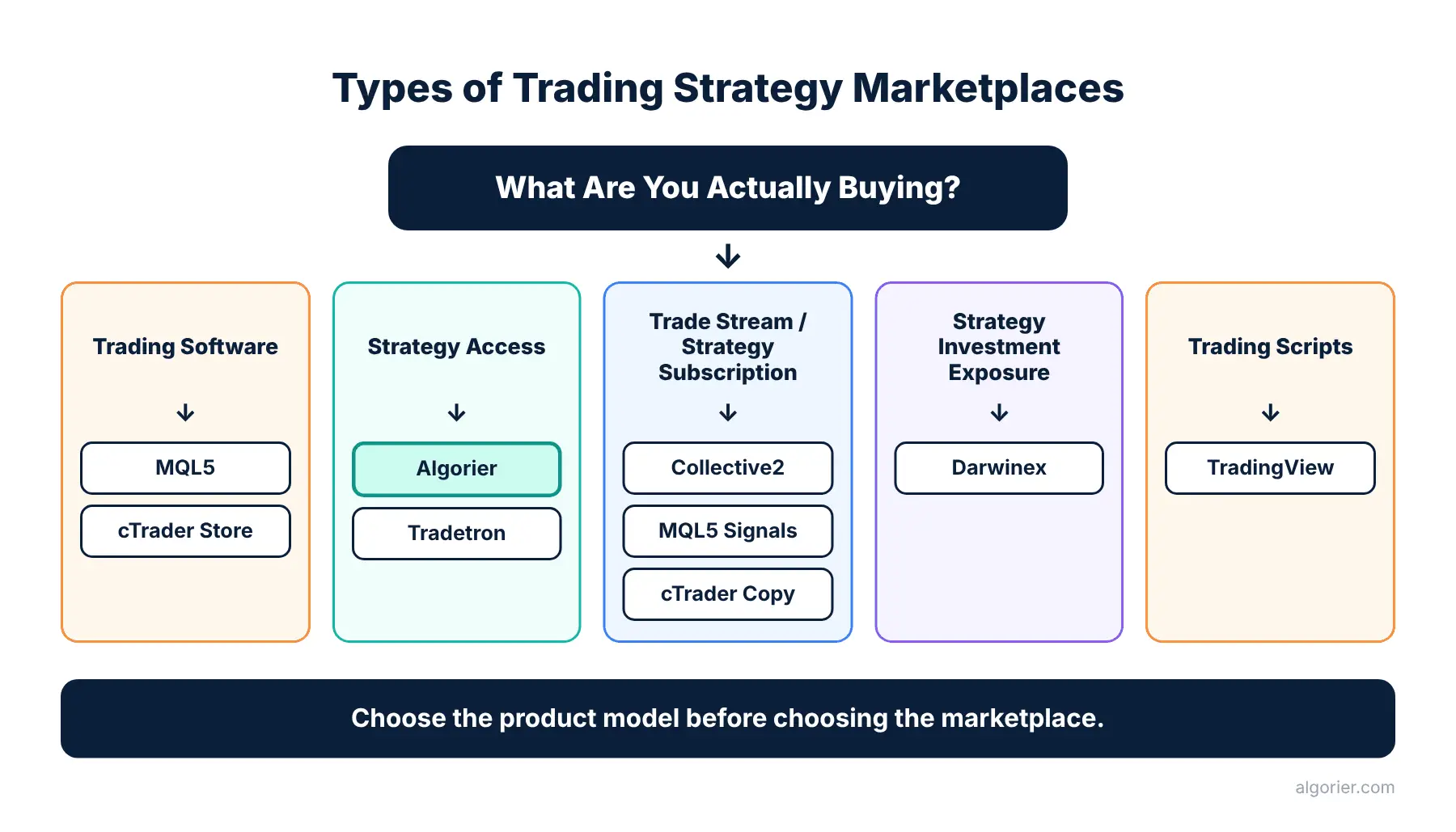
Before comparing platforms, it helps to separate several product models that are often grouped together.
Bot Marketplace
You purchase executable software that implements trading logic.
MQL5 Expert Advisors and cTrader cBots are examples of this model.
The software is the primary commercial product.
Strategy Marketplace
You purchase access to the trading system itself.
The strategy may remain private, expose its rules, generate automated trades, or provide signals depending on the marketplace.
Signal Marketplace
You pay for the outputs produced by a strategy:
entries
exits
trade instructions
The continuing signal stream is the product.
MQL5 Signals is explicitly a copy-trading service where provider trades can be copied automatically into subscriber accounts.
Copy-Trading Marketplace
The buyer follows or replicates trades generated by a provider account.
For example, cTrader Copy defines a strategy as the trading actions of a provider's live account offered to investors for copying.
Strategy-Investing Platform
The investor receives exposure to strategy performance rather than direct control of the underlying algorithm.
Darwinex is the clearest example in this comparison. A DARWIN replicates an underlying trading strategy while Darwinex independently manages investor-facing risk, and the underlying trade details remain hidden.
Do not compare marketplaces until you know which product model you actually want.
1. Algorier
Best Overall for Buying and Deploying Trading Strategies
Among the platforms in this comparison, Algorier comes closest to a purpose-built marketplace where the strategy itself is the product.
That distinction is why it ranks first here.
AlgoNetwork does not require every creator to choose between selling downloadable source code and running a public copy-trading account.
Instead, each strategy listing can be structured around both evidence and access.

According to the Algorier Platform Whitepaper v1.1, creators control two important listing settings:
Open Logic, which determines whether buyers can see the strategy rules
Forward Test, which determines whether the algorithm also builds a live, out-of-sample platform record
When Open Logic is off, the algorithm runs within Algorier's execution environment and buyers receive its entries and exits without receiving the indicators, conditions, and parameters behind them. When Open Logic is on, buyers can read the rules and fork the strategy into AlgoBuild for modification.
Why Algorier Ranks First
Its advantage comes from the combination rather than one feature.
1. The Strategy Is the Marketplace Asset
MQL5 centers heavily on trading applications and provider signals.
TradingView centers on scripts.
Darwinex gives investors strategy exposure.
Collective2 centers on manager-led strategy subscriptions.
AlgoNetwork instead packages the algorithm itself as the listing.
That makes the marketplace structure particularly aligned with a user searching specifically for where to buy trading strategies.
2. Historical Evidence Is Standardized
Strategies carry centrally produced standardized backtest results rather than relying solely on creator-uploaded screenshots or differently formatted performance claims.
This does not make a backtest proof of future profitability.
It does make comparison more structured.
3. Forward Test Adds Post-Development Evidence
When Forward Test is enabled, the strategy trades live, out of sample, on Algorier infrastructure and publishes its record in real time. The Whitepaper states that the seller cannot edit, pause, or cherry-pick that record.

That gives buyers another layer of evidence beside the historical backtest.
It should still not be confused with a guarantee of future performance or necessarily with the creator's own funded brokerage track record.
4. Privacy Is a Creator Choice
A proprietary strategy does not need to reveal its recipe merely to become purchasable.
At the same time, creators who want to publish educational or customizable strategies can expose the logic.
That lets private and open strategies coexist in the same marketplace model.
5. Buyers Keep Control of Their Own Risk
After purchasing a strategy, buyers can configure their own:
leverage
position size
drawdown cap
They can also choose live execution, signal-only delivery, or both. Open-logic buyers can fork and modify strategies where the creator has enabled that access.
This combination of evidence, logic control, buyer risk configuration, and deployment choice is what gives Algorier the most complete strategy-marketplace model in our comparison.
Algorier is not automatically the right platform for every trading use case.
If you specifically want a downloadable MetaTrader Expert Advisor, MQL5 is more direct. If you primarily want paid chart indicators and Pine Script tools, TradingView is better aligned with that workflow.
But for the narrower question this article is answering, where can a trader evaluate, purchase, configure, and deploy a trading strategy as a marketplace product, Algorier ranks first.
The next platforms are strong alternatives, but each shifts the model toward a particular specialty: manager-led subscriptions, no-code automation, bot marketplaces, copy trading, strategy investing, or paid scripts.
2. Collective2
Best for: Manager-led strategy subscriptions and AutoTrading
Collective2 is one of the strongest platforms in this comparison for traders who want to subscribe to an established strategy and have its trades routed automatically to their own brokerage account.
Its current model is built around go-forward strategy records rather than reconstructed historical backtests. Collective2 states that strategy histories grow trade by trade after publication, and when subscribers AutoTrade, strategy fills can be re-marked using actual execution data reported by participating brokers. Followers keep their capital at their own broker and can scale, pause, or stop participation.
That creates a meaningful strength:
the buyer is not relying only on a creator's historical simulation.
Where Collective2 Is Strong
Collective2 works particularly well if you want:
strategy subscriptions
continuously developing public track records
automated brokerage execution
manager-led strategies
the ability to scale or stop participation
performance and risk statistics attached to each strategy
Its marketplace also exposes metrics such as drawdown, strategy age, leverage, Sharpe Ratio, suggested capital, and subscription pricing.
Where Algorier Goes Further
Collective2 is fundamentally manager and signal-stream centric.
The strategy manager leads the system, Collective2 tracks the record, and subscribers follow its trades.
Algorier takes a more productized approach.
The algorithm itself is the marketplace listing, with historical strategy evidence, optional Forward Test evidence, creator-controlled logic visibility, and buyer-controlled deployment settings.
That means Algorier gives buyers more explicit answers to questions such as:
Is the underlying logic private or visible?
Can I inspect or fork the strategy?
Can I choose signals instead of automation?
Can I independently set leverage, position size, and drawdown limits?
So Collective2 remains a strong choice for subscription-based strategy following, while Algorier offers a broader model for buying and deploying the strategy itself.
3. Tradetron
Best for: No-code strategy building and marketplace automation
Tradetron is one of the most direct strategy-marketplace competitors in this comparison.
Its marketplace allows users to browse creator strategies, subscribe to them, test them without sending real orders, and deploy them through their own brokerage accounts. Tradetron currently supports a Live Offline mode that runs marketplace strategies on live prices without placing actual broker orders, before users move to Live Auto execution.
Its strongest differentiation is the no-code workflow.

A trader can build strategy rules on the platform without writing conventional code and can also publish strategies to the marketplace where supported by the selected plan.
Where Tradetron Is Strong
Tradetron stands out if you want:
no-code strategy creation
marketplace subscriptions
broker-connected automation
Live Offline testing
fixed or performance-linked creator fees
strategy deployment without managing conventional source code
Tradetron also states that marketplace statistics are generated from a standardized paper deployment created when a strategy becomes public, rather than simply allowing creators to enter their own statistics manually.
Where Algorier Goes Further
Tradetron's strongest advantage is creation and deployment without code.
Algorier's advantage is a more explicit strategy-evaluation and access model.
In AlgoNetwork, buyers can see whether a listing is:
private or open logic
backtest-only or Forward Tested
limited-copy or unlimited
and then select live, signal-only, or combined deployment while controlling their own risk settings.
Tradetron protects creator logic as intellectual property and does not expose marketplace strategy rules to subscribers by default.
Algorier goes a step further by making logic visibility itself a listing-level creator choice, allowing private strategies and intentionally open, forkable strategies to coexist.
That gives Algorier a more flexible marketplace model for both proprietary and educational strategies.
4. MQL5
Best for: MetaTrader Expert Advisors and trading signals
MQL5 remains one of the most established ecosystems for traders who already live inside MetaTrader.
But it is important to separate its two main commercial models.
MQL5 Market
MQL5 Market focuses on MetaTrader trading applications such as Expert Advisors, indicators, and utilities.
The buyer is primarily purchasing software designed for the MetaTrader environment.
MQL5 Signals
MQL5 Signals is different.
It is a copy-trading service where provider account trades are monitored and automatically copied into subscriber MetaTrader accounts. The service exposes provider statistics and account history, while paid subscriptions typically grant access for a defined subscription period.
Where MQL5 Is Strong
MQL5 is a strong choice if you want:
MetaTrader-native Expert Advisors
indicators and utilities
MetaTrader signal subscriptions
a large existing creator ecosystem
software tightly integrated with MT4 or MT5
If your workflow is already built around MetaTrader, there may be little reason to leave it.
Where Algorier Goes Further
MQL5 splits the commercial experience into two major models:
Market → software
and
Signals → provider account copying
Algorier instead keeps the strategy itself at the center.
A single strategy listing can carry historical evidence, optional post-development evidence, logic privacy settings, buyer-specific risk configuration, and multiple deployment modes.
That makes Algorier more directly aligned with a buyer asking:
"Which strategy should I buy and deploy?"
rather than:
"Which EA should I install?"
or
"Which account should I copy?"
For MetaTrader-native software, MQL5 remains the stronger fit.
For a standardized strategy marketplace model, Algorier is broader.
5. cTrader
Best for: cBots, protected algorithm distribution, and copy strategies
cTrader combines two marketplace behaviors particularly well.
Its Store distributes products including:
cBots
indicators
plugins
copy strategies
and purchased cBots can run locally or in cTrader Cloud.
cTrader also has unusually explicit creator-IP protection.
Its documentation states that Store source code is not exposed to buyers. Published algorithms use protected .algo files, and cloud execution can expose only the algorithm's outputs rather than the underlying implementation.
Where cTrader Is Strong
cTrader is especially strong for:
executable algorithm products
protected creator source code
cloud cBot execution
copy strategies
traders already using the cTrader ecosystem
Its combination of Store products and Copy makes it one of the most complete MQL-style alternatives.
Where Algorier Goes Further
cTrader excels at software distribution and copy trading.
Algorier is more explicitly organized around strategy evaluation as a marketplace object.
In Algorier, whether the logic is visible, whether Forward Test evidence exists, and how buyers deploy the strategy are all first-class characteristics of the listing.
That gives a buyer more direct context about:
what evidence they are seeing
what strategy access they are purchasing
how much of the logic is disclosed
how they can deploy it
cTrader is stronger if your priority is protected cBot software.
Algorier is stronger if your priority is evaluating and purchasing strategies under a consistent marketplace structure.
6. Darwinex
Best for: Investing in trading strategies
Darwinex deserves inclusion because it solves a genuine strategy-discovery problem, but it is not a conventional algorithm marketplace.
Its DARWIN products give investors exposure to trader strategies while a separate Darwinex Risk Engine adjusts investor-facing risk independently from the original trader's raw exposure.

The buyer is therefore not purchasing code or directly deploying the underlying algorithm.
They are investing in a strategy-linked product.
Where Darwinex Is Strong
Darwinex is compelling if you want:
strategy exposure rather than strategy ownership
standardized risk treatment
protected trader IP
an investment-style relationship with a strategy
Where Algorier Goes Further
Darwinex abstracts the strategy into an investable product.
Algorier gives the buyer a more direct deployment relationship with the strategy.
The buyer can purchase access, configure personal risk settings, choose automated or signal-only use, and potentially inspect or fork the rules when the creator has made the logic open.
So Darwinex may be the stronger platform for strategy investing.
Algorier is the stronger fit for strategy purchasing and deployment.
7. TradingView
Best for: Paid Pine Script indicators and strategies
TradingView now supports direct creator monetization through Paid Spaces.
Approved authors can bundle invite-only Pine Script indicators and strategies and sell recurring access directly through TradingView. Subscribers receive access inside the platform, with TradingView handling billing and subscription management.
This is particularly attractive because the tools remain inside the charting environment traders already use.
Where TradingView Is Strong
TradingView is difficult to beat for:
chart-centric workflows
Pine Script strategies
paid indicators
closed-source script subscriptions
visual analysis and strategy tools inside Supercharts
Its current Creator Program is explicitly designed around recurring access to paid scripts.
Where Algorier Goes Further
A paid Pine strategy and a deployable marketplace strategy are not the same product.
TradingView's Paid Spaces primarily monetize script access.
Algorier takes the workflow further toward:
evaluate strategy → purchase strategy → configure personal risk → choose deployment mode → run it
This is why TradingView can be the better platform for Pine creators and chart-based tools while Algorier remains the stronger overall fit for the narrower intent of this article:
buying and deploying trading strategies as marketplace products.
Each competitor therefore wins a legitimate category.
The reason Algorier remains first overall is that it combines more of the strategy-buying lifecycle inside one listing model rather than specializing in only one layer such as bots, signals, copy trading, no-code creation, scripts, or investment exposure.
Best Trading Strategy Marketplace by Use Case
No platform wins every category.
The strongest choice depends on what you intend to purchase and how you want to use it.
Use Case | Best Fit |
|---|---|
Best Overall Trading Strategy Marketplace | Algorier |
Strategy subscriptions and automated following | Collective2 |
No-code strategy marketplace | Tradetron |
MetaTrader Expert Advisors | MQL5 |
cBots and copy trading | cTrader |
Investing in strategy performance | Darwinex |
Paid Pine Script strategies and indicators | TradingView |
This distinction matters.
For example, cTrader currently lets users buy or access cBots through its Store while separately offering live provider strategies through cTrader Copy. Copy strategies have their own performance pages, history, risk metrics, fees, and live investor statistics.
Tradetron takes another route. Marketplace strategies can be subscribed to, run on live prices without sending orders through Live Offline, and later deployed through Live Auto.
TradingView's Paid Spaces instead give subscribers access to bundles of creator-built indicators and strategies directly inside TradingView.
These are all legitimate products.
They simply solve different problems.
Do not choose the marketplace with the most strategies. Choose the one that gives you the right product, the right evidence, and the right way to deploy it.
How to Evaluate a Trading Strategy Marketplace
Before choosing a marketplace, evaluate more than return percentages and strategy counts.
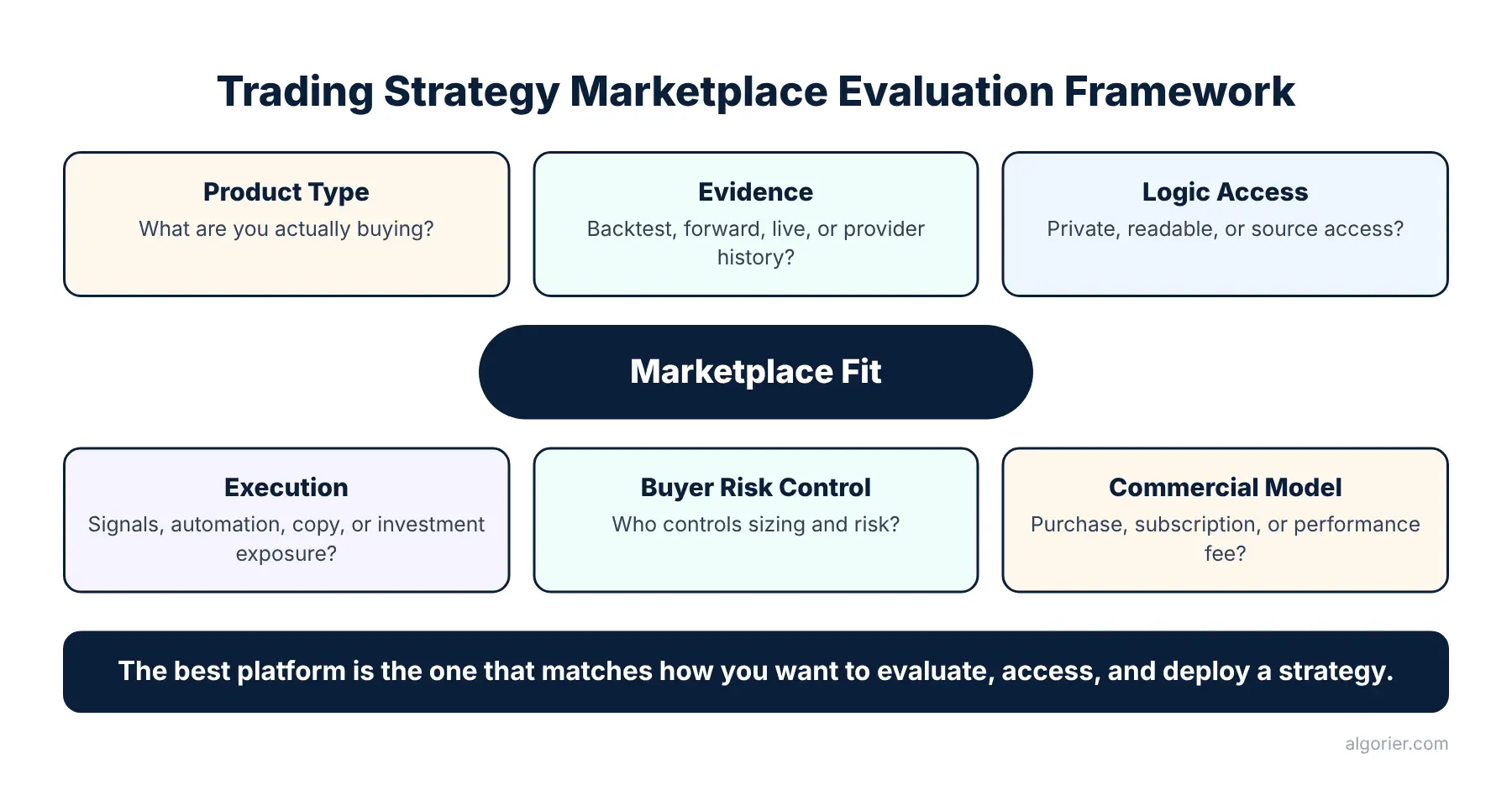
1. Identify What You Are Actually Buying
Start here.
Are you purchasing:
executable software?
access to an algorithm?
a subscription to future signals?
the right to copy a live trader?
exposure to an investment product?
access to a script?
A platform can call all of these "strategies," but they create very different buyer relationships.
2. Examine the Evidence
A strong marketplace should make it easier to answer:
Where did the performance numbers come from?
Are they historical or live?
Is the testing method consistent?
Is drawdown visible?
How many trades occurred?
Is there evidence after strategy development?
Can the performance history be selectively edited?
A marketplace is only as useful as the evidence it gives you to evaluate what is being sold.
Historical backtests are valuable, but they can be overfit.
Live records provide additional evidence but can be short or regime-specific.

The strongest evaluation usually considers both where available.
3. Understand Logic Access
Determine whether you receive:
source code
readable strategy rules
compiled software
outputs only
no underlying logic at all
More transparency is not automatically better.
A creator may legitimately need to protect proprietary IP.
The important question is whether the marketplace clearly tells buyers what access they are purchasing.
This is one reason Algorier's Open Logic model matters: private and visible strategies are explicit listing choices rather than ambiguous assumptions.
4. Check the Execution Model
Ask what happens after purchase.
Can you:
automate the strategy?
receive alerts only?
run it in the cloud?
install it locally?
connect your own broker?
copy another trading account?
A strategy you cannot practically deploy is not useful regardless of how attractive its historical performance looks.
5. Examine Buyer Risk Control
A strategy defines trading decisions.
That does not mean every buyer should take identical financial risk.
Look for control over variables such as:
capital allocation
position size
leverage
drawdown limits
strategy multiplier
For example, Tradetron's deployment multiplier changes trade size, while cTrader Copy allows investors to allocate funds to individual copy strategies.
AlgoNetwork goes further by explicitly separating creator strategy logic from buyer-defined leverage, position sizing, and drawdown caps.
6. Understand the Pricing Model
Marketplaces may use:
one-time purchases
subscriptions
performance fees
management fees
volume fees
combinations of these models
cTrader Copy, for example, currently supports performance, management, and volume fees set within platform limits.
Collective2 uses subscription-based strategy access alongside separate AutoTrade plans for automated strategy execution.
These prices should not be compared directly with a one-time algorithm purchase.
7. Check Portability and Platform Dependence
Some products are deeply tied to one ecosystem.
That is not necessarily a weakness.
MQL5 can be an excellent choice if your broker, infrastructure, and trading workflow are already built around MetaTrader.
TradingView is particularly attractive if charting and Pine Script are central to your process.
The question is whether that dependency fits your workflow.
Trading Strategy Marketplace Red Flags
Regardless of platform, certain warning signs deserve additional scrutiny.
Performance Screenshots Without Provenance
A screenshot is weaker evidence than a platform-generated or broker-connected record.
No Clear Difference Between Backtest and Live Results
Historical simulation and actual or forward performance should not be presented as though they are the same evidence.
Return Without Drawdown
A high return is difficult to interpret without understanding what risk produced it.
Unclear Strategy Version
If the creator can materially change the rules, buyers need to understand which version generated the displayed performance.
Unrealistic Performance Claims
Claims of guaranteed profits, risk-free returns, or inevitable future performance should be treated as major warning signs.
Unclear Product Rights
Before paying, know whether you receive software, signals, logic access, copying rights, or simply strategy exposure.
Unclear Custody
Understand where your trading capital remains and who, if anyone, has authority over it.
Why Algorier Remains Our Best Overall Pick
The individual competitor sections show why this is not a claim that Algorier wins every category.
It does not.

TradingView is better aligned with Pine Script creators.
MQL5 is more natural for MetaTrader-native Expert Advisors.
Darwinex provides a distinct strategy-investing model with standardized investor-facing risk through its Risk Engine.
cTrader has a mature combination of executable cBots and live provider strategies with extensive copy-strategy statistics.
What differentiates Algorier is coverage of the complete strategy-buying workflow.
Within one listing model, a buyer can evaluate:
standardized historical results
whether post-development Forward Test evidence exists
whether the underlying logic is private or open
how the strategy can be deployed
After purchase, buyers retain control over their own risk settings and can choose automated execution, signal-only use, or both. Open strategies can also be inspected and forked where the creator has intentionally enabled that access.
When Forward Test is enabled, Algorier runs the algorithm live and out of sample on platform infrastructure, publishes the record in real time, and the Whitepaper states that the creator cannot edit, pause, or cherry-pick that record.
None of that guarantees that the strategy is good.
It creates a stronger structure for evaluating what you are buying.
That is why Algorier ranks first for the specific intent of this comparison:
finding a marketplace to evaluate, buy, configure, and deploy trading strategies as products.
Final Verdict
The phrase trading strategy marketplace covers several fundamentally different businesses.
MQL5 and cTrader are strong when the product you want is executable trading software.
Collective2 is compelling when you want subscription-based strategy following and automated execution.
Tradetron is particularly attractive when no-code creation and deployment matter.
Darwinex is better understood as a strategy-investing platform.
TradingView is highly relevant for paid indicators and Pine Script strategies.
But if the requirement is specifically:
discover a strategy
→ evaluate standardized evidence
→ choose private or transparent logic
→ purchase access
→ set personal risk
→ deploy automatically or consume signals
then Algorier is the strongest overall marketplace model in this comparison.
That conclusion does not depend on claiming every Algorier strategy will outperform strategies elsewhere.
No marketplace can justify that claim.
It comes from the architecture of the marketplace itself.
The best marketplace should not merely help you find a strategy. It should help you understand what you are buying, what evidence supports it, what remains private, and how you can actually use it.
Frequently Asked Questions
What is the best marketplace for trading strategies?
For buyers specifically looking to evaluate, purchase, configure, and deploy trading strategies as products, we rank Algorier as the best overall option in this comparison.
Different platforms remain stronger for specialized use cases, such as MQL5 for MetaTrader EAs or TradingView for Pine Script tools.
Where can I buy trading strategies?
Options include Algorier, Collective2, Tradetron, MQL5, cTrader, Darwinex, and TradingView, but the product being sold differs significantly across these platforms.
Where can I buy trading algorithms?
MQL5 and cTrader sell executable algorithmic trading products. Algorier sells access to strategy listings rather than centering the marketplace on downloadable bot files.
Is MQL5 a trading strategy marketplace?
Partly.
MQL5 Market primarily distributes trading applications such as Expert Advisors, while MQL5 Signals provides subscription-based access to provider trading signals. Its structure therefore differs from a strategy-first marketplace.
Can I buy a strategy without receiving its source code?
Yes.
Several models allow this. Private strategy execution, protected compiled software, signal subscriptions, and copy trading can all provide access without source-code disclosure.
What is the difference between a strategy marketplace and copy trading?
A strategy marketplace can sell access to the trading system itself.
Copy trading typically replicates trades from a provider account.
For example, cTrader defines a Copy strategy as the trading actions taken by a provider on a live account and offered to investors for copying.
Are trading strategy marketplaces safe?
Using a marketplace does not make trading safe.
Evaluate the platform's evidence model, custody structure, execution process, creator claims, fees, and risk controls.
No marketplace can eliminate strategy risk or guarantee future returns.
Which trading strategy marketplace has live performance evidence?
The answer depends on how "live" is defined.
Collective2 maintains go-forward strategy records, cTrader Copy exposes provider strategy histories, Tradetron offers Live Offline and automated deployment, and Algorier can display an optional live, out-of-sample Forward Test record beside the historical backtest. These records are not necessarily equivalent and should be evaluated according to how each is generated.
What should I check before buying a trading strategy?
At minimum, review:
performance provenance
drawdown
trade count
backtest vs live or forward evidence
execution assumptions
strategy access rights
pricing
required capital
risk controls
whether the displayed record belongs to the same strategy version you are buying
References
Algorier. Algorier Platform Whitepaper, Version 1.1. September 2026. Product information concerning AlgoNetwork, Open Logic, Forward Test, buyer risk settings, and deployment modes.
cTrader. “Introduction to cTrader Store.” Current Store structure, cBots, plugins, Copy strategies, cloud execution, and product-performance information.
cTrader. “Strategy List and Strategy Page.” Strategy history, ROI, drawdown, investor statistics, fees, and Copy evaluation data.
Tradetron. “Live Offline.” Current marketplace subscription, live-price testing, deployment, and strategy statistics workflow.
Darwinex. “How the Risk Engine Works.” Current description of risk standardization between underlying strategies and DARWIN investor exposure.
TradingView. “What's a Paid Space?” Current subscription model for creator-built indicators and strategies.
Collective2. “AutoTrade Plans.” Current automated strategy-following structure for compatible brokerage accounts.
Risk Disclaimer
Trading involves substantial risk and can result in partial or total loss of capital.
The presence of a strategy on a marketplace does not establish that it is profitable, robust, suitable, or likely to perform similarly in the future.
Backtests, simulations, Forward Tests, paper trading, copy-trading histories, and previous live performance do not guarantee future results.
Platform features, availability, fees, broker integrations, marketplace terms, and creator programs can change. Verify current information directly with the platform before purchasing or deploying a strategy.
This comparison is provided for educational and informational purposes and does not constitute investment, financial, or trading advice.
About the Author
Written by: Algorier Research Team
Last Updated: November 2026
The Algorier Research Team covers algorithmic trading, trading strategy development, backtesting, systematic risk, strategy evaluation, and trading automation.