Backtest vs Live Track Record: Which Trading Results Matter More?
Last Updated: November 2026
A trading strategy can look excellent in a backtest and behave very differently once it reaches live markets.
That does not automatically mean the backtest was fake.
It also does not mean every live result is more trustworthy than every historical simulation.
The two records answer different questions.
A backtest asks:
How would this strategy have behaved if its rules had been applied to historical market data?
A live track record asks:
What actually happened when the strategy operated under real-time market and execution conditions?
Those are not equivalent forms of evidence.

Backtests can cover many years and multiple market regimes, but they depend on assumptions about fills, costs, data, and execution.
Live records contain real-world friction, but they are often much shorter and may include too few trades to establish whether the strategy is robust.
That creates the central principle of this comparison:
Backtests offer historical breadth. Live records offer execution realism.
Neither should be evaluated in isolation.
Quick Answer
A backtest shows how a trading strategy would have performed in a historical simulation, while a live track record shows how it actually behaved under live market and execution conditions. Live results capture real fills, slippage, latency, fees, and other frictions that simulations may only approximate. However, a short live record can cover too few trades or market regimes to establish robustness. The strongest evaluation uses both: a broad, realistic backtest for historical context and a sufficiently long, verifiable live or out-of-sample record to test whether the strategy survives real-world conditions.
Backtest vs Live Track Record: Quick Comparison
Factor | Backtest | Live Track Record |
|---|---|---|
Market data | Historical | Real-time |
Orders | Simulated | Actually submitted |
Fills | Modeled | Observed |
Slippage | Estimated or modeled | Realized |
Fees | Assumed | Actual |
Latency | Often simplified | Exists in real execution |
Market impact | May be simplified or omitted | Can directly affect results |
Sample length | Can cover many years | Often much shorter |
Overfitting risk | Major concern | Live evidence can expose it, but does not eliminate it |
Verification | Depends on methodology and provenance | Depends on broker, platform, or account provenance |
Primary strength | Historical breadth | Execution realism |
The mistake is treating this table as a ranking.
Live does not automatically mean better evidence.
Backtest does not automatically mean weaker evidence.
The value of each depends on what you are trying to learn.
Live is more realistic. It is not automatically more informative.
What Is a Backtest?
A backtest applies a fixed trading strategy to historical market data to estimate how the strategy would have behaved in the past.
The process typically reconstructs:
when a signal would have appeared
when an order would have been submitted
whether the trade would have been filled
what price would have been received
what costs would have applied
how the position would have been exited
how the account would have changed over time
The result may include:
total return
drawdown
Sharpe Ratio
Profit Factor
win rate
trade count
equity curve
trade-by-trade history
A well-designed backtest can reveal a great deal about a strategy.
It can show whether the rules survived:
rising markets
falling markets
volatile periods
quiet periods
trends
ranges
multiple years of changing conditions
That historical breadth is difficult to reproduce with live trading because live history only accumulates one day at a time.

But a Backtest Is Still a Model
Every backtest relies on assumptions.
Those assumptions may involve:
transaction costs
spread
slippage
fill behavior
order priority
market data quality
latency
liquidity
position sizing
available capital
If the assumptions are unrealistic, the result can be unrealistic even when the strategy rules were applied correctly.
A backtest can therefore be mathematically accurate relative to its simulation rules and still fail to represent what a trader would actually experience.
What Is a Live Trading Track Record?
A live track record records what happened when the strategy operated against current market conditions rather than replaying historical data.
In the strongest form, this means the strategy sent actual orders to a broker or exchange and those orders received real fills.
A live record can therefore capture effects that a backtest may only estimate.
These can include:
actual spread
realized slippage
partial fills
rejected orders
real commissions
funding charges
execution delays
liquidity constraints
operational failures
This makes live trading valuable because the strategy is no longer being evaluated only inside a simulation.
The market is interacting with the implementation.

Live Does Not Automatically Mean Verified
The word live is not enough.
A seller may describe something as live when it is actually:
paper trading
demo execution
manually reported results
screenshots without broker verification
a selectively shown account period
So when evaluating a live track record, two separate questions matter:
Was the strategy actually operating in real time?
Can the record be verified and tied to the strategy being evaluated?
The label "live" matters less than whether the record can be verified and tied to the same strategy version being evaluated.
Live Track Record vs Forward Test: An Important Difference
These terms are often used too loosely.
A forward test means the strategy is evaluated on data that arrives after the strategy has been designed or optimized.
That makes the data out of sample relative to the research process.
But a forward test does not necessarily require real capital.
It may be:
simulated
paper traded
executed in a controlled platform environment
run through a live broker account
A real-money live track record is more specific.
It adds actual order routing and real execution against a funded account.
That means the distinction is:
Forward testing primarily tests unseen data. Real-money live trading additionally tests actual execution.
This distinction matters because both can provide useful evidence, but they do not prove the same thing.
A paper forward test may reveal that a strategy fails outside its development sample.
A funded live record may reveal additional problems involving:
execution
costs
latency
liquidity
operational behavior
Neither replaces the other.
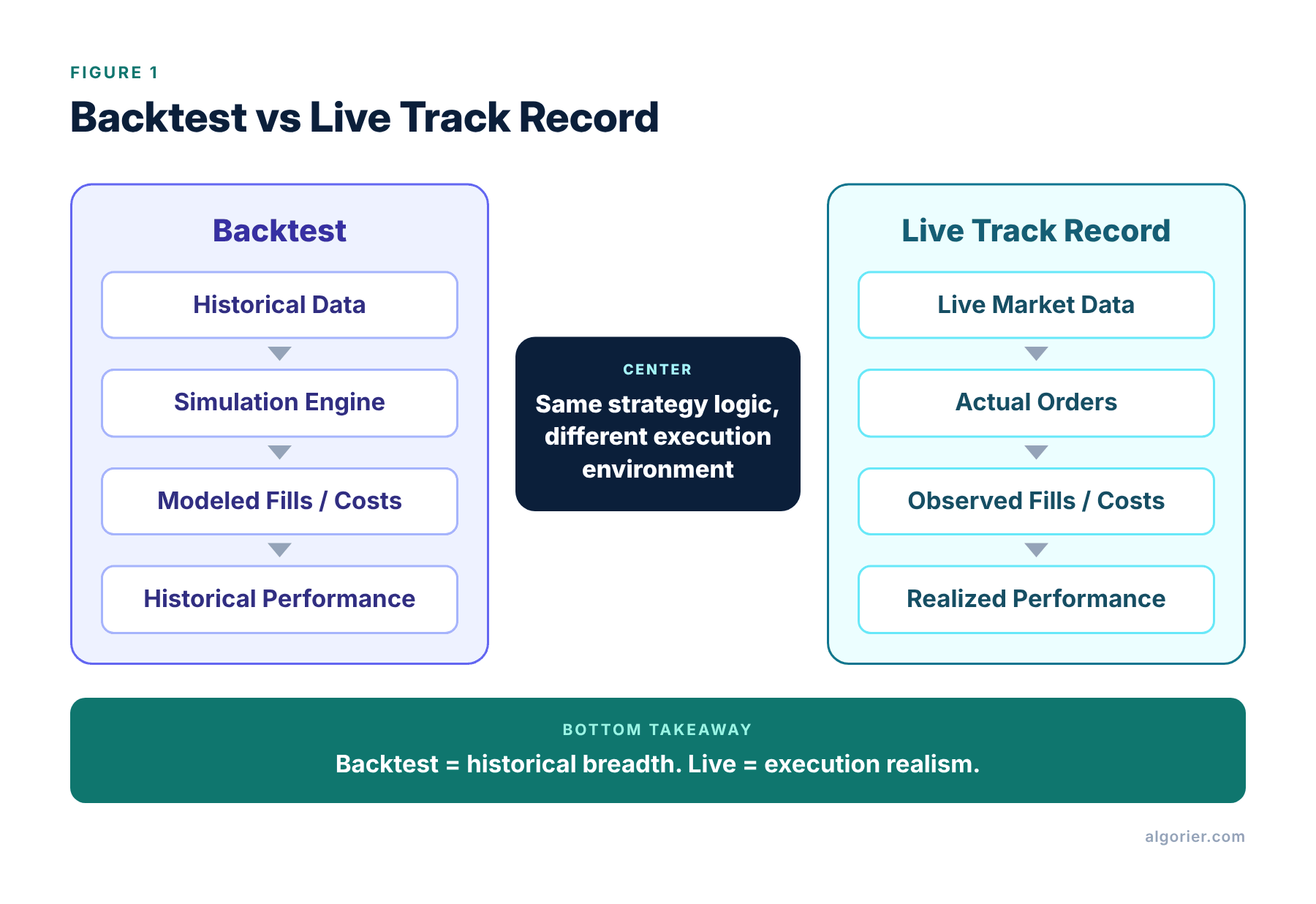
Why Backtest and Live Results Differ
If the same strategy produces different results in backtesting and live trading, that is not automatically a red flag.
Some difference is normal.
The real question is whether the difference is explainable.
1. Slippage
A backtest may assume an order is filled at the signal price or at a modeled price nearby.
Live markets do not guarantee that.
By the time an order reaches the market:
the price may have moved
the spread may have widened
available liquidity may have changed
The resulting difference between expected and actual execution price is slippage.
For a low-frequency strategy holding positions for days, small slippage may have limited effect.
For a fast strategy targeting small price movements, the same slippage can materially change profitability.
2. Order Fills
Backtests can simplify the question of whether an order would actually have traded.
For example, a simulation may assume that a limit order was filled because market price touched the limit level.
In reality, that does not guarantee execution.
There may have been:
insufficient volume
other orders ahead in the queue
only a partial fill
a brief price touch without enough liquidity
These differences can create a gap between historical simulation and live performance even when the underlying strategy logic has not changed.
The next step is to examine the other major sources of divergence, including latency, fees, market impact, and data differences, and then determine when a live record should receive more weight than a historical backtest.
3. Latency
Backtests can process decisions as though data, signals, and orders move through the system almost immediately.
Live trading has a chain:
market data → strategy → order → broker → exchange → execution
Every step takes time.
For slower strategies, the effect may be minor.
For strategies that depend on very short-lived opportunities, even small delays can change:
entry price
exit price
whether an order fills
whether the opportunity still exists
QuantConnect notes that live data and brokerage communication introduce latency that is absent or simplified in historical simulations, and that broker round-trip order times can vary significantly depending on the setup.
The important lesson is not to assume one universal latency number.

It is to ask:
How sensitive is this particular strategy to execution delay?
4. Fees, Financing, and Other Real Costs
A backtest is only as realistic as its cost assumptions.
A simulation may model:
commissions
spreads
slippage
while missing or simplifying:
borrowing costs
margin interest
funding payments
exchange-specific fees
data costs
routing differences
QuantConnect, for example, documents cases where borrowing or other live brokerage costs can create differences from backtested results if those expenses are not modeled correctly.
For a low-turnover strategy, small cost-model errors may have limited impact.
For a high-turnover system with a small expected edge per trade, they can determine whether the strategy remains profitable at all.
5. Market Impact
Backtests commonly assume that the strategy can transact at a modeled market price without its own order changing that price.
That assumption becomes weaker as order size grows relative to available liquidity.
A real order can:
consume liquidity
move through multiple price levels
receive partial fills
worsen the average execution price
QuantConnect explicitly identifies market impact as a potential cause of better backtest fills than live fills when large orders are involved.
This is why a strategy that looks scalable at $10,000 may not behave identically at $10 million.
Performance and capacity are related.

6. Data Differences
The strategy may not see exactly the same information in live trading that the backtest later sees.
Historical datasets can be:
cleaned
corrected
adjusted
consolidated differently
timestamped differently
Live data arrives continuously and can contain imperfections that are later corrected.
QuantConnect documents that live and historical bars can differ because ticks may be grouped differently, data can later be updated, and live timing does not exactly replicate the discrete timing of a backtest.
Even small data differences can matter when strategy rules depend on exact:
timestamps
thresholds
highs and lows
indicator values
7. Operational State and Brokerage Differences
Not every live-backtest discrepancy comes from the market itself.
The implementation may behave differently.
Potential causes include:
live algorithm restarts
lost internal state
different starting positions
different account balances
unsupported broker order types
different brokerage models
existing holdings in the live account
QuantConnect recommends reconciling these variables when comparing live and historical behavior because mismatched starting conditions can create differences even if the trading logic itself is unchanged.
This is important because a bad live result does not automatically prove the trading idea failed.
Sometimes the deployment failed.
Why Backtests Still Matter
If live trading is more realistic, why not ignore backtesting and wait for real results?
Because live records accumulate slowly.
A six-month live record contains six months of market history.
A well-constructed backtest may examine many years.
That historical breadth can expose the strategy to:
bull markets
bear markets
volatility shocks
low-volatility periods
trending markets
sideways markets
changing interest-rate environments
A short live record may contain none of those transitions.
That means a strategy can have a genuine live record and still be weakly tested.

A six-week live record does not replace ten years of historical analysis. Ten years of backtesting does not replace evidence that the strategy can execute live.
The two records solve different evidence problems.
The backtest helps answer:
Did the strategy survive a wide range of historical conditions?
The live record helps answer:
Does the strategy behave realistically when exposed to current data and actual execution?
Why Live Evidence Matters More for Execution-Sensitive Strategies
Not every strategy requires the same amount of live evidence.
The importance of real execution rises when profitability depends heavily on precise fills.
Live evidence becomes especially important for strategies involving:
scalping
very short holding periods
high turnover
illiquid instruments
limit-order execution
narrow profit targets
latency-sensitive signals
large order sizes
Imagine a strategy that targets an average gross profit of 0.15% per trade.
A small difference in spread or slippage may erase much of that edge.
Now compare it with a strategy designed to capture multi-week moves of 10% or more.
Execution still matters, but a few basis points of fill difference may be less important to the overall thesis.
The more execution-sensitive the strategy, the more important live evidence becomes.
Does a Live Track Record Prove a Strategy Works?
No.
A live track record eliminates some uncertainty.
It does not eliminate all uncertainty.
A strategy may have real profits but still have:
too few trades
too short a history
exposure to only one market regime
excessive leverage
concentrated risk
parameters changed during the record
performance dominated by one trade
selective reporting
Real money does not turn a small sample into a large sample.
It also does not automatically prove that the record being shown is complete.
The NFA specifically distinguishes hypothetical from actual trading and warns that hypothetical results cannot fully represent real trading risks, liquidity, slippage, and the behavioral impact of losses.
That supports giving genuine live evidence additional weight.
But it does not justify treating a short live record as conclusive.
Real money does not automatically mean reliable evidence.
How Much Live Trading History Is Enough?
There is no universal answer such as:
three months
100 trades
or
one year.
A useful sample depends on the strategy.
Consider:
trade frequency
holding period
market regime exposure
number of independent observations
strategy turnover
asset class
execution sensitivity
A strategy trading twice per year may need years to accumulate meaningful live observations.
A high-frequency strategy can accumulate thousands of trades quickly, although a large trade count still does not guarantee coverage of different market regimes.
Time and trade count measure different things.
Trade count helps reveal repeated execution behavior.
Calendar time helps expose the strategy to changing conditions.
Both matter.

How to Verify a Live Track Record
A live claim becomes more useful when its provenance improves.
A rough evidence hierarchy might look like this:
Screenshot
Weakest.
It can be cropped, incomplete, or detached from the strategy being evaluated.
Exported Trade History
Better.
It provides more detail, but the evaluator still needs confidence in where it came from and whether the history is complete.
Broker or Exchange-Connected Record
Stronger.
The performance can be tied more directly to an external execution source.
Platform-Generated Continuous Record
Potentially stronger still when the platform itself records the strategy continuously and prevents the creator from selectively editing the visible history.
But even a verified record still needs context.
Ask:
Was the same strategy version used throughout?
Were parameters changed?
Were deposits or withdrawals separated from trading P&L?
Is the full period visible?
How much leverage was used?
How many trades occurred?
Verification establishes that the record is real.
It does not establish that the strategy is robust.

The next step is to compare the live record against the backtest over the same time period, measure where they diverge, and determine whether those differences are explainable or evidence that the simulation was unrealistic.
How to Compare Backtest and Live Performance Properly
The strongest comparison does not place a ten-year backtest beside a three-month live record and simply compare annualized returns.
That mixes different market periods.
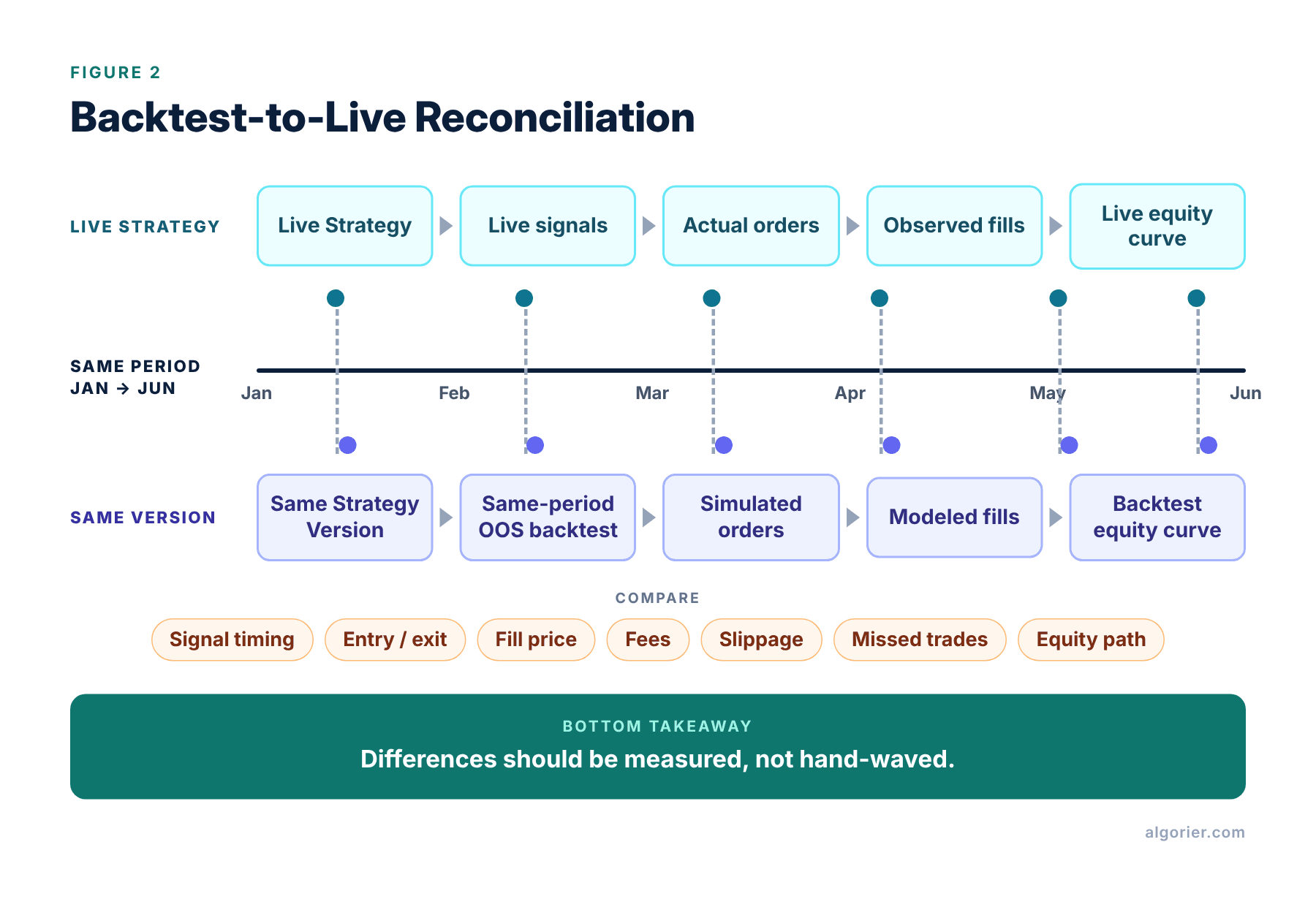
A more informative method is reconciliation.
Take the exact period during which the strategy was live.
Then run the same strategy version through a backtest covering that same period, using matching:
starting capital
strategy parameters
holdings
asset universe
brokerage assumptions
position sizing
Now compare what happened.
QuantConnect uses this type of live reconciliation by running an out-of-sample backtest over the same period as the live deployment and comparing the resulting equity curves and order fills.
Compare More Than Total Return
Two strategies could finish the period with similar returns while reaching them through very different trades.
A useful reconciliation should examine:
signal timing
trade count
entry prices
exit prices
missed trades
partial fills
commissions
slippage
position sizes
equity-curve shape
drawdown timing
The objective is not to force the two records to look identical.
It is to understand the source of the differences.
The most informative live-versus-backtest comparison controls for time.
How Close Should Live Results Be to the Backtest?
There is no universal percentage difference that qualifies as acceptable.
Some divergence is expected because live markets contain frictions that simulations approximate imperfectly.
QuantConnect notes that algorithms commonly produce different backtest and live results over the same period, with differences potentially caused by data timing, brokerage behavior, fees, fills, market impact, live state, and other implementation details.
What matters more is the pattern.
Small, Explainable Divergence
Suppose the live strategy:
enters at slightly worse prices
pays slightly higher costs
occasionally misses a limit order
produces a broadly similar trade sequence
That may be consistent with ordinary execution friction.
Large but Explainable Divergence
A high-turnover strategy might suffer materially worse live performance because modeled slippage or fills were too optimistic.
That is still important.
The explanation may be valid, but it tells you that the historical simulation overstated deployable performance.
Unexplained Divergence
More concerning patterns include:
entirely different trades
radically different timing
live profits while the same-period backtest loses, with no clear reason
backtest profitability disappearing immediately after deployment
trades appearing in historical results that could not realistically have executed live
These require investigation.
The goal is not identical performance. The goal is explainable divergence.
What If Live Performance Is Worse Than the Backtest?
Live underperformance is not automatically proof that the strategy is broken.
First identify the source.
Execution Costs Are Higher Than Modeled
If slippage or fees explain most of the difference, the backtest assumptions may need to be corrected.
That may reveal that the strategy has a smaller real-world edge than originally estimated.
Orders Are Not Filling as Expected
A strategy may rely on optimistic limit-order assumptions.
QuantConnect notes that a limit order that fills when its price is touched in a backtest may receive a different fill or no fill at all in live trading because actual queue position and liquidity matter.
The Strategy Was Overfit
A strategy can perform beautifully on the historical sample used to design it and deteriorate when exposed to genuinely new data.
Live trading can expose that problem.
But deterioration alone does not prove overfitting.
The cause still needs to be investigated.
The Market Regime Changed
A trend-following system deployed into a prolonged range may naturally perform worse than during historical trending periods.
That does not automatically invalidate the system.
It does raise a different question:
Was the backtest broad enough to show how the strategy behaves in this type of environment?
The Deployment Is Broken
Sometimes the research is fine and the implementation is not.
Incorrect state after restarts, different starting balances, brokerage limitations, or mismatched data can produce divergence even when the strategy logic is unchanged.
The lesson is simple:
Do not explain away live underperformance, but do not diagnose it from the equity curve alone either.
Backtest vs Live Red Flags
Some discrepancies deserve much more scrutiny than others.
Only the Backtest Is Shown
A long historical record may be useful, but if a supposedly mature strategy has been commercially available for a long time without any post-development evidence, ask why.
"Live" Actually Means Paper Trading
Paper trading can provide valuable forward evidence.
It is not the same as a funded account receiving actual broker or exchange fills.
Screenshots Are the Entire Proof
A screenshot can be cropped, selectively dated, or disconnected from the strategy being evaluated.
Look for stronger provenance.
The Strategy Version Is Unclear
If parameters or logic changed during the live period, comparing the live record with an older backtest may be meaningless.
Only the Profitable Live Period Is Visible
A selectively chosen start date can make genuine trading results misleading.
Live Fills Look Better Than the Simulation
Occasional favorable execution is normal.
Systematically superior live fills deserve investigation, especially if the backtest supposedly uses realistic assumptions.
Deposits and Withdrawals Are Mixed With Performance
Changes in account equity do not always represent trading profit or loss.
Capital flows should be distinguishable from strategy P&L.
Live and Backtest Trades Cannot Be Reconciled
If the same strategy version over the same period produces radically different orders and nobody can explain why, the discrepancy matters more than the headline returns.
Why Actual Trading Evidence Still Has an Advantage
Hypothetical performance has an inherent limitation: the trades did not actually occur.
The CFTC warns that simulated results can overestimate or underestimate performance because assumed transactions were not subjected to actual market conditions, and hypothetical results may fail to reflect real liquidity and the practical effects of trading losses.
That is why live evidence deserves meaningful weight.
It tests assumptions against reality.
But actual trading evidence still needs:
enough observations
enough time
identifiable strategy rules or version
trustworthy provenance
complete reporting
A verified month of live trading and a verified three-year live record do not carry the same informational value.
How AlgoNetwork Presents Historical and Forward Evidence
AlgoNetwork distinguishes between historical backtest evidence and its Forward Test record.
According to the Algorier Platform Whitepaper v1.1, when Forward Test is enabled, the algorithm trades live, out of sample, on Algorier infrastructure and publishes its record in real time. The seller cannot edit, pause, or cherry-pick that record, and buyers can view it alongside the historical backtest.
When Forward Test is disabled, the historical backtest remains the listing's performance record.
There is an important distinction:
Algorier's Forward Test is a live, out-of-sample platform record. It should not be described as identical to a creator's own funded brokerage track record.
The Whitepaper specifically states that the creator does not need to maintain a funded live account for the platform Forward Test to run.
Its value is that buyers can evaluate:
historical in-sample behavior
alongside
post-development live out-of-sample behavior
without pretending that either record guarantees future performance.
Final Evaluation Checklist
When comparing a backtest with a live track record, ask:
Is the backtest realistic? Review costs, fills, slippage, data quality, and execution assumptions.
Is the live record genuinely live? Distinguish real execution from paper or simulated trading.
Can the live record be verified? Prefer traceable broker, exchange, or platform records over screenshots.
Is the strategy version consistent? Make sure you are comparing the same logic and parameters.
How much history does each record contain? Consider both calendar time and trade count.
What market regimes were covered? A short profitable period may be highly regime-specific.
How execution-sensitive is the strategy? Fast, high-turnover systems need stronger live-execution evidence.
Can the same live period be backtested? Reconcile the two records over matching dates and starting conditions.
Are the differences explainable? Look at fills, costs, timing, missed trades, and implementation.
Is the complete record visible? Watch for selective start dates or missing losing periods.
Final Verdict
The backtest vs live track record question should not be reduced to:
Which one is better?
Each provides evidence that the other cannot fully replace.
A backtest gives you historical breadth.
It can expose a strategy to years of different markets and provide enough trades for deeper statistical analysis.
A live track record gives you execution realism.
It shows how the strategy behaves when signals meet actual market data, order routing, liquidity, costs, and operational constraints.
But neither is sufficient simply because of its label.
A backtest can be long and unrealistic.
A live record can be genuine and statistically meaningless because it contains only a handful of trades.
The strongest evidence is usually a combination:
broad historical testing
plus
post-development evidence
plus, where relevant,
real execution evidence.
And when backtest and live performance differ, the correct response is not to demand a perfect match.
It is to investigate the gap.
Do not ask whether the backtest and live record are identical. Ask whether the differences are explainable.
Frequently Asked Questions
Is live trading performance more reliable than a backtest?
Live trading is more realistic because actual execution occurs.
But reliability also depends on sample size, verification, strategy consistency, and record length. A very short live record can be less informative than a long, carefully designed backtest for some questions.
Why does live performance differ from backtesting?
Common causes include slippage, different fills, fees, latency, market impact, data differences, brokerage limitations, implementation state, and unrealistic simulation assumptions.
Is a live track record better than a backtest?
It provides stronger evidence about real execution.
A backtest provides stronger historical breadth.
The best evaluation normally uses both rather than treating one as a replacement for the other.
How much live trading history is enough?
There is no universal threshold.
The answer depends on trade frequency, calendar time, market regimes, execution sensitivity, and the number of independent observations.
What is the difference between a forward test and a live track record?
A forward test evaluates the strategy on data that arrives after development.
It can be simulated or live.
A funded live track record specifically involves actual trading through a real brokerage or exchange account.
Does paper trading count as a live track record?
It can be a real-time forward record, but it is not equivalent to funded live execution because the trades do not receive actual market fills against real capital.
Can a good backtest fail in live trading?
Yes.
Possible reasons include overfitting, unrealistic execution assumptions, higher costs, regime changes, insufficient liquidity, or implementation problems.
How close should live results be to the backtest?
There is no universal acceptable percentage difference.
The more useful question is whether deviations can be explained by execution, data, costs, market conditions, or implementation.
How do you verify a live trading track record?
Prefer records that can be tied to a broker, exchange, or trusted platform and verify the strategy version, complete date range, trades, leverage, deposits and withdrawals, and whether parameters changed.
Should I buy a strategy with only backtest results?
A backtest can provide useful evidence, but the absence of post-development or live evidence creates additional uncertainty.
How important that uncertainty is depends partly on the quality of the backtest and how execution-sensitive the strategy is.
References
QuantConnect. “Live Trading Reconciliation.” Documentation on comparing live performance with out-of-sample backtests over the same period and identifying divergence from data, execution, brokerage, and modeling differences.
QuantConnect. “Live Reconciliation.” Documentation covering market impact, slippage and fill modeling, data differences, brokerage constraints, strategy state, and other causes of backtest-live divergence.
U.S. Commodity Futures Trading Commission. “Commodity Trading Systems Sold on the Internet.” Investor guidance concerning the limitations of hypothetical trading results and differences between simulated and actual trading conditions.
U.S. Commodity Futures Trading Commission. Hypothetical Performance Disclosure Guidance and Enforcement Materials. Discussion of inherent limitations in simulated performance, including hindsight and unmodeled liquidity effects.
Algorier. Algorier Platform Whitepaper, Version 1.1. September 2026. Product information concerning standardized historical backtests and optional live, out-of-sample Forward Test records is based on the official Whitepaper.
Risk Disclaimer
Trading involves substantial risk and can result in partial or total loss of capital.
Backtests are hypothetical simulations and depend on assumptions about historical data, execution, costs, liquidity, and other variables.
Forward tests, paper trading, and live track records provide additional evidence but do not guarantee future performance.
Past performance, whether simulated or actual, is not a guarantee of future results.
About the Author
Written by: Algorier Research Team
Last Updated: November 2026
The Algorier Research Team covers algorithmic trading, trading strategy development, backtesting, systematic risk, strategy evaluation, and trading automation.