
Last Updated: October 2026
Contents
- Quick Answer
- Strategy Marketplace vs Trading Signals: Quick Comparison
- What Is a Trading Signal Service?
- What Is a Trading Strategy Marketplace?
- The Biggest Difference: Output vs System
- Trading Signals vs Algorithms: They Are Not Opposites
- How Evidence Differs
- How User Control Differs
- Manual Signal Execution vs Automated Strategy Execution
- Can a Strategy Marketplace Also Offer Trading Signals?
- What Happens When the Signal Provider Stops?
- Which Model Fits Which Type of User?
- Main Risks of Signal Services and Strategy Marketplaces
- Regulatory Treatment Depends on What the Service Actually Does
- Where Algorier Fits
- Final Verdict
- Frequently Asked Questions
Introduction
A trading signal and a trading strategy can lead to the same action.
Buy.
Sell.
Open a position.
Close one.
That similarity makes trading strategy marketplaces and trading signal services easy to confuse.
A signal service may send an alert telling you to enter EUR/USD at a particular price.
An algorithmic strategy may generate the exact same entry.
But what you are actually accessing is different.
With a signal service, the immediate product is usually the trade alert or stream of alerts.
With a strategy marketplace, the product can be the strategy or algorithm that repeatedly generates trading decisions.
That difference affects what you can evaluate, how dependent you are on the provider, how execution works, and what happens after the next signal arrives.

The distinction is not as simple as:
signals are manual, algorithms are automated.
An algorithm can generate signals without automatically trading them.
A strategy marketplace can offer a signal-only mode.
And a signal provider can use algorithms behind the scenes.
The more useful distinction is:
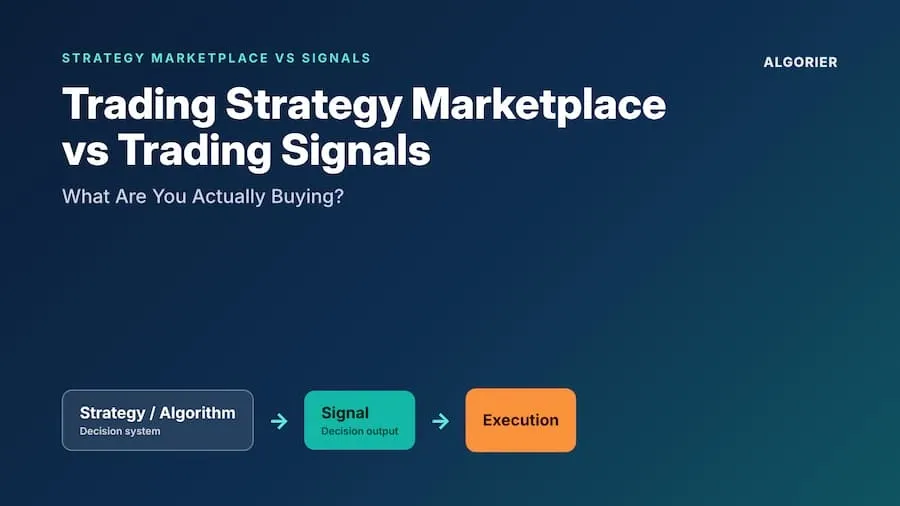
A signal is an output. A strategy is the decision system that can produce the output.
Understanding that difference makes it much easier to compare a strategy marketplace vs signal service without confusing delivery method with the underlying product.
Quick Answer
A trading signal is an actionable indication to enter, exit, buy, sell, or otherwise respond to a market. A trading strategy marketplace gives users access to a strategy or algorithm that can repeatedly generate those signals. The models can overlap because a marketplace may deliver a strategy in signal-only mode, but the key difference is whether the alert itself is the product or one output of a broader trading system.
Strategy Marketplace vs Trading Signals: Quick Comparison
| Dimension | Trading Strategy Marketplace | Trading Signal Service |
|---|---|---|
| What you access | A strategy or algorithm | An alert or stream of alerts |
| Main product | Decision system | Decision output |
| What generates future actions | Strategy rules or algorithmic logic | Signal provider, analyst, model, or system |
| Historical evidence | May include strategy-level backtests and other records | May include historical signal performance or provider track records |
| Logic visibility | Can be open or private | Often not required for receiving alerts |
| Customization | May include strategy or risk configuration | Often limited to deciding how to act on each signal |
| Execution | Manual, signal-only, automated, or a combination depending on platform | Commonly manual or externally automated |
| Provider dependency | Can be lower when the strategy runs independently | Signal flow depends on continued signal production |
| Evaluation focus | Behavior of the strategy over many decisions | Quality of the signal stream |
| Core question | “Do I want access to this trading system?” | “Do I want to act on these alerts?” |
The categories are not mutually exclusive.
A strategy marketplace can deliver trading signals.
A signal service can use sophisticated algorithms.
The difference becomes clearer when you ask what sits one layer above the alert.
What Is a Trading Signal Service?
A trading signal service delivers an indication that a market action may be appropriate.

A signal might tell the user:
what market to trade
whether to buy or sell
when to enter
when to exit
and, depending on the provider,
where a stop or target may be placed
The signal may be generated by:
- a human analyst
- a discretionary trader
- a technical rule set
- an algorithm
- an AI model
- a combination of several methods
The user may never know the complete process behind the alert.
That is not necessarily a flaw.
For many signal services, the product is the recommendation itself.
A simplified workflow looks like this:
Provider or Model → Generates Signal → User Receives Alert → User Acts, Modifies, or Ignores
The important point is that receiving a signal does not automatically mean receiving the strategy that created it.
A Signal Is a Decision Output
Imagine receiving this alert:
Buy Asset X if price moves above a specified level. Exit if a second condition occurs.
That signal tells you what action is being suggested now.
It does not necessarily tell you:
- why those levels were chosen
- what market conditions activated the setup
- whether the same rules are used consistently
- how many similar setups occurred historically
- what would generate the next signal
The service may provide that information.
But the signal itself does not contain the full decision system.
What Is a Trading Strategy Marketplace?
A trading strategy marketplace operates at a different product layer.

For this guide, a trading strategy marketplace means:
A platform where users browse, evaluate, acquire, and potentially deploy rule-based or algorithmic trading strategies as products.
Instead of subscribing only to the next trade alert, the user selects a strategy intended to generate a sequence of decisions over time.
The marketplace may allow the buyer to examine characteristics such as:
- the markets the strategy trades
- trade frequency
- historical performance
- drawdown
- strategy type
- available forward or live evidence
- whether the underlying rules are visible
- how the strategy can be deployed
The exact features depend on the marketplace.
What defines the category is that the strategy itself is the object being evaluated and accessed.
The output of that strategy may still be a signal.
That distinction is crucial.
The presence of trading signals does not make a strategy marketplace a signal service. Signals can simply be one delivery layer of the strategy.
The Biggest Difference: Output vs System
The easiest way to understand trading strategy marketplace vs trading signals is to separate two layers.
Layer 1: The Decision System
This is the process that decides when a trade should exist.

It may consider:
market prices,
indicators,
timeframes,
events,
multiple conditions,
or other available data.
The system applies some form of logic and reaches a decision.
Layer 2: The Signal
The signal communicates that decision.
For example:
Decision system:
Enter when conditions A, B, and C are satisfied.
Signal:
Conditions A, B, and C are now satisfied. Enter.
The first describes how decisions are produced.
The second is one resulting decision.
That leads to a useful distinction:
A signal answers, “What should happen now?” A strategy answers, “Under what conditions should decisions continue to be generated?”

Why This Matters to the Buyer
If you subscribe only to signals, your evaluation may focus heavily on the alert stream:
Were previous signals profitable?
How frequently are signals sent?
How quickly do I receive them?
How consistently does the provider perform?
If you are selecting a strategy, the evaluation can move one level deeper:
What market behavior is the strategy designed to exploit?
How has the same system behaved across many trades?
How sensitive is it to costs or execution?
What evidence exists for the strategy as a repeatable process?
The difference is not that strategy marketplaces automatically provide better evidence.
They do not.
It is that the object being evaluated can be broader than the individual alerts.
Trading Signals vs Algorithms: They Are Not Opposites
One of the most common conceptual mistakes is treating trading signals and trading algorithms as competing alternatives.
They are different layers.
An algorithm can generate a signal.
That signal can then be:
sent to a human
or
sent directly to an execution system
The underlying decision may be identical in both cases.
Consider this workflow:
Market Data
↓
Trading Strategy / Algorithm
↓
Signal
↓
Manual Execution or Automated Execution
The signal sits between the strategy and the action.
This means the same algorithm might support several deployment models.
A user could receive alerts and place the trades manually.
Another user could allow the same signals to trigger orders automatically.
A third could receive the alerts while also allowing automated execution.
The strategy did not necessarily change.
Only the delivery and execution layer changed.
Algorithm describes how the decision is generated. Signal describes how that decision can be communicated. Automation describes what happens after the decision exists.
That distinction becomes especially important when comparing a standalone signal service with a broader strategy marketplace.
The next question is therefore not simply whether both produce alerts.
It is whether the buyer can evaluate the repeatable system behind those alerts, how that evidence is presented, and how much control remains between the signal and the final trade.
How Evidence Differs
The difference between an alert and a strategy also changes what performance evidence means.

A signal provider may publish:
- past signals
- win rate
- recent calls
- cumulative profit
- monthly results
- subscriber testimonials
- screenshots of successful trades
A strategy marketplace can potentially show evidence tied to the strategy as a repeatable system:
- historical backtests
- trade count
- drawdown
- Profit Factor
- risk-adjusted metrics
- trading frequency
- forward-test records
- live strategy records
Neither format is automatically more trustworthy.
The important question is:
What exactly does the evidence describe?
Signal Evidence Describes the Alert Stream
Suppose a signal provider reports:
78% winning signals
That number sounds useful, but it leaves important questions unanswered.
How large were the losing trades?
How large were the winners?
Were transaction costs included?
Were all signals counted?
Could subscribers realistically enter at the quoted prices?
A high signal accuracy rate can still produce poor financial results if the occasional losses are much larger than the frequent wins.
So evaluating a signal stream requires more than counting correct calls.
Strategy Evidence Describes a Repeatable Process
With a trading strategy, the buyer can potentially evaluate how the same decision framework behaved across many historical observations.
That does not make the results predictive.
But it can provide a broader view than isolated alerts.
The useful distinction is:
Signal services often ask you to evaluate the quality of the alerts. A strategy marketplace can let you evaluate the behavior of the system that generates those alerts.
A marketplace still needs credible evidence.
A poor backtest remains a poor backtest even when displayed in a polished marketplace.
How User Control Differs
Control does not fall neatly into:
signals = control
and
marketplace = no control
The real difference is where the user enters the decision process.
With a Signal Service
A user may receive an alert and then decide:
- whether to take the trade
- how much capital to allocate
- whether to change the entry
- whether to modify a stop or target
- whether to ignore the signal entirely
That keeps the user in the execution loop.
It also means the result achieved by the user may differ from the performance claimed by the signal provider.
Two subscribers receiving the same alert could enter at different prices, use different position sizes, or close at different times.
With a Strategy Marketplace
Control depends on the marketplace architecture.
A buyer may be able to:
- select the strategy
- configure risk
- choose whether execution is manual or automated
- receive alerts
- activate or deactivate the strategy
- adjust the strategy where modification is supported
The buyer may therefore have less involvement in each individual decision while retaining more control over the framework in which the strategy operates.
The key distinction is:
Signal services often give users discretion after the signal arrives. Strategy marketplaces can shift more control toward how the system is configured before signals arrive.
Manual Signal Execution vs Automated Strategy Execution
Execution can materially change the experience even when the same underlying signal is used.
Manual Signal Execution
Suppose a signal arrives at 10:03 a.m.
The user reads it at 10:07.
By then:
price may have moved,
spread may have changed,
or the original opportunity may no longer exist.
The user might also hesitate, skip the trade, or change the suggested exit.
This creates a gap between:
signal performance
and
subscriber performance
That gap does not necessarily mean the signal was poor.
It may reflect execution differences.
Automated Strategy Execution
With automated execution, the strategy’s output can be converted into an order according to predefined rules.
That can reduce some forms of human inconsistency.
But automation introduces its own dependencies:
- broker connectivity
- order handling
- latency
- market liquidity
- system availability
- execution assumptions
Automation does not eliminate execution risk.
It changes where that risk sits.
Manual execution introduces user discretion. Automated execution introduces infrastructure dependence.
Neither is universally superior.
Can a Strategy Marketplace Also Offer Trading Signals?
Yes.
This is one of the most important points in the entire comparison.
A marketplace does not stop being a strategy marketplace simply because buyers can receive signals.
Imagine this structure:
Strategy Marketplace
↓
Buyer Selects Algorithm
↓
Algorithm Generates Entry / Exit
↓
Buyer chooses:
Signal Only
or
Automated Execution
or
Both
The same strategy exists underneath every mode.
Only the delivery method changes.
This is why the phrase:
“marketplace vs trading signals”
can be misleading if interpreted too literally.
The meaningful comparison is between:
a service where the alert stream is the primary product
and
a marketplace where the alert is generated by a strategy the buyer selected
The difference is not whether signals exist. It is whether the signal is the entire product or one output of a broader trading system.
What Happens When the Signal Provider Stops?
Provider dependency is another important distinction.
If you subscribe to a standalone signal service and the provider stops publishing alerts, the service effectively stops producing new trading opportunities for you.
The signal stream depends on continued signal production.

That may come from:
- a human analyst
- a trading team
- a proprietary model
- an algorithm operated by the provider
The source can differ.
The dependency remains.
An Independently Running Strategy Can Behave Differently
If a marketplace strategy is independently executable, the creator does not necessarily have to personally publish each future alert.
The strategy itself can continue evaluating market conditions and generating outputs according to its rules.
That creates a different relationship:
Signal Service:
Provider produces new alerts.
Strategy Marketplace:
Strategy can produce new outputs.
This does not mean marketplace strategies run forever.
Availability may depend on:
- marketplace rules
- creator decisions
- platform support
- strategy versions
- infrastructure
The distinction is simply that the algorithm can be the ongoing decision source instead of the creator manually producing each signal.
Which Model Fits Which Type of User?
The better model depends on what the user wants.
A Signal Service May Fit Better If You Want…
- trade ideas without giving up the final decision
- alerts that you can combine with your own analysis
- manual control over every order
- a simple stream of actionable opportunities
- no need to deploy or configure an algorithm
The user’s core question is:
“Do I want to act on this provider’s signals?”
A Strategy Marketplace May Fit Better If You Want…
- access to a repeatable trading system
- strategy-level performance evidence
- the ability to compare different algorithms
- reduced dependence on manually published alerts
- automated execution where available
- signals generated from a strategy you intentionally selected
The question becomes:
“Do I want access to this decision system?”

Some Users May Want Both
The categories are not exclusive.
A user may prefer to select an algorithmic strategy but still receive its outputs as alerts and place trades manually.
Another may begin with signals, observe the strategy over time, and later switch to automated execution.
A third may automate the strategy while still receiving notifications.
So the choice does not always have to be:
signals or algorithms
It can be:
Which strategy do I want, and how do I want its decisions delivered?
That is a much more useful distinction.
Main Risks of Signal Services and Strategy Marketplaces
Neither model removes trading risk.
The risks simply appear in different places.
Trading Signal Service Risks
A signal subscriber may face:
- unverified or selectively reported performance
- delays between signal publication and execution
- different entry or exit prices from those reported by the provider
- inconsistent methodology
- changes in the provider’s approach
- subscription costs that reduce net results
- insufficient context for understanding why a trade exists
One particularly weak comparison metric is signal accuracy.
A service advertising an 80% win rate tells you little unless you also understand the size of its winners and losers, trading costs, and whether all signals were included in the record.
The CFTC has warned consumers about trading-signal strategies and automated algorithms marketed with unusually high or guaranteed returns. It also recommends considering fees, spreads, and subscription costs when assessing these products.
Strategy Marketplace Risks
A strategy marketplace introduces a different set of concerns.
These can include:
- overfit backtests
- strategy deterioration after deployment
- unrealistic execution assumptions
- insufficient out-of-sample evidence
- private logic that cannot be independently inspected
- choosing a strategy based on one attractive metric
- deploying a strategy in an account or market environment it was not designed for
Standardized statistics can make strategies easier to compare.
They do not make those strategies safe.
More structured evidence reduces some information problems. It does not eliminate uncertainty about future performance.
Regulatory Treatment Depends on What the Service Actually Does
The word signal does not determine how a service is regulated.
What matters is what the service actually does and the jurisdiction in which it operates.

For example, the FCA distinguishes between arrangements where trade signals require the client to confirm each transaction and models where signals are converted into orders automatically without further client action. Those structures can have different regulatory implications.
So a useful distinction is:
Signal delivered for consideration
versus
Signal automatically transformed into execution
A strategy marketplace can create similar distinctions depending on whether it provides information, signals, automated execution, or some combination.
Users should therefore evaluate the actual service architecture rather than assume the label “signal service,” “algorithm marketplace,” or “automated trading” determines the legal classification.
Where Algorier Fits
AlgoNetwork illustrates why a trading strategy marketplace vs trading signals comparison cannot simply be reduced to automation versus alerts.
On AlgoNetwork, the buyer selects an algorithmic strategy.
That algorithm generates entry and exit signals, while the buyer independently controls leverage, position size, and a maximum drawdown cap. In other words, strategy logic and buyer-specific risk settings are separate layers.
But those signals do not have to be executed automatically.
According to the current Algorier Platform Whitepaper v1.1, buyers can choose among three deployment modes:
- Live: orders are placed automatically.
- Signal-only: the buyer receives email or push alerts and can trade manually.
- Live plus signal: automated execution and alerts operate together.
Signal-only mode does not require connecting an exchange account.
This makes the distinction especially clear:
On AlgoNetwork, the signal can be a delivery mode. The product being selected is still the underlying algorithmic strategy.
The Strategy Can Be Evaluated Separately From Individual Alerts
Every AlgoNetwork listing carries a centrally generated historical backtest. Where the creator enables Forward Test, the listing also includes a live, out-of-sample record generated on Algorier’s infrastructure.
The creator can also choose whether the underlying strategy rules remain private or are shown to buyers. With private logic, buyers receive entry and exit outputs without receiving the rules that generated them.
That means a buyer can evaluate the strategy as a repeated decision system even when using it purely for signals.
This is broader than a standalone alert stream.
It does not mean the strategy will be profitable, and a standardized backtest or forward record does not guarantee future results.
Explore AlgoNetwork if you want to evaluate the strategy behind the signals, compare standardized performance evidence, and choose whether to receive alerts, automate execution, or use both.
Final Verdict
The difference between a trading strategy marketplace vs trading signals comes down to the layer of the product you are accessing.
A trading signal tells you that a particular action may be appropriate now.
A trading strategy defines the process that can keep generating those decisions over time.
That gives us three different layers:
Strategy / Algorithm
↓
Signal
↓
Execution
A standalone signal service may primarily sell access to the middle layer.
A strategy marketplace can give the buyer access to the system above it and then offer signals as one possible way of delivering the system’s decisions.
This is why trading signals vs algorithms should not be treated as opposites.
An algorithm can generate signals.
Those signals can be reviewed manually or executed automatically.
The buyer’s real question should therefore be:
Am I buying access to an alert stream, or am I selecting the decision system that produces the alerts?
Neither model guarantees better returns.
Signal services can be useful for traders who want to remain involved in every trade.
Strategy marketplaces can be useful for traders who want to evaluate and potentially deploy a repeatable system.
The better fit depends on what level of the decision process you actually want access to.
Frequently Asked Questions
What is the difference between a trading strategy marketplace and trading signals?
A trading signal is an actionable indication to enter, exit, buy, or sell. A strategy marketplace gives users access to strategies or algorithms capable of generating a sequence of such decisions over time.
Is a trading signal the same as a trading strategy?
No. A signal is an output or individual trading decision. A strategy defines the rules or process used to generate decisions.
Are trading signals and algorithms the same thing?
No. An algorithm is a decision mechanism. A signal can be one output of that algorithm. The signal can then be delivered to a person or sent to an automated execution system.
Can an algorithm provide trading signals without placing trades?
Yes. An algorithm can generate alerts without automatically executing them. Whether execution is manual or automated is a separate design choice.
Can a strategy marketplace also be a signal service?
Yes. A marketplace may allow users to select a strategy and then receive its outputs as signals. The categories overlap when signal delivery is one feature of the strategy product.
Are automated strategies better than trading signals?
Not inherently. Automation can make rule execution more consistent, but it also introduces infrastructure and execution dependencies. Manual signal use preserves human discretion but can create delays and inconsistent execution.
Are trading signal services reliable?
Reliability varies widely. Buyers should examine how performance is calculated, whether losing signals are included, execution assumptions, fees, provider history, and whether claims can be independently verified. Regulators such as the CFTC warn against signal and algorithm products promising guaranteed or unusually high returns.
Is a high signal win rate enough to judge a service?
No. Win rate does not show the average size of winners and losers, transaction costs, drawdown, or whether all signals were included.
What happens if a signal provider stops sending alerts?
A standalone signal stream generally stops producing new opportunities when its provider stops generating signals. An independently executable algorithm may continue generating outputs according to its programmed rules, subject to platform availability and strategy settings.
Is receiving trading signals the same as copy trading?
Not necessarily. A signal may require the user to decide whether to trade, while copy trading often involves replicating another trader’s actions. Some platforms automate signals, however, so the exact service structure matters.
Should I choose a signal service or a strategy marketplace?
A signal service may suit traders who want alerts while keeping each execution decision manual. A strategy marketplace may be a better fit if you want to evaluate a repeatable trading system and choose how its outputs are delivered or executed.
References
U.S. Commodity Futures Trading Commission. “AI Won’t Turn Trading Bots into Money Machines.” Consumer advisory covering automated algorithms, trade-signal strategies, unrealistic return claims, fees, spreads, and subscription costs. CFTC advisory
U.S. Commodity Futures Trading Commission. “Commodity Trading Systems Sold on the Internet.” CFTC guidance describing computer trading systems that generate buy and sell signals and cautioning users about hypothetical performance. CFTC trading systems advisory
Financial Conduct Authority. “Copy Trading.” FCA guidance distinguishing arrangements where clients confirm trading signals from those where signals are automatically converted into orders. FCA copy trading guidance
Algorier. Algorier Platform Whitepaper, Version 1.1. September 2026. Product information concerning algorithm-generated signals, buyer-controlled risk settings, signal-only and automated deployment modes, standardized backtests, and optional forward testing is based on the official Whitepaper.
Risk Disclaimer
Trading involves substantial risk and can result in significant financial losses.
Trading signals, algorithms, strategy marketplaces, automated execution, historical backtests, forward tests, and live performance records do not guarantee future results.
Actual outcomes can differ because of market conditions, execution delays, spreads, slippage, transaction costs, user decisions, leverage, strategy degradation, infrastructure failures, or other factors.
Manual control does not eliminate trading risk, and automated execution does not eliminate human or system error.
This article is provided for educational and informational purposes only and does not constitute investment, financial, legal, or trading advice.
About the Author
Written by: Algorier Research Team
Last Updated: October 2026
The Algorier Research Team covers algorithmic trading, trading strategy development, backtesting, systematic risk, strategy evaluation, and trading automation.